
Guide
Best gourami tank mates (and which fish to avoid)
Compatible fish for dwarf, honey, pearl and blue gouramis - plus the ones that cause problems.
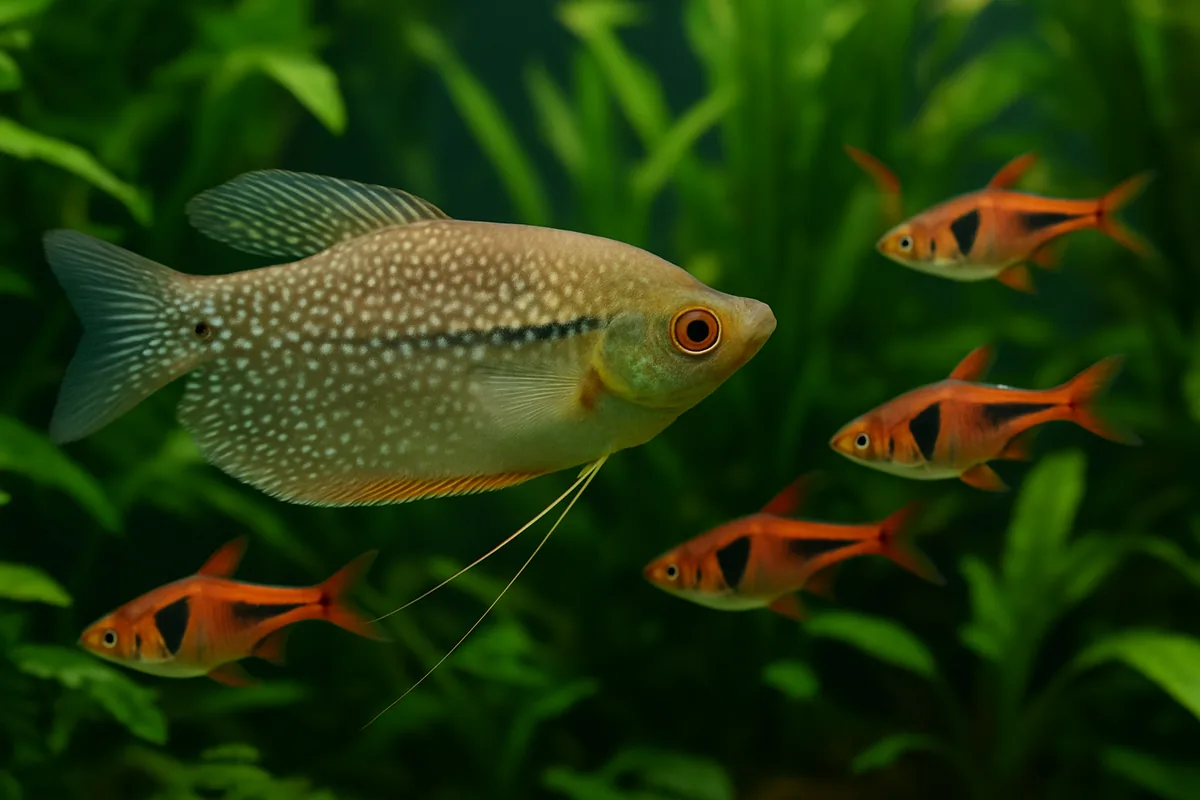
- Good mates: peaceful fish that share warm, soft-to-moderate water and don't nip fins - corydoras, kuhli loaches, otocinclus, harlequin rasboras, rummynose and other peaceful tetras.
- The golden rule: no fin-nippers. Gouramis' long trailing "feelers" are exactly what tiger barbs and serpae tetras go for.
- One male per tank: two male gouramis of the same type usually fight. A male with females works in a larger, well-planted tank.
- Avoid: bettas (rival labyrinth fish), boisterous or aggressive fish, and anything needing cool water.
- Size up: honey/dwarf 60 L+, pearl/blue 100 L+, kissing gourami much larger.
- Check before you buy: model the mix in the stocking calculator - it flags clashes and bioload.
Pairing Honey Gourami with something specific? Our fish compatibility checker compares any two of 815 species on water parameters, predation risk, fin nipping, temperament and tank size - and draws them both at life size so you can see the difference.
What makes a good gourami tank mate
Gouramis are labyrinth fish - they breathe air at the surface - and most of the popular ones are peaceful to semi-aggressive. A good tank mate ticks four boxes: it's peaceful, it shares the same warm and soft-to-moderate water, it isn't a fin-nipper, and ideally it occupies a different part of the tank so it isn't competing with the gourami at the surface. Get those right and gouramis make superb, characterful community fish.
Those long thread-like pelvic fins trailing under a gourami aren't decoration - they're sensory "feelers." Fin-nippers make a beeline for them, which is why the single most important rule is to keep gouramis well away from known nippers.
The best gourami tank mates
These are reliable choices for most community gouramis (dwarf, honey, pearl):
- Corydoras catfish - peaceful bottom-dwellers that stay out of the gourami's way. Keep a group of six or more.
- Kuhli loaches - shy, eel-like, and completely non-confrontational.
- Otocinclus - tiny, peaceful algae-eaters for an established, mature tank.
- Harlequin rasboras and other rasboras - peaceful mid-water schoolers with matching water needs.
- Rummynose, ember and other peaceful tetras - avoid the nippy ones (serpae, black skirt); stick to the calm schoolers.
- Peaceful livebearers (platies, mollies) - fine on temperament, but they prefer harder water, so they suit gouramis kept at the harder end of the range.
- Snails and, with small gouramis, dwarf shrimp - nerite and mystery snails are safe; shrimp are safe with honey and dwarf gouramis but larger gouramis will hunt them.
Fish to avoid
- Fin-nippers - tiger barbs, serpae tetras, black skirt tetras. They shred gourami feelers and fins.
- Bettas - another surface-breathing labyrinth fish; the two often treat each other as rivals. Best kept apart.
- Other male gouramis of the same or a similar species - males are territorial and will fight.
- Aggressive or large cichlids - too rough for a gourami's temperament.
- Boisterous, fast fish (large danios, big active barbs) - they out-compete the slower gourami for food and stress it.
- Goldfish and coldwater fish - a temperature mismatch; gouramis want tropical warmth.
Buying a "community" barb on the same trip as a gourami. Tiger barbs are sold as community fish and look harmless in the shop tank - then they spend every evening chasing the gourami and nipping its feelers. Check compatibility before you buy, not after.
Tank mates by gourami type
Which mates work depends a lot on which gourami you have - temperament varies widely across the group.
Honey and dwarf gouramis (the peaceful ones)
The most peaceful and the easiest to stock around. Almost any calm community fish works. Dwarf gouramis are gorgeous but can be shy and are unfortunately prone to disease from mass-breeding, so buy from a good source. A honey gourami is one of the most trouble-free centrepiece fish you can keep.
Pearl gouramis
Larger (up to about 12 cm / 5 in) but genuinely peaceful, which makes a pearl gourami an excellent community centrepiece. Give it a 100 L (25 gal) tank or bigger and pair it with peaceful mid- and bottom-dwellers.
Three-spot, blue, gold and opaline gouramis
These are all colour forms of the same species (Trichopodus trichopterus), and they're the most territorial of the common gouramis - especially the males. Give them robust (but still peaceful) tank mates that can hold their own, avoid timid or slow fish, and keep only one male. A bigger, well-planted tank with broken sight-lines keeps the peace.
Kissing gouramis
Big fish (up to 30 cm / 12 in) that need a much larger tank and similarly sized, robust tank mates. Not a nano-community fish.
Model your gourami community before you buy - the free calculator flags clashes and bioload.
Open the stocking calculatorHow many, and how much space
Stock one gourami as a centrepiece (or a male with a female or two in a larger tank), then build a community of peaceful schooling and bottom fish around it. Keep schooling tank mates in proper groups of six or more so they feel secure and behave naturally. As a rough guide: honey and dwarf gouramis suit 60 L (15 gal) and up, pearl and blue/three-spot gouramis want 100 L (25 gal)+, and larger species need more again. When in doubt, size up - more space reduces aggression and gives everyone room to avoid conflict. For broader care details, see our gourami care guide, and to sanity-check any mix, run it through the stocking calculator.
What are the best tank mates for a gourami?
Peaceful fish that share warm, soft-to-moderate water and don't nip fins or compete at the surface: corydoras, kuhli loaches, otocinclus, harlequin rasboras, and peaceful tetras. Snails are safe; shrimp suit small gouramis but not large ones. Avoid fin-nippers, other male gouramis, and boisterous fish.
Can gouramis live with bettas?
It's risky and usually best avoided. Both are labyrinth fish that breathe at the surface and can be territorial, so they often see each other as rivals. It sometimes works in a large, heavily planted tank, but there's no reliable way to predict it and a fight can be fatal.
Can you keep two gouramis together?
Keep only one male of a given gourami type per tank - two males of the same species usually fight. A male with one or more females can work in a large, well-planted tank. Honey and pearl gouramis are more tolerant; three-spot, blue, gold and opaline gouramis are the most territorial.
Why do fin-nippers hurt gouramis specifically?
Gouramis have long thread-like pelvic fins - feelers they use to sense their surroundings. Nippers like tiger barbs and serpae tetras target these trailing feelers, which stresses the gourami and can lead to infection. Keep gouramis away from any known nipper.
What size tank do gouramis and tank mates need?
Honey and dwarf gouramis want at least 60 L (15 US gal); pearl and blue/three-spot gouramis want 100 L (25+ US gal) or more; kissing gouramis need a much larger tank. Give more space when adding a community, and check bioload and compatibility with a stocking calculator before you buy.
More guides · Gourami care · Stocking calculator · Signs of stress · App-aquatic