
Hub
Freshwater Aquarium Plants: Complete Care Guides
Last updated: May 2026
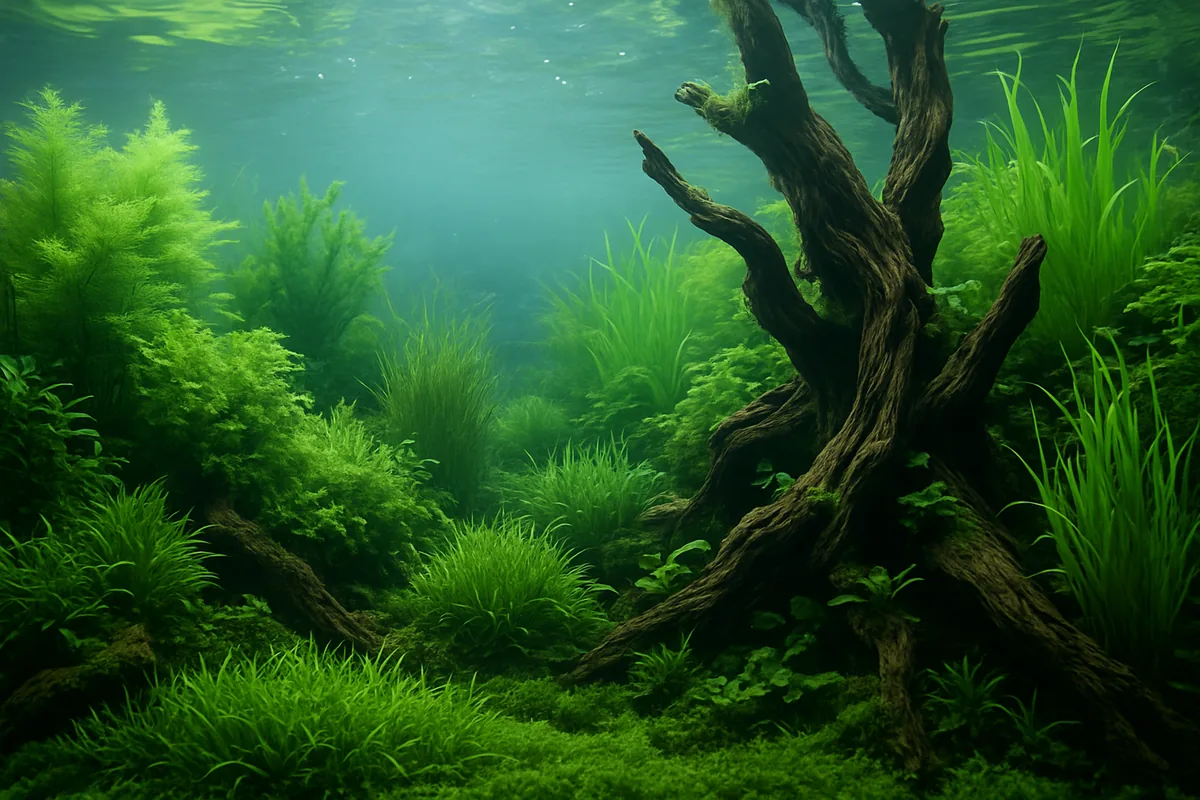
- No plant is truly zero-maintenance: even the hardiest species need stable parameters, some light, and occasional trimming or leaf removal.
- Light is the most common failure point: most cheap hood lights are too dim for anything beyond Anubias and Java fern - measure in PAR or at least check wattage per litre.
- Substrate matters for root feeders: swords, crypts, and vallisneria pull nutrients through their roots; plain gravel with root tabs beats rich substrate for non-root feeders.
- CO₂ injection is optional for most of these species but doubles growth speed - manage expectations before you buy.
- Planting depth kills more plants than pests do: burying the rhizome on Anubias or Java fern will rot it within weeks.
- Plants help, but don't replace water changes: even a heavily planted tank needs regular maintenance - nitrates still accumulate.
Lay these plants out in your own tank size with the free aquascape planner. It knows how tall and wide each plant grows, hides the ones that would outgrow your tank, ties ferns and Anubias onto wood rather than burying them, and gives you a shopping list.
Why plant selection matters more than people admit
Walk into any fish shop and the plants are usually crammed into a single display with no light information, no water parameter requirements, and no indication of whether they actually grow submerged. A significant number of "aquarium plants" sold in the hobby - including many labelled tissue cultures - are bog or marginal plants that will slowly die underwater. Knowing which species genuinely thrive submerged, and under what conditions, saves you money and frustration.
The nine species below represent the most reliably beginner-friendly freshwater plants available. Each one is genuinely aquatic, widely available, and forgiving of imperfect conditions. They're grouped roughly by care level and growing habit so you can build a planted tank logically rather than just buying whatever looks good in the shop.
No planted tank is truly hands-off. The "low tech" label means no CO₂ injection required - it doesn't mean no lighting, no nutrients, and no maintenance. If you want green without upkeep, silk plants exist. Live plants are worth it, but go in with accurate expectations.
The rhizome plants: Java fern and Anubias
Java fern (Microsorum pteropus)
Java fern is probably the single most forgiving aquarium plant available. It tolerates low light (15-30 PAR), a wide pH range (6.0-8.0), temperatures from 18-30°C (64-86°F), and hard or soft water. It grows slowly - a few new leaves per month under low light - and needs no substrate at all. Attach it to driftwood or rock with thread or super glue gel and let it root itself over a few weeks.
Growth rate increases noticeably with moderate light and liquid fertiliser, but you won't kill it by neglecting either. It does well in low-tech community tanks alongside livebearers, tetras, and most cichlids that don't actively dig or eat plants.
The rhizome - the thick horizontal stem the leaves grow from - must not be buried. Plant it against a surface, not into substrate. A buried rhizome turns black and rots within a few weeks, and the plant won't recover.
Anubias (Anubias barteri and varieties)
Anubias barteri is the standard species, but you'll also find Anubias nana, Anubias coffeefolia, and several others. All share the same care requirements: low to moderate light, attach to hardscape rather than plant in substrate, rhizome must stay exposed. They're slower growing than Java fern - sometimes only one new leaf per month - but they're virtually indestructible under normal community tank conditions.
One genuine problem: algae. Anubias leaves are thick, waxy, and long-lived, which makes them excellent surfaces for spot algae and beard algae to colonise, especially in higher-light tanks. Keep light intensity moderate and photoperiod to 8 hours or less if algae is an issue.
A small group of Amano shrimp (Caridina multidentata) will graze algae off Anubias leaves continuously. Three to five per 60 litres makes a visible difference.
Java moss and carpeting plants
Java moss (Taxiphyllum barbieri)
Java moss grows in almost any freshwater conditions - pH 5.0-8.0, temperatures 15-28°C (59-82°F), low to high light. It attaches to any surface, grows as a free-floating mass, or gets tied to mesh to form a carpet or wall. In high light with CO₂ it grows quickly and needs frequent trimming; in low light it grows slowly but stays alive.
Its main practical use beyond aesthetics is as a breeding and fry habitat. Dense moss provides cover that dramatically increases fry survival in a community tank. For shrimp tanks, it's essentially mandatory - shrimp graze the biofilm that accumulates on the strands constantly.
Monte Carlo (Micranthemum tweediei)
Monte Carlo is a carpeting plant - it spreads horizontally and forms a dense, bright green foreground mat. It needs moderate to high light (50-80+ PAR at substrate level), a fine substrate it can root into, and ideally CO₂ injection for reliable, dense growth. Without CO₂ it will survive in high light but grow more slowly and may develop gaps rather than a tight carpet.
Planting Monte Carlo in clumps rather than spreading individual stems in a grid pattern. Dense clumps trap debris, the bottom of the clump dies from lack of light and flow, and the whole patch lifts. Plant individual stems 1-2 cm apart across the substrate and let them fill in.
The heavy feeders: Amazon sword and vallisneria
Amazon sword (Echinodorus grisebachii / bleheri)
Amazon swords are root-feeding plants that grow large - easily 40-50 cm tall in a mature tank, with leaves spanning 20+ cm across. They work well in tanks of 120 litres and up as a centrepiece or background plant, but they'll outgrow a nano tank quickly. They need nutrient-rich substrate or root tabs placed under them every 3-4 months, moderate light (30-50 PAR), and temperatures of 22-28°C (72-82°F).
Under good conditions they'll send out runners and produce daughter plants. Once a daughter has 4-5 leaves and visible roots, you can cut it free and replant it.
Vallisneria (Vallisneria spiralis and others)
Vallisneria produces long, grass-like leaves that reach the surface and spread via runners, making it ideal as a background or side plant in tanks 60 litres and above. It tolerates hard, alkaline water better than most plants - pH 6.5-8.5 and GH up to 20 - which makes it one of the few plants that works well in liquid rock tap water. It does need moderate light and benefits from root tabs.
Vallisneria is sensitive to liquid glutaraldehyde-based fertilisers (sold as Excel or similar). Even normal doses can melt it back. If you dose these products, switch to a different fertiliser or reduce dosing dramatically and watch for leaf damage.
Fast growers and stem plants
Hornwort (Ceratophyllum demersum)
Hornwort grows faster than almost any plant in this list - under good light it can add several centimetres per day. It doesn't root and is usually kept floating or loosely weighted at the bottom. Fast growth means fast nutrient uptake, which genuinely helps keep nitrates in check in a stocked tank. It also provides excellent cover for fry and surface-dwelling fish.
The downside: it sheds needles constantly, especially when moved or disturbed, and those needles get everywhere - into filters, under substrate, through sponges. Budget extra cleaning time if you keep it.
Water wisteria (Hygrophila difformis)
Water wisteria is a stem plant with deeply lobed, finely cut leaves that look more complex than the care requirements justify. It grows quickly in moderate light without CO₂, tolerates temperatures of 22-30°C (72-86°F), and accepts a wide pH range (6.5-7.5 comfortably, wider with some adaptation). Trim the tops and replant cuttings to propagate - the cut stems branch and keep growing. It works well as a background or midground filler in community tanks.
Crypts: the misunderstood genus
Crypt wendtii (Cryptocoryne wendtii)
Crypts have a reputation as tricky beginner plants, mostly because of crypt melt - the tendency for leaves to go transparent and disintegrate shortly after being moved to a new tank. This is a stress response to changed water conditions, not disease. The rhizome and roots almost always survive if you leave the plant in place. New leaves grow back within 2-4 weeks, adapted to the new water chemistry.
Once established, C. wendtii is one of the most reliable plants in the hobby. It grows in low to moderate light, prefers nutrient-rich substrate or root tabs, and propagates readily via runners. Leaf colour varies from green to brown to reddish depending on light intensity - higher light tends to bring out more colour.
If your crypts melt when you first plant them, don't dig them up. The urge to check if the roots are alive, replant them, or replace them is almost always counterproductive. Leave them alone for three weeks before drawing any conclusions.
Nutrients, light, and the CO₂ question
Most beginners overspend on substrate and underspend on light. A basic aquatic plant substrate helps, but a good light over plain gravel with root tabs will outperform a rich substrate under a dim hood every time. For the species in this guide, aim for at least 20-30 PAR at substrate level for low-tech species, 50+ PAR for Monte Carlo and faster-growing stems.
Liquid fertilisers - a comprehensive all-in-one like Tropica Specialised or a two-part macro/micro split - are worthwhile once your tank is cycled and you're seeing slow or pale growth. Dosing before you have an established tank and fish load usually just feeds algae. Check the water parameters guide if you're unsure what your baseline looks like before adding nutrients.
CO₂ injection is not required for any of the nine species here, but it will accelerate growth and improve plant health noticeably. If you're running a low-tech tank and seeing slow but steady growth with healthy colour, you don't need it. If you want a dense carpet of Monte Carlo on a realistic timescale, CO₂ helps a lot.
Remember that plants consume nitrates but don't eliminate the need for water changes - phosphates, dissolved organics, and trace element imbalances all accumulate regardless. Keep up with your regular water changes even in a heavily planted tank.
Running your lights longer doesn't help plants grow faster - it mostly helps algae. A consistent 8-hour photoperiod with a timer is the single cheapest algae prevention measure available.
Stocking and plants: how they interact
Fish load affects plants in both directions. Too few fish means too little CO₂ (fish respiration is a meaningful CO₂ source in a low-tech tank) and too few nutrients from waste. Too many fish overwhelms even fast-growing plants with nitrates and can cause algae blooms. A reasonably stocked community tank and a mix of the plants above will generally self-balance better than either extreme.
Use the free stocking calculator to check whether your fish load is in a sensible range before blaming poor plant growth on other causes. And if your tank isn't cycled yet, plants won't rescue you from an ammonia spike - get the cycle established first with our guide to cycling a fish tank. App-aquatic lets you log test results and track parameter trends over time, which makes it easier to see whether your plants are actually having a stabilising effect.
Track your parameters and get care reminders with App-aquatic.
Get the free appCan I keep live plants in a tank without CO₂?
Yes, for most of the species here. Java fern, Anubias, crypts, Java moss, hornwort, water wisteria, and vallisneria all do well without CO₂ injection. Monte Carlo and faster-growing stem plants benefit from CO₂ but can survive without it if your light is strong enough. The trade-off is slower growth and sometimes less compact form.
Why are my aquarium plant leaves turning yellow?
The most common cause is nitrogen deficiency - older leaves yellow first when nitrates are very low (under 5 ppm). Iron deficiency shows as yellowing between leaf veins while veins stay green. If your tank is newly set up and understocked, a small dose of liquid fertiliser often fixes it. If you have lots of fish and yellowing is still happening, check your light duration and intensity first.
Do aquarium plants actually reduce nitrates?
Yes, but the effect varies a lot with plant mass and growth rate. Fast-growing stem plants like hornwort and water wisteria take up nitrates quickly and measurably. Slow-growers like Anubias take up very little. No planted tank eliminates the need for water changes - plants reduce nitrate accumulation, they don't stop it.
Why did my crypt melt after I planted it?
Crypt melt is a normal stress response to changed water chemistry. The leaves die back but the rhizome and root system almost always survive. Leave the plant undisturbed and new leaves will emerge within 2-4 weeks adapted to your water. Digging it up to check or replanting it usually just resets the clock and causes another melt cycle.
What's the easiest aquarium plant for a complete beginner?
Java fern. It tolerates low light, a pH of 6.0-8.0, temperatures from 18-30°C (64-86°F) and hard or soft water, and it needs no substrate - tie or glue it to driftwood or rock and keep the rhizome exposed. Anubias is a close second and just as tough, but grows even more slowly and picks up spot algae in brighter tanks. If you also want something fast-growing that soaks up nitrate, hornwort is the easiest option.