
Guide
Liquid aquarium tests vs test strips: the full evidence-based case
If you only read one paragraph: liquid colourimetric kits are the hobby’s default for a reason. They are slower, but they resolve low-level ammonia and nitrite better, track nitrate trends more honestly, and degrade more predictably in storage than dry dip strips. Strips are genuinely useful for rapid triage once you already know how to test properly. This guide explains the chemistry, the failure modes, the economics, and exactly where each tool belongs.
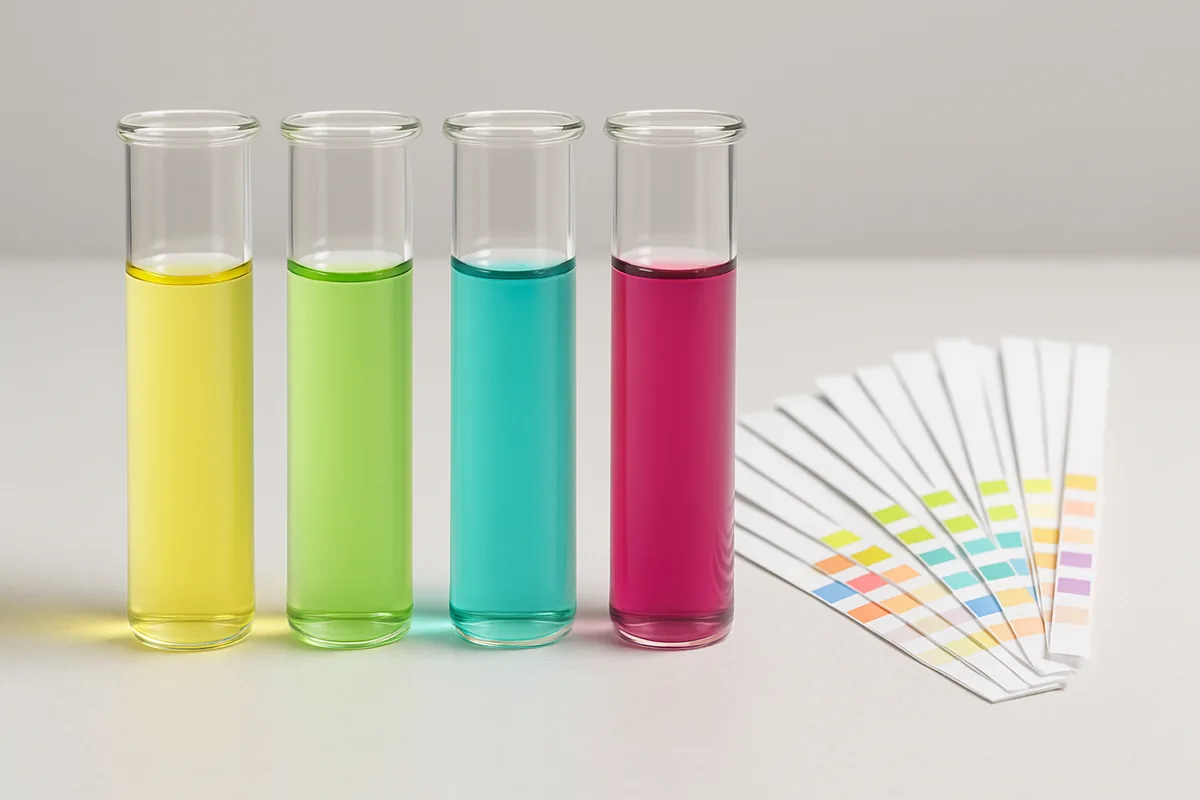
- For cycling and emergencies: use a liquid freshwater master kit (ammonia, nitrite, nitrate, pH). Strips are optional, not primary.
- Why liquids win: better resolution at harmful low concentrations, stable reagents in capped bottles, predictable sample volumes in tubes, long peer-reviewed pedigree for ammonia salicylate chemistry in environmental water testing.
- Why strips persist: speed, no vials to wash, one dip for multiple rough parameters, backpack-friendly shops and classroom demos.
- Biggest strip failure mode: humidity inside the foil or tub; pads are dry chemistry sponges competing with aquarium room air.
- Honest pairing: liquids for decisions · strips for quick checks between water changes.
- Gh/KH nuance: drop-count hardness tests typically beat hardness pads when you actually need numbers (see our GH and KH guide).
Affiliate disclosure. We may earn a commission if you buy through these links; you pay the same price.
This guide compares three setups: a liquid freshwater master kit (ammonia, nitrite, nitrate, pH), 5-in-1 strips for quick checks, and a separate GH & KH drop kit. Start with the master kit - strips are supplementary; hardness is its own bottle set.
Why fishkeepers fight about strips vs liquids
Fish deaths cluster at two mistakes: misunderstanding the nitrogen cycle (adding fish early) and misreading ammonia or nitrite as “fine” when they are not. Hobby forums are full of side-by-side photos where strips read “zero” while liquids show faint colour above zero during a cycle. Colour photography and phone white balance amplify the arguing, but the underlying issue is instrumentation: immersion strips prioritise throughput; liquid kits prioritise tonal separation on a calibrated chart paired with consistent light path.
If you maintain an aquarium for years and log results, liquids also become cheaper per data point despite higher shelf price upfront. Strip packs look cheap until you tally how often you peel another stick because last week’s colour looked ambiguous.
For context alongside this article, pair our tank cycling guide, tracking water parameters guide, and the companion Freshwater Master Test Kit breakdown (brand packaging names vs what you chemically measure).
Analytical primer: precision, bias, resolution
- Accuracy (absence of systematic bias): does the measurement centre on truth on average?
- Precision: if you repeated the identical sample ten times, would you get tightly clustered readings?
- Resolution: smallest step you can discriminate on the supplied scale.
- Limit of detection: lowest concentration your method can confidently separate from blank water.
Hobby aquarium products rarely publish coefficient-of-variance tables on packaging. Regulatory environmental labs do. So we extrapolate thoughtfully: aquarium liquids still behave like miniature wet chemistry assays; immersion strips resemble rapid point-of-care tests that trade granularity for ergonomic speed.
Hobby colourimeters use the whole water column colour. Strips squeeze reactions into stacked pads barely a millimetre thick plus overcoat films. Thin pads mean faster diffusion - but also narrower dynamic range engineering choices: strip manufacturers widen colour buckets so ageing pads still land inside a vaguely right band.
Liquid ammonia tests share DNA with validated water-lab methods
Serious ammonia tests in aquarium kits overwhelmingly use substituted indophenol (“salicylate”) chemistry avoiding classic phenol hazards. Researchers comparing phenate and salicylate total ammonia nitrogen (TAN) methods in freshwater and saline matrices report extremely tight agreement between compliant laboratory implementations; as one published comparison shows, optimised salicylate flow analysis tracks phenate-derived values closely across an order of magnitude of concentrations (Liao et al., 2012, salicylate vs phenate in environmental water analysis).
Interpretation for aquarists: you are colouring a water sample using reaction chemistry cousins to what fisheries and aquaculture labs still argue about statistically. Hobby kits truncate that pathway into laminated cards rather than diode-array spectrophotometers, but the assay class is respectable. That does not magically make API or any branded bottle ISO 17025 certified; it demonstrates why serious fishkeepers intuitively trust bottles over spongy pads.
What ammonia numbers actually describe
Hobby ammonia kits report total ammonia nitrogen equivalents read against calibrated charts combining NH4+ and small NH3(aq) fractions depending on temperature and pH. Because NH3 toxicity itself depends on temperature and pH, your mission is spotting unwanted total ammonia spikes early. Strip ammonia pads often mash low-positive bands visually even when liquids still separate a faint 0.25 ppm wedge from pristine blank - the exact wedge that matters mid-cycle.
Liquid nitrate: cadmium-route colourimetry (and discipline)
Traditional hobby nitrate liquids reduce nitrate to nitrite then complete a diazonium dye step; many consumer kits historically used cadmium-bearing reagents. Modern packaging increasingly asks you to responsibly dispose heavy-metal waste with household chemical rules. Functionally though, liquids ask you for serial dilution mindset: read within 60 s versus 300 s windows exactly as labelled, smash-bottle nitrogen reagents as instructed (“nitrate #2 shaking” is a meme because under-mixed reagent genuinely prints falsely low nitrate). Strips shorten that choreography to fifteen seconds plus hope you did not touch the pads.
Physiology of a dip strip
- Polyester backing arranges porous pads laminated with membranes controlling wicking speed.
- Each pad hides lyophilised enzyme or indicator cocktails tuned for particular analytes plus surfactants to spread aquarium water evenly.
- Seal integrity matters: reopening tubs daily in humid fish rooms floods pads with vapour-phase water. You get colour creep, sluggish development, drifting blanks.
- Chromogenic timing is strict yet frequently ignored.
“This 6-in-one strip replaces my master kit because it includes GH, KH and nitrate.”
Multi-analyte strips cram half a rainbow into a thumbnail. They are marvellous for scouting “ballpark sane vs obviously broken.” They are poorer at answering “is my nitrate 15 or 35 this week,” which is precisely the housekeeping question mature tanks hinge on.
Side-by-side: what differs in practice
| Liquid colourimetric kit | Dip strips | |
|---|---|---|
| Sample volume | Fixed millilitres in glass or plastic cuvette; identical path length every time unless you freestyle. | Wicking volume loosely controlled - surface tension plus how long you waved the dip card. |
| Daily cycling ammonia | Separate colour ladders for ammonia and nitrite; easier to stare at slight pink. | Pads often saturate or compress low traces if pads age or hydration drifts. |
| Nitrate trending | More distinct bands across 5 / 10 / 20 / 40 style scales (exact chart depends on manufacturer). | Colours between 10–40 ppm often blur into argumentative avocado mush. |
| Storage | Seal bottles; keep cool; contaminants stay out if lids stay clean. | Moist air is Enemy One; silica gel packets inside strip cans only postpone inevitability. |
| Operator skill gradient | Washing tubes between opposite tests avoids cross-talk; shake discipline required. | Finger grease on pads, wrong dip-clock, dripping over edge contaminate neighbouring pads. |
Parameter playbook
Ammonia (NH4+ / NH3, reported as nitrogen)
Liquids dominate. Cycling is fundamentally an ammonia-awareness game. Liquids amplify subtle colour deltas at sub-1 ppm. Strips can still spike hot enough to yell “problem,” but they stumble when ammonia is subtly above zero exactly when you are coaxing Nitrosomonas along.
Nitrite (NO2−)
Liquids dominate. Same argument: discerning trace nitrite distinguishes “still toxic” versus “finally collapsing toward zero.”
Nitrate (NO3−)
Liquids broadly win for steady maintenance. You care about deltas over weeks once bioload balances. Liquid charts usually space colour stops more discriminably; strips condense economically into fewer stops because each pad occupies physical real estate at the expense of tonal nuance.
pH
Liquids often outperform cheap universal strips when you need single-decimal awareness; high-range vs low-range bottles cover extremes. Strips can be close if fresh; edge-of-range colours (below 6 or above 8) often look muddy. For mission-critical breeding you eventually consider a maintained meter (calibration fluids not cheap). See water too acid or alkaline for behaviour linked to pH stress.
GH and KH
Drop endpoint titration > strip pads. Count drops until dye flips endpoint; convert using manufacturer tables. Strip GH/KH are OK for scouting in softwater vs rock-hard tap comparisons, mediocre for tuning remineralisation salts for shrimp. Our tap water for aquarium guide walks why starting water matters.
Gasping at the surface, piping, lethargy, clamped fins: strip-then-shrug is dangerously fast. Crack the liquid ammonia and nitrite immediately, do staged water changes if needed, skim ammonia spike guidance and fish gasping at the surface. Those articles assume numbers you trust.
Community benchmarking (and its limits)
Large forum threads periodically compare simultaneous bottle and strip readings. These are not blind peer review, but they repeatedly show divergence concentrated at ammonia and nitrate low ends (community collections such as Aquarium Co-op threads debating API strips vs liquids illustrate the pattern visually). Photos exaggerate Bayer demosaicing; trust repeated personal protocols more than strangers’ JPEGs.
Cost amortisation arithmetic (order-of-magnitude)
- Master liquid kit upfront: high single purchase.
- Lifetime cost per ammonia test: drops dramatically if you rinse gear, recap bottles, freeze unused tanks for years (OK, kidding - do not freeze; keep temperate stable).
- Strips: low opening cost yet each strip consumes every pad simultaneously even if you only cared about ammonia that morning.
- Hidden strip tax: second dip because “that didn’t look right,” repeat until narrative wins.
You do fishkeeping partly as science cosplay anyway; optimising pennies matters less than optimising preventable fish death. Liquids amortise morally and economically.
Same three kit types · quick links
Digital colorimeters: the third lane (not strip, not eyeball)
Handheld photometers (often called “checkers” in marketing) measure absorbance of your prepared sample with a LED and photodiode rather than asking your brain to interpret pastel. They remove inter-observer colour vision differences and room lighting bias. Trade-offs: higher entry cost, calibration and cuvette cleanliness still matter, sensor drift if batteries run low, proprietary reagent cartridges for some models. They do not suddenly nullify the liquids vs strips distinction; they are still wet chemistry with better readout hardware. For most households, a quality master liquid kit plus disciplined logging already wins; photometers become attractive for breeders, multiple large systems, or shrimp keepers chasing tight nitrate windows.
Laboratory context (without pretending your kitchen is NSF certified)
- Environmental microbiology textbooks repeat that colourimetric nitrate assays may employ cadmium amalgam reactors for reduction; hobby kits distill that lineage into bottled consumer warnings.
- Portable strip readers exist industrially (reflectance photometry) but aquarium hobby tubs do not bundle hardware calibration sliders - your eyeballs are the spectrophotometer.
- Validated methods get written up and argued about in journals; dipstick urinalysis and environmental screening tests face parallel debates about specificity vs portability. Aquarium strips inherit that trade-space.
Myth busting encore
“Hospital-grade strips! Marine precision! Matches lab equipment.”
Manufacturers stretch adjectives until compliance teams breathe. Aquarium retail strips remain consumer semi-quantitative devices. Respect them accordingly - great for scouting, dubious for solemn declarations ending in dead discus Facebook posts circa 2009 vibes.
Multi-tank maintenance routes, classroom demos, travel, quick assurance that you did not forget dechlorinator after a water change, checking if that odd bucket of aged water still matches expectations. They are layered intel, not replacing titrated liquids when decisions matter.
Where to buy
We may earn a commission if you buy through these links; you pay the same price.
- Liquid master kit (ammonia, nitrite, nitrate, pH) - Freshwater Master Test Kit
- Multi-parameter dip strips (quick checks) - API 5-in-1 test strips
- GH & KH (hardness titration kits) - GH & KH liquid test kit
Shopping outside the UK? Search the same product names at a retailer you trust.
- Read under indirect natural daylight; white paper behind the tube beats LED strip lighting that tints aquamarine.
- Track date opened on each bottle with painter’s tape.
- Never touch strip pads; hold the plastic handle only.
- Rinse glassware between opposing chemistries (ammonia vs nitrite) to avoid carryover.
- Log numeric interpretations in App-aquatic so week-to-week comparisons stay meaningful even when memory lies.
Related guides
Log liquid test results, spot trends, and never argue with past-you about what that chart colour meant last Tuesday.
Get the free appAre liquid aquarium tests more accurate than test strips?
For toxic nitrogen parameters, almost always yes in hobby practice. Liquids give better resolution at the low concentrations that define whether a cycle is safe. Strips trade maximum resolution for speed.
Why do test strips disagree with my liquid kit?
Different chemistries on the pads, ageing moisture, sloppy timing, or user error shaking nitrate liquids. Confirm by repeating both protocols carefully; liquids usually remain the tie-break signal once technique is squared away.
Should I use strips while cycling?
Only as adjunct quick checks - not as authoritative measurements. Decide cycle completion based on repeatable liquid ammonia and nitrite readings hitting zero profiles described in our cycle guide.
Which is cheaper?
Long-term aquarium keeping: liquids amortise sharply. Strip cartons look cheap upfront but burn multiple pads verifying doubts.
Do strips expire?
Yes; humidity accelerates intangible expiry even before printed dates. Toss bottles that produce muddy or oddly fast colours versus controls.
Is pH okay on strips?
Sometimes - if fresh and interpreted conservatively inside common community tanks. Sensitive breeding or buffering plans deserve liquids or calibrated meters.
GH/KH strips vs liquids?
Drop-count titrations routinely beat strip pads unless you genuinely only need qualitative hard vs soft. See GH and KH.
Can strips and liquids coexist?
Absolutely: liquids anchoring correctness; strips giving speed between thorough sessions.
What about nitrate test pads “reading high” forever?
Chronic discrepancies imply expired pads or tank organics interfering (rare extremes). Rotate new reagents yearly for mission-critical setups or when colours fight you.
Do laboratories use strips?
Field screening yes; regulatory reporting no. Hobby liquids align philosophically nearer lab assays than laminated dip cards do.
All guides · Recommended kits · Master test kit · Track parameters · Ammonia spike · Lower nitrate · Get the app