Guide
How to track aquarium water parameters
Knowing what to test, how often, and what the numbers mean helps you catch problems early and keep fish healthy.
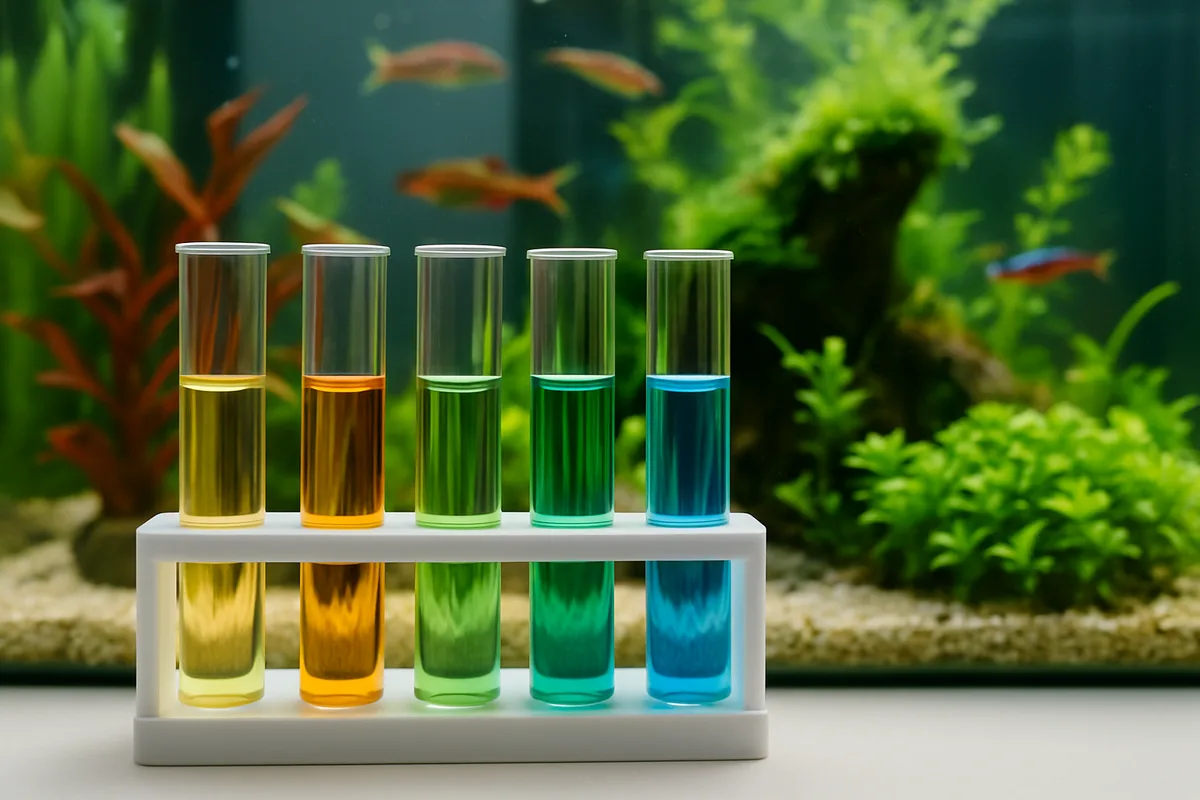
- Test these four first: ammonia, nitrite, nitrate, and pH. Everything else is secondary for most freshwater community tanks.
- Safe readings in a cycled tank: ammonia 0 ppm, nitrite 0 ppm, nitrate under 20 ppm, pH stable within your fish's preferred range.
- Stability beats perfection: a pH of 7.4 that never moves is safer than one that swings between 6.8 and 7.6 each week.
- Test more often when things change: new fish, after a filter clean, during cycling, or whenever a fish looks off.
- Log every result: a single reading tells you where you are; a series of readings tells you where you're heading.
- Liquid test kits beat dip strips for accuracy - worth the extra few minutes per test.
Why water chemistry kills more fish than disease does
Most fish deaths blamed on "mystery illness" are actually chemistry failures. The fish showed stress signals for days - clamped fins, surface gasping, hiding - but because no one tested the water, the root cause was never found. By the time visible symptoms appear, the damage is often already done.
In the wild, fish live in enormous bodies of water where waste dilutes fast and chemistry stays consistent across seasons. Your tank holds 60 or 200 litres. Uneaten food, fish waste, and a dying plant can shift ammonia from 0 to 1 ppm within 24 hours. That's why tracking parameters over time - not just testing once when something seems wrong - is one of the most useful habits you can build as a fishkeeper.
Most beginners test their water once or twice, see good numbers, and stop. Then something goes wrong three months later and they have no baseline to compare against. A log of 20 past readings is genuinely more useful than your most accurate single test.
The four parameters that matter most
Ammonia (NH₃/NH₄⁺)
Ammonia is fish waste - the direct byproduct of respiration and the breakdown of organic matter. It's toxic even at low concentrations. At 0.5 ppm it causes gill damage; at 2 ppm it can kill within hours, depending on species and water temperature. In a healthy, fully cycled tank, ammonia should read 0 ppm at all times. Any reading above zero in an established tank demands immediate action: a partial water change, a check on stocking levels, and an honest look at your filter.
One thing worth knowing: ammonia toxicity increases with pH. At pH 8.0, ammonia is significantly more dangerous than the same concentration at pH 7.0. This matters if you keep hard-water species or a planted tank buffered high.
Any reading above zero is a signal to act - not to wait and retest tomorrow.
Nitrite (NO₂⁻)
Beneficial bacteria in your filter convert ammonia into nitrite. Nitrite is less immediately lethal than ammonia, but it's still highly toxic - it interferes with the blood's ability to carry oxygen, which is why fish with nitrite poisoning often gasp at the surface even in well-oxygenated water. Like ammonia, the target in a cycled tank is 0 ppm. Nitrite spikes in new tanks during the cycling process, or any time the bacterial colony is disrupted - over-cleaning a filter, using tap water to rinse filter media, or adding too many fish too quickly.
Nitrate (NO₃⁻)
Nitrate is the end product of the nitrogen cycle. It's far less toxic than ammonia or nitrite, but it still stresses fish at high concentrations and fuels algae growth. Most freshwater fish do fine below 20 ppm; some sensitive species (discus, certain cichlids) prefer under 10 ppm. Nitrate creeps up between water changes - managing it is mostly a matter of changing water consistently and not overfeeding. If yours climbs above 40 ppm regularly, that's a signal to change water more often or look at stocking levels.
Nitrate is the one parameter where trends matter most. If you're seeing 10 ppm seven days after a water change one month, and 30 ppm seven days after a change the next month, your bioload is increasing - probably because your fish are growing. Catching that trend early prevents the chronic low-level stress that shortens fish lives.
pH
pH measures how acidic or alkaline your water is on a scale of 0-14, with 7.0 being neutral. Most tropical community fish tolerate a range of 6.5-7.8 without issue. The mistake most people make isn't having the "wrong" pH - it's letting it swing. A pH that shifts 0.5 units overnight stresses fish far more than a steady pH that's slightly outside the textbook ideal for that species.
pH can drop over time in tanks with soft water or heavy biological load, as organic acids accumulate and CO₂ levels rise. It can also rise in hard-water tanks or heavily planted setups with intense lighting. Testing weekly tells you whether yours is drifting - which it often does silently.
Chasing a target pH with additives. Dumping pH-down or pH-up products into a tank without understanding what's driving the pH creates unstable chemistry that's worse than leaving it alone. If your pH is genuinely wrong for your fish, the fix is usually a water source change or a substrate swap - not a bottle of chemicals added weekly.
Additional parameters worth testing
The core four cover most problems in most tanks. But depending on your water supply and what you keep, these are worth knowing:
GH (general hardness) measures dissolved calcium and magnesium. It matters for fish that have a strong preference for soft or hard water - tetras and rasboras generally prefer softer water (3-8 dGH), while livebearers and African cichlids prefer harder (10-20+ dGH). Keeping the wrong species in mismatched water doesn't kill them quickly, but it shortens lives and suppresses breeding.
KH (carbonate hardness) is your tank's buffering capacity - its resistance to pH swings. Low KH (under 3-4 dKH) means your pH can crash suddenly, particularly in CO₂-injected planted tanks overnight. Testing KH alongside pH makes sense if you're seeing unexplained pH fluctuations.
Phosphate doesn't stress fish directly but drives algae growth. If you're fighting persistent algae despite reasonable nitrate levels, phosphate is worth testing.
Chlorine and chloramine should be neutralised by a quality dechlorinator before water ever hits your tank. You don't need to test for these routinely - but if you ever skip or underdose your dechlorinator during a water change and then see ammonia-like stress symptoms, test for it.
How often to test
There's no single right answer here, but this framework works for most fishkeepers:
New or cycling tank: test ammonia and nitrite every day, or every other day at minimum. You need to know where you are in the cycle and catch dangerous spikes before they kill fish. Read the how to cycle a fish tank guide if you haven't yet - starting without cycling is the single most common cause of early fish deaths.
Established tank, stable stock: test ammonia, nitrite, and nitrate once a week. Test pH every two weeks, or whenever you do a water change with tap water from a different season (municipal water chemistry often changes in spring and summer).
After any disruption: adding new fish, cleaning your filter, treating for disease, or moving the tank - test the next day and every few days afterwards until readings are stable.
When fish are behaving oddly: test immediately. Surface gasping, flashing, lethargy, or appetite loss all have water chemistry as a leading suspect.
Rinsing filter media under the tap is one of the most common ways to crash a cycled tank. Chlorinated tap water kills the beneficial bacteria that process ammonia. Rinse filter media in a bucket of tank water only, and only when it's visibly clogged - not on a schedule.
Liquid tests vs. dip strips
Dip strips are fast and cheap. They're also often inaccurate enough to be misleading - particularly for nitrite and nitrate, where the colour differences between danger levels are subtle. For pH they're more reliable, but even there a liquid test is easier to read accurately.
Liquid reagent kits (the API Freshwater Master Test Kit is the industry standard recommendation for good reason) take about 5 minutes per parameter and give you results you can trust. If you're going to bother testing, use a method that gives you accurate data.
Why logging matters more than testing
A single test result answers one question: "Is something critically wrong right now?" A log of tests over weeks answers a far more useful question: "Is my tank stable, and which direction is it drifting?"
Nitrate creeping from 10 ppm to 30 ppm over four weeks is easy to miss test-by-test. On a graph, it's obvious. The same goes for pH gradually dropping in a soft-water tank, or ammonia spiking slightly every Monday after weekend overfeeding.
You can log in a notebook, a spreadsheet, or an app. App-aquatic lets you log test results, set reminders for your next test, and see your parameter trends over time - it works offline and stores everything on your device. The method matters less than the habit. What you want is a record that tells you whether your tank is healthy over time, not just on the day you happen to test.
Always test at the same time of day. pH in particular fluctuates through the day in planted tanks as CO₂ is consumed by plants during lighting hours. Testing at the same time each week makes your readings directly comparable.
What good parameters actually look like
Here's a practical reference for a cycled freshwater community tank:
Ammonia: 0 ppm
Nitrite: 0 ppm
Nitrate: under 20 ppm (under 10 ppm for sensitive species)
pH: 6.5-7.8 for most community species - stable above all else
Temperature: 24-27°C (75-81°F) for most tropical species - not a water test, but worth monitoring alongside chemistry
GH: 4-12 dGH for most community fish
KH: 4-8 dKH recommended for pH stability
If your readings consistently sit within these ranges and stay stable, you're doing it right. If you're stocking sensitive or demanding species, check the specific requirements - a discus tank and a guppy tank are not managed the same way. The free stocking calculator can help you think through bioload as you plan your stock.
Track your parameters and get care reminders with App-aquatic.
Get the free appHow often should I test aquarium water?
Weekly for ammonia, nitrite, and nitrate in an established tank. Every one to two days during cycling. Immediately any time fish are behaving strangely or you've made a significant change to the tank.
My ammonia reads 0 but fish still look stressed - what's going on?
Test nitrite and nitrate too - ammonia isn't the only toxic parameter. Also check temperature, confirm your dechlorinator was used correctly for recent water changes, and look at dissolved oxygen (heavy surface agitation helps). Some stress has disease causes rather than chemistry causes, but rule out water quality first.
Is 40 ppm nitrate dangerous?
Not acutely, for most fish. But chronically elevated nitrate - staying above 40 ppm for weeks - causes immune suppression and shortens lifespans, particularly for sensitive species. It also strongly promotes algae. Aim to keep it below 20 ppm through regular water changes and avoid letting it creep above 40 ppm between changes.
Do I need to test GH and KH, or just pH?
For most community tanks with adaptable species, pH plus the core four is sufficient. Test GH if you're keeping species with strong hardness preferences - soft-water tetras, wild bettas, or hard-water livebearers. Test KH if your pH is swinging unexplained, particularly in a planted tank with CO₂.
Why does my pH keep dropping?
The most common causes are low KH (insufficient buffering capacity), CO₂ accumulation from heavy biological load, or organic acids from decaying matter. Test your KH - if it's below 3 dKH, that's your answer. More frequent water changes, removing decaying organic matter, and increasing surface agitation to off-gas CO₂ overnight all help stabilise pH.
More guides · Recommended kits · How to cycle · Fish gasping at surface · Lower nitrate · water displacement, water change frequency · Phosphate · TDS · Get the app · App-aquatic