
Guide
How often to change aquarium water
A simple schedule by tank size, stocking, and how you keep fish - so you don't underdo or overdo it.
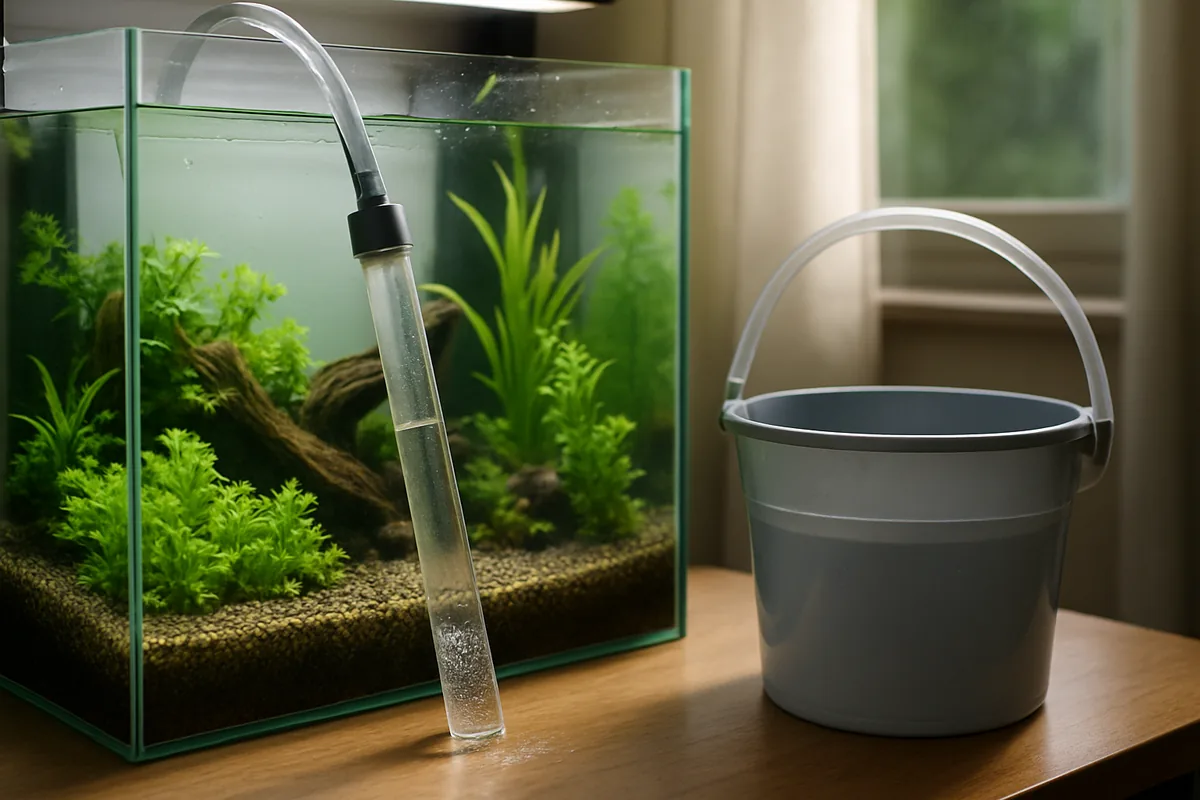
- Default starting point: 25% weekly works for most tropical freshwater tanks - adjust up or down based on what your tests actually show.
- Small tanks (under 10 gallons) need more attention: weekly changes are the minimum; twice weekly if heavily stocked.
- Nitrate is your real guide: keep it under 20 ppm for sensitive fish, under 40 ppm as an absolute ceiling for hardy species.
- Heavily stocked or big fish = more frequent changes: a 40-gallon tank with two oscars needs more work than a 40-gallon planted community tank.
- Don't skip and double up: a sudden 50% change after two weeks of neglect is harder on your fish than two steady 25% changes.
- Plants and filtration reduce how much work you need - but they don't eliminate water changes entirely.
Why water changes actually matter
Water changes do three things nothing else can fully replace. First, they dilute nitrate - the end product of the nitrogen cycle that accumulates steadily in any closed system. Second, they remove dissolved organic compounds (DOCs): hormones, tannins, medications, and biological waste that your filter doesn't strip out. Third, they replenish trace minerals that fish and plants consume over time, keeping water chemistry stable.
The filter handles ammonia and nitrite. It does not remove nitrate. Only water changes (or a heavily planted tank with the right conditions) keep nitrate in check long-term. That's the core reason this routine exists.
A lot of experienced fishkeepers will tell you their tank "runs fine" on monthly water changes. Some of those tanks genuinely do. What they're not telling you is that they often have lightly stocked, heavily planted setups with years of refinement behind them. If you're newer to the hobby, copying that approach before you've dialled in your tank is how you end up with sick fish and no idea why.
The right starting frequency for your tank
There's no universal answer, but there is a useful default: 25% once per week. It's enough to keep nitrate controlled in most moderately stocked setups, it doesn't stress fish the way large sudden changes can, and it gives you a weekly opportunity to actually look at your tank and spot problems early.
From that baseline, you adjust. After a month of weekly changes, test your nitrate the day before a scheduled water change. If it's sitting comfortably below 20 ppm, your current routine is working. If it's regularly hitting 30-40 ppm or above, you need to increase volume or frequency - or both.
By tank size
Under 10 gallons (nano tanks): Water chemistry can shift fast in a small volume. A single overfeeding session or one fish death you don't catch quickly can spike ammonia in hours. Weekly 25-30% changes are the baseline here. In a nano that's heavily stocked - say a 5-gallon betta tank with a snail colony - twice weekly at 20-25% is often better than one larger change.
10-30 gallons: Weekly 20-25% is the standard. These tanks are more forgiving than nanos but still accumulate waste faster than larger setups. Stick to weekly until you have consistent test data suggesting you can stretch it.
40-75 gallons: Weekly 20-30% is typical. With a moderate stocking level, some keepers successfully drop to every 10-14 days, but test first - don't assume. A 55-gallon tank stocked with a school of larger fish like Amatitlania nigrofasciata (convict cichlids) produces far more waste than the same tank with a school of neon tetras.
Over 75 gallons: Larger water volumes dilute waste more slowly, which sounds like less work - and it often is. Many large tanks do well on weekly 20% or biweekly 25-30% changes. The risk here is complacency. Bigger tanks forgive neglect longer before showing symptoms, which means problems can get further along before you notice them.
Sensitive species like discus, altum angelfish, and most apistogrammas do better kept under 10 ppm - factor that in when setting your routine.
By stocking level
Tank size tells you half the story. Stocking density tells you the other half. A lightly stocked 20-gallon tank with six small tetras and a good filter might genuinely be fine on biweekly changes. The same tank with a pair of adult Pterophyllum scalare and a full school of corydoras will need weekly changes without question.
Use a stocking calculator to assess whether your tank is within reasonable limits, then test to confirm what your water is actually doing. The calculator gives you a starting framework; your test kit gives you reality.
Judging stocking by the "inch per gallon" rule and then setting a water change schedule based on that number. That rule doesn't account for fish body mass, waste output, or territorial behaviour. Two adult goldfish in a 20-gallon tank are not comparable to twenty small tetras, even if the total inches are similar.
New tanks need a different approach
If your tank is still cycling or has just finished cycling in the last few weeks, standard weekly change advice doesn't fully apply. During a fish-in cycle, you may need to do small daily or every-other-day changes to keep ammonia and nitrite below 0.5 ppm - the threshold above which fish start experiencing gill damage. This isn't about nitrate yet; it's about keeping the water safe while your beneficial bacteria population establishes itself.
Once the cycle is complete and parameters are stable (0 ammonia, 0 nitrite, detectable nitrate), you can settle into a regular weekly schedule. Give it another four to six weeks of testing before you consider stretching to biweekly intervals.
Large water changes in a cycling tank can crash your cycle by removing too much of the ammonia that feeds developing beneficial bacteria colonies. During a fish-in cycle, keep individual changes under 30% and test before and after each one.
When to change more, and when you can do less
Signs you need to increase frequency or volume
Nitrate regularly above 20-25 ppm before your scheduled change is the clearest signal. Beyond chemistry, watch your fish: clamped fins, reduced activity, fish hanging near the surface, and loss of colour are all stress indicators that often correlate with water quality - even when the tank looks clean. A tank can look crystal clear while hosting 40 ppm nitrate, elevated DOCs, and stressed fish. Clarity is not cleanliness.
Other triggers for more frequent changes: you've added new fish, you've been overfeeding, a fish died and you didn't catch it for a day or two, or you've recently used medication (most meds need to be partially removed after the treatment period).
When you can genuinely do less
A heavily planted tank with a light stocking level and strong filtration is the scenario where you can sometimes stretch to biweekly or even every three weeks without problems. Live plants consume nitrate and ammonia directly, particularly fast-growing species like Egeria densa, Ceratophyllum demersum, or floating plants like Pistia stratiotes. In a well-balanced planted tank, the plants do a meaningful share of the water quality work.
But "well-balanced" takes time and testing to establish. If you're newer to planted tanks, still do weekly changes while you learn what your specific setup produces. The data you collect over two or three months is what earns you the confidence to ease off the schedule - not an assumption that plants mean less maintenance.
Always test nitrate the day before a scheduled change, not the day after. Pre-change readings tell you how much waste your tank produces between changes. Post-change readings just confirm you diluted it - which you already know you did.
How to do the change correctly
The mechanics matter almost as much as the frequency. Use a gravel siphon (also called a gravel vacuum) and work systematically across the substrate - this removes settled detritus that breaks down into ammonia over time. Don't clean the entire substrate in one session; clean roughly a third each week so you're not disrupting the beneficial bacteria that live in the substrate.
Refill with dechlorinated water matched closely to your tank temperature - within 1-2°C (2-4°F). A significant temperature difference stresses fish even when the volume is modest. If you're using tap water, dose your dechlorinator in the bucket or in the tank before adding water. Never add untreated tap water directly.
Check your aquarium water parameters - particularly pH and hardness - for consistency between tap water and tank water. In some areas, tap water pH swings significantly with seasonal variations in municipal treatment. Testing occasionally confirms you're not introducing chemistry shifts with each refill.
Cleaning the filter on the same day as a water change. Filter maintenance removes beneficial bacteria; a water change also temporarily disrupts tank chemistry. Doing both at once compounds the stress. Separate them by at least a week.
Consistency beats perfection
The fishkeepers with the healthiest tanks over the long term are almost never the ones doing the most sophisticated water chemistry management. They're the ones who do their changes on a regular schedule without skipping. A 25% change every single week for a year is worth more to your fish than occasional 40% changes whenever you remember.
Set a recurring reminder - same day each week. App-aquatic lets you log your test results and track nitrate trends over time, so you can see whether your current routine is actually working or whether something has shifted. Patterns that are invisible when you're testing ad hoc become obvious when you have three months of data in front of you.
For guidance on choosing fish that suit your setup and experience level, the best fish for beginners guide covers species with forgiving water requirements - a useful consideration when you're still dialling in your maintenance routine.
Track your parameters and get care reminders with App-aquatic.
Get the free appCan I do too many water changes?
Yes, though it takes some effort to get there. Very large or very frequent changes can stress fish by constantly shifting pH, temperature, and mineral content. The risk is highest in tanks with fish sensitive to stable water chemistry - discus, wild-caught cichlids, soft-water tetras. For most community tanks, daily changes of 10-15% are fine during a fish-in cycle; otherwise, once or twice weekly at 25-30% is well within safe limits. The bigger danger for most fishkeepers is changing too little, not too much.
What happens if I skip a week?
In a moderately stocked, well-filtered tank, one missed week is unlikely to cause a visible problem. Nitrate will be higher, but probably not catastrophically so. The issue is when one skipped week becomes a habit. If you've missed a week, do your next change on schedule - don't compensate by doubling the volume. A sudden 50% change in a tank that hasn't been touched in two weeks is more stressful than two modest consecutive changes.
Do I still need water changes if I have live plants?
Almost certainly yes, unless you have a very specific, heavily planted, lightly stocked setup that's been running and tested long enough to confirm it. Plants consume nitrate and ammonia, but they don't eliminate dissolved organics, hormones, or all the other compounds that accumulate over time. A planted tank can often get away with less frequent changes than a bare tank, but "less frequent" is still usually not "never." Test regularly to find out what your specific tank actually needs.
My water looks clear - do I really need to change it?
Yes. Water clarity tells you about suspended particles, not dissolved waste. Nitrate, dissolved organics, and ammonia are all invisible. A tank can look pristine and still have nitrate above 40 ppm. Test the water, don't just look at it. This is one of the most consistent mistakes newer fishkeepers make.
How much water should I change each time?
25% is the standard recommendation and works well for most setups. Going above 50% in a single change is generally unnecessary and risks temperature and chemistry swings. If your nitrate is consistently high, the answer is to change more often, not to do massive single changes. For tanks that are cycled and stable, 20-30% weekly covers the vast majority of situations.
More guides · Archimedes water displacement · Maintenance schedule · Water parameters · App-aquatic