
Compatibility
Can Angelfish Live With Guppies?
Last updated: May 2026
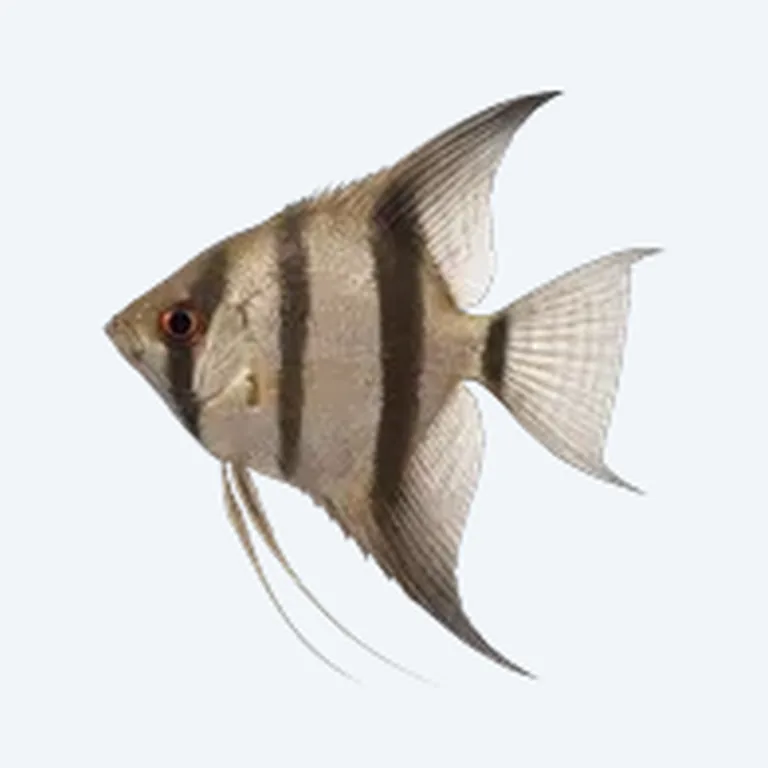
- Short answer: no. Adult angelfish (Pterophyllum scalare) will eat standard guppies. This isn't aggression - it's predation. A guppy that fits in an angelfish's mouth will eventually end up there.
- Size is the deciding factor. Angelfish can swallow fish up to roughly half their body length. A 15 cm (6 in) adult angelfish can take a full-grown male guppy whole.
- Water parameters conflict. Guppies thrive at pH 7.0-8.0 and prefer harder water. Angelfish do best at pH 6.5-7.2 in softer conditions. Keeping both happy in the same tank requires a compromise that suits neither perfectly.
- Temperature overlap is narrow but real. Both species tolerate 26-27°C (79-81°F), but guppies prefer slightly warmer and harder water than most angelfish setups provide.
- Tank size matters independently. Angelfish need at minimum a 110-litre (30-gallon) tall tank. That's a hard floor - not a soft suggestion.
- Better alternatives exist. If you want a mixed community, there are far more compatible options than forcing these two together.
Checking Angelfish against Guppy? Our fish compatibility checker compares any two of 815 species on water parameters, predation risk, fin nipping, temperament and tank size - and draws them both at life size so you can see the difference.
Why angelfish eat guppies
Angelfish are cichlids. They're not aggressive in the way an Oscar or a convict cichlid is, but they are natural predators of small fish and invertebrates in the wild Amazon basin. They hunt by sight and strike quickly at anything moving and small enough to swallow.
A standard male guppy reaches about 3-4 cm (1.2-1.6 in). A female tops out around 5-6 cm (2-2.4 in). A mature angelfish body (excluding fins) typically spans 10-15 cm (4-6 in). Do the arithmetic: most guppies fall well within the predation window for an adult angelfish.
The usual scenario plays out like this: you buy juvenile angelfish and juvenile guppies at the same time, everything looks fine for a few months, and then the angelfish grow. One morning you count your guppies and there are fewer than yesterday. A week later, there are none. The angelfish weren't "being aggressive" - they were being angelfish.
Pet shop staff often tell customers these two species can coexist "as long as the fish are the same size when introduced." That's technically true for about three months. After that, the angelfish grow faster and the guppies stop being safe. You're not setting up a permanent community - you're buying yourself a brief window before the inevitable.
The water parameter problem
Even if you somehow solved the predation issue - say, by keeping only large female guppies with young, small angelfish - the chemistry requirements push in different directions.
pH and hardness
Guppies are livebearers from brackish-influenced Caribbean and South American coastal waters. They do best at pH 7.2-8.0 and a general hardness (GH) of 8-12 dGH. Soft, acidic water stresses them, suppresses immune function, and leads to fin rot and wasting.
Angelfish come from slow-moving Amazonian blackwater and clearwater rivers. Their ideal range is pH 6.5-7.0, GH 3-8 dGH. They can adapt to pH 7.2 reasonably well, but above 7.5 you'll see slower growth, increased susceptibility to disease, and reduced breeding success over time.
You can find a midpoint - pH 7.0-7.2, moderate hardness - that both species survive in. But "surviving" and "thriving" aren't the same thing, and long-term health will be compromised for at least one of them.
Temperature
This is where the two species come closest to agreeing. Guppies are comfortable at 24-28°C (75-82°F). Angelfish prefer 26-30°C (79-86°F). A setting of 26-27°C (79-80°F) works acceptably for both. Temperature, at least, isn't the dealbreaker here - but it's also not a reason to ignore everything else.
If you're tracking parameters across multiple tanks, App-aquatic lets you log water tests per tank and flags when values drift outside your target range. Useful if you're running a guppy tank and an angelfish tank separately - which is exactly what most experienced keepers do.
What most guides miss: the guppy tail problem
Even in cases where angelfish don't outright eat guppies, they frequently nip at long guppy tails. Male fancy guppies have been selectively bred for flowing, dramatic finnage that extends well past their body. To a cichlid, that tail looks like a target.
Chronic tail nipping doesn't kill guppies quickly, but it creates ragged fins, opens infection pathways, and causes constant stress. A stressed guppy has a suppressed immune response. Within weeks you'll be dealing with fin rot, ich, or both. The angelfish may appear perfectly calm and "not aggressive" the whole time.
Tail nipping often happens at night or when you're not watching. If your guppies' fins look progressively more ragged and you can't identify a cause in your water parameters, observe the tank for an hour after lights-out with a dim red or blue light. You may catch the angelfish in the act.
Tank size and setup requirements
Angelfish are tall fish - their dorsal and ventral fins can add another 15 cm (6 in) of height to their body profile. They need vertical swimming space, which means a tank at least 45 cm (18 in) deep. Standard 110-litre (30-gallon) tanks are usually cube-shaped or tall enough to work. Long, shallow tanks do not suit them regardless of volume.
Guppies, by contrast, are comfortable in most standard tank shapes and don't need much height. Their requirements around tank architecture don't conflict with angelfish, but the minimum tank size for angelfish - 110 litres for a single pair, more for a group - is significantly larger than what many guppy keepers are running.
Standard 60 cm (24 in) tall tanks work well; shallow tropical community tanks do not, regardless of how many litres they hold.
Are there any scenarios where this works?
Honest answer: rarely, and with significant caveats.
Some keepers report long-term success keeping large female guppies (5-6 cm) with well-fed, non-aggressive individual angelfish. Female guppies lack the dramatic tails of males, which reduces nipping triggers. Well-fed angelfish are less motivated to hunt. In a heavily planted tank with plenty of cover, smaller fish have more escape routes.
But this isn't a reliable community setup - it's a lucky combination of individual temperaments. You can't guarantee it will hold, and you can't predict which angelfish will tolerate guppies and which won't until it's too late for the guppies.
If you're building a tank from scratch and want both species, build two tanks. A guppy colony tank and an angelfish community tank are both rewarding to keep. Forcing the two together isn't worth the stress - for the fish, or for you.
What to keep with angelfish instead
Angelfish are actually good community fish when paired correctly. They coexist well with fish that are too large to eat, too fast to catch, or not triggering predatory instincts with flowing fins or bright colouration.
Solid tank mates for adult angelfish include:
- Corydoras catfish - bottom dwellers that stay out of the angelfish's territory and are too armoured to be worth attacking.
- Larger tetras - rummy-nose tetras (Hemigrammus rhodostomus), black skirt tetras (Gymnocorymbus ternetzi), or lemon tetras (Hyphessobrycon pulchripinnis) are all fast enough and big enough to coexist safely.
- Dwarf gouramis (Trichogaster lalius) - similar water preferences, peaceful, and not small enough to be predated.
- Bolivian rams (Mikrogeophagus altispinosus) - compatible water parameters, similar temperament, less likely to clash than German blue rams in hard water.
- Bristlenose plecos (Ancistrus sp.) - efficient algae cleaners that angelfish ignore entirely.
Avoid small neon tetras (Paracheirodon innesi) with adult angelfish for the same reason as guppies - they're the right size to eat.
Buying neon tetras and angelfish together because they look good in photos. In the wild, neon tetras are angelfish prey. In a tank, the outcome is the same. Larger cardinal tetras (Paracheirodon axelrodi) at 4-5 cm fare slightly better but are still borderline with large angelfish.
What to keep with guppies instead
Guppies belong in a peaceful community with fish that share their water chemistry preferences and won't outcompete or harass them. Good options include:
- Platies and mollies - fellow livebearers with near-identical water preferences, easy to keep together.
- Endlers livebearers (Poecilia wingei) - closely related to guppies, compatible in every sense, and striking to look at.
- Harlequin rasboras (Trigonostigma heteromorpha) - peaceful schooling fish, tolerant of slightly harder water.
- Pygmy corydoras (Corydoras pygmaeus) - small, peaceful bottom dwellers that work well at the lower temperature range guppies prefer.
See our best fish for beginners guide for a fuller breakdown of species that work in a straightforward community setup.
Before you stock anything: get the basics right
Stocking decisions only matter if your tank is properly cycled. An uncycled tank will kill guppies faster than any angelfish will. Make sure you understand the nitrogen cycle and have completed a proper fishless cycle before adding any livestock. Then check your water parameters are stable and appropriate for whichever species you're keeping.
If you're planning a stocking list, run it through the free stocking calculator first - it'll flag conflicts you might not have considered, including temperature mismatches and bioload issues.
Track your parameters and get care reminders with App-aquatic.
Get the free appCan baby angelfish live with guppies?
Temporarily. Juvenile angelfish at 3-4 cm don't pose an immediate predation threat to adult guppies, but they grow quickly. Within 4-6 months most angelfish will have reached a size where standard guppies are at risk. It's not a stable long-term setup - you're just delaying the problem.
What if I only keep female guppies with angelfish?
Female guppies are larger (up to 6 cm) and lack the flowing tails that trigger nipping, so the risk is lower. Some keepers manage this combination in well-planted tanks. But size alone doesn't eliminate predation risk - a hungry or curious angelfish will still go after a female guppy that fits in its mouth. It's a better bet than males, but still not a reliable community pairing.
My angelfish has lived with guppies for months - why is everyone saying it won't work?
Individual fish vary. Some angelfish are lazier hunters, some are raised with smaller fish from a young age and don't seem to register them as prey, and some tanks provide enough cover that guppies survive by luck. But this isn't the norm, and it won't necessarily hold as the angelfish ages or gets hungrier. The people saying it didn't work aren't making it up - they're describing the typical outcome.
Can angelfish live with endlers livebearers instead of guppies?
No - endlers are even smaller than guppies, typically 2-3 cm for males. They're more at risk, not less. If the appeal is a livebearer in the same tank, there isn't a safe one small enough to be interesting but large enough to survive with adult angelfish.
How do I know if my tank water suits angelfish?
Test for pH (target 6.5-7.2), GH (target 3-8 dGH), and keep temperature at 26-28°C (79-82°F). If your tap water is hard and alkaline - common in many parts of the UK, US Midwest, and Australia - you'll need to buffer it down or use RO water blended with tap. Check our water parameters guide for the full breakdown and how to adjust your values safely.