Fish care
Freshwater Angelfish: Complete Care Guide
Last updated: May 2026
- Tank size: 180 L (48 US gal) minimum, but taller is more important than longer - angels grow to 15 cm (6 in) body height and need vertical swimming room.
- Water: 24-30°C (75-86°F), pH 6.0-7.5, soft to moderately hard. Stability matters more than hitting an exact number.
- Predation risk is real: any fish small enough to fit in an adult angel's mouth - neon tetras, small rasboras, ember tetras - will eventually disappear. Juvenile angels won't bother them; adult angels will.
- Filtration: they produce more waste than their elegant appearance suggests. Aim for turnover of 6-8× tank volume per hour, with mechanical and biological media both doing work.
- Temperament: semi-aggressive, especially during spawning. Pairs become genuinely territorial and will harass or kill tank mates that can't escape.
- Care level: intermediate - not a beginner fish, but manageable once your tank is cycled and parameters are stable.
Understanding what angelfish actually are
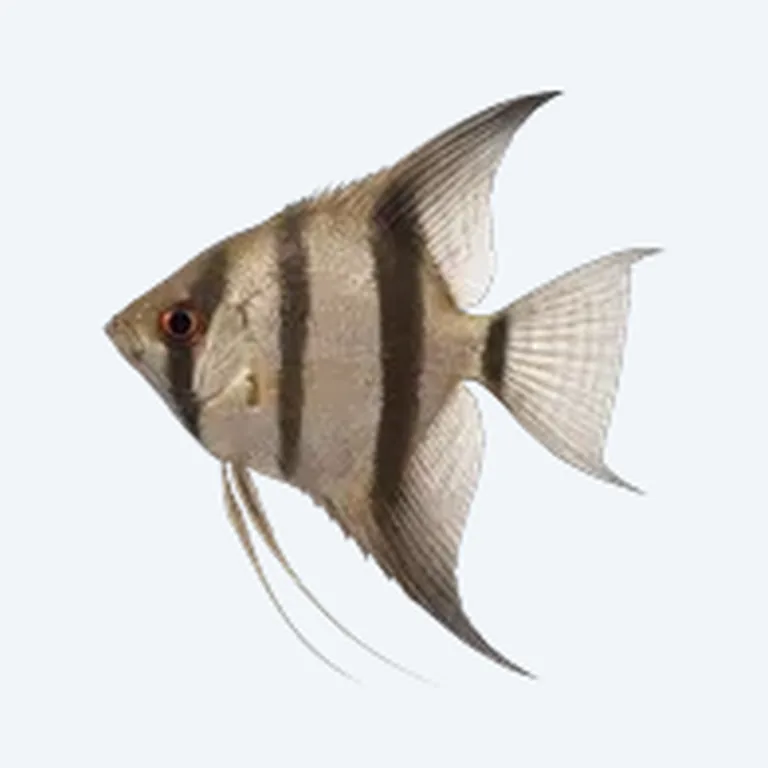
Pterophyllum scalare is a cichlid. That fact matters more than almost anything else in this guide. Most people walk into a fish shop, see something beautiful and graceful, and buy four for a community tank without realising they've just added four cichlids with territorial instincts, real predatory capability, and the potential to reshape their entire tank's social dynamic.
Wild angelfish come from slow-moving, heavily vegetated rivers across the Amazon basin - the Amazon, Orinoco, and Essequibo systems. The water there is warm, soft, and stained dark with tannins. It's not pristine; it's biologically rich and chemically stable. That tells you what they're built for: consistent warmth, low to moderate hardness, and plenty of structure to retreat into and defend.
In captivity, the fish available in shops are overwhelmingly captive-bred strains - veil, koi, marble, platinum, and others. These tolerate harder, more neutral water than wild-caught fish, but they're still cichlids with the same instincts. Don't let the ornamental breeding fool you into treating them like passive display fish.
Tank size and dimensions: height first
The 180 L (48 US gal) minimum exists for a reason, but the number that actually constrains most people is height. P. scalare grows to roughly 15 cm (6 in) in body length and - because of its laterally compressed, triangular shape - nearly as tall, especially with extended fin rays. A standard 180 L tank at 45 cm (18 in) tall works, but 50-60 cm (20-24 in) is noticeably better. Short, wide "breeder" tanks that fit the volume minimum but sit only 30-35 cm tall are unsuitable.
For a group of four to six juveniles growing on together - the most natural way to let a compatible pair form - you want at least 250-300 L (65-80 US gal) with adequate height. This also gives subdominant fish somewhere to go when a breeding pair starts pushing boundaries.
If you're buying a new tank specifically for angels, prioritise a 60 cm (24 in) water column height over extra floor length. Many aquarium retailers stock "angel tanks" in exactly this format. The extra vertical space makes aquascaping with tall plants and driftwood dramatically more effective, and the fish use it constantly.
Water parameters: stability beats perfection
Captive-bred angels will survive - and usually thrive - across a fairly wide range: 24-30°C (75-86°F), pH 6.0-7.5, general hardness up to about 12-15 dGH. Wild-caught fish and serious breeding setups demand softer, more acidic water, but for general community keeping, chasing ultra-soft, acidic conditions is unnecessary and can introduce instability that does more harm than good.
What genuinely matters is that parameters don't swing. A pH that drifts from 6.5 to 7.4 over a week as CO2 fluctuates, or a temperature that drops 3°C overnight because of a heater fault, stresses fish in ways that make them susceptible to disease and reduces immune function. Keep a reliable thermometer you actually read, not one you glance at occasionally.
79°F - the middle of the safe range, where angels feed well, show good colour, and aren't pushed toward accelerated aging by chronic heat.
On hardness: the hobby genuinely debates how much it matters for captive-bred fish. The honest position is that fish bred in tap water across generations have adapted, and moderately hard, neutral water (up to 12 dGH, pH 7.0-7.2) is fine for the vast majority of aquarium strains. If you're sourcing wild-caught fish or trying to breed consistently, softer water (4-8 dGH, pH 6.5-6.8) makes a measurable difference to spawning success and fry viability.
For a full breakdown of what each parameter actually does, see our guide to aquarium water parameters.
The predation problem: what most guides understate
This is where a lot of community tank advice fails people. Juvenile angels - under 5 cm (2 in) - look harmless and often coexist fine with small schooling fish. Adult angels with a body height of 12-15 cm are a different animal. Their mouths can accommodate fish up to about 3-4 cm (1.5 in) body length without difficulty.
Neon tetras (Paracheirodon innesi), cardinal tetras (P. axelrodi), ember tetras (Hyphessobrycon amandae), chili rasboras (Boraras brigittae), small danios - all of these are at genuine risk with adult angels. The aquarium trade markets these as compatible because they often coexist for months, sometimes longer. But "hasn't been eaten yet" isn't the same as compatible, and once predation starts, it doesn't stop.
If you want a mixed community with neon tetras and angels, you're probably going to lose tetras. You might get lucky with a particularly well-fed, docile adult in a large, heavily planted tank - but you're gambling with fish lives for an aesthetic combination. Larger tetras like black skirts (Gymnocorymbus ternetzi), Colombian tetras (Hyphessobrycon columbianus), or rummy-noses (Hemigrammus rhodostomus) are genuinely safer companions.
Good tank mate options include: larger characins (rummy-nose tetras, lemon tetras, black phantom tetras), peaceful bottom dwellers like Corydoras species and smaller Ancistrus plecos, dwarf cichlids like Apistogramma in larger setups, and peaceful mid-swimming fish of comparable size. Avoid other territorial cichlids unless the tank is large enough to establish clear territories, and avoid fin nippers like tiger barbs - angels' long fins are too tempting a target.
Use the free stocking calculator to check bio-load and compatibility before committing to a combination.
Filtration and waste load
Angels eat well, and they produce waste proportionate to that. The graceful, slow-moving appearance fools people into under-filtering their tanks. A canister filter or a quality hang-on-back with both mechanical and biological media is the baseline. For a 250 L (65 US gal) setup with four to six angels and companion fish, you want genuine biological filtration capacity - not just flow rate.
Target 6-8× tank volume per hour in turnover, but prioritise gentle delivery. High-velocity surface agitation stresses these fish and discourages natural behaviour. Spray bars, lily pipes, or a diffused outlet work well. Sponge filters as supplementary biological filtration are genuinely useful in angel tanks - cheap, effective, and harmless to fry if you ever breed them.
Angels are sensitive to dissolved organics and elevated nitrates. Tanks that are "clear" but running 40-80 ppm nitrate on a poor water change schedule will show it in dull colour, clamped fins, and susceptibility to hole-in-the-head disease (Hexamita-related HLLE). Keep nitrates under 20 ppm with regular partial changes. Read our guide on how often to do water changes if you're unsure of a baseline schedule.
Cycling your tank before adding fish
This applies to every fish, but it's listed here because angels are intermediate-care fish that frequently get added to uncycled tanks by hobbyists who underestimate them. An uncycled tank will spike ammonia, and angels are noticeably less tolerant of ammonia stress than hardy beginner fish. If you're new to the process, read the guide on how to cycle a fish tank before purchasing anything.
Target: 0 ppm ammonia, 0 ppm nitrite, and a measurable nitrate reading before angels go in. Not negotiable.
Feeding
Angels are opportunistic omnivores. In the wild they eat small invertebrates, insects, larvae, and plant material. In captivity, a high-quality cichlid pellet or flake as a base, supplemented with frozen or live foods - bloodworm, brine shrimp, daphnia, white mosquito larvae - keeps them in excellent condition and brings out breeding behaviour.
Feed once or twice daily, only what they'll consume in two to three minutes. Angels are enthusiastic eaters and will beg convincingly, but overfeeding is one of the most common drivers of poor water quality in angel tanks. A fasting day once a week does no harm and may improve digestion.
Feeding exclusively dry flake. It's convenient, but a purely flake-fed diet over years tends to produce dull colour and leaves fish nutritionally short of what they need. Frozen bloodworm two or three times a week costs almost nothing and makes a visible difference within weeks.
Behaviour, breeding, and social dynamics
Angels form monogamous pairs and are seasonal spawners in the wild, though captive fish will spawn year-round given the right conditions. A group of six juveniles raised together will naturally pair off as they mature - usually around 6-12 months at good growth rates. The pair bond is strong, and once formed, a spawning pair becomes significantly more territorial.
They deposit eggs on flat surfaces: broad-leaved plants like Echinodorus species, flat stones, or even the aquarium glass. Both parents guard the eggs and fan them with their fins. At 26-27°C, eggs hatch in roughly 60 hours. First-time parents often eat the clutch - this is normal and usually improves with subsequent spawns.
If you're not trying to breed, the main thing to manage is aggression. A spawning pair in a community tank will claim significant territory and may injure or kill fish that venture into it. Either remove the pair to a dedicated breeding tank, or ensure the community tank is large enough and structured enough for other fish to maintain distance.
App-aquatic's care reminders and parameter logging are useful here - tracking spawning cycles alongside water temperature and chemistry patterns helps identify what's triggering breeding behaviour if you want to encourage or manage it.
Health: what to watch for
The most common issues in angel tanks are predictable and mostly preventable:
Hole-in-the-head (HLLE): Pitting around the lateral line and head, associated with Hexamita infection, poor nutrition, and chronically high nitrates. Improve water quality, add variety to diet, and treat with metronidazole if the condition is progressing. Early cases often resolve with water quality alone.
Ich (Ichthyophthirius multifiliis): White salt-grain spots, usually triggered by temperature drops or stress from new additions. Raise temperature to 28-29°C and treat with a proprietary ich medication. Don't wait - ich spreads fast in warm water.
Fin rot: Ragged, receding fin edges. Bacterial in origin, usually secondary to physical damage from nipping or poor water quality. Fix the root cause first. Mild cases resolve with clean water; severe cases may need antibiotic treatment.
Wasting in pairs: If one fish in a bonded pair dies, the survivor sometimes stops eating and wastes away. This is documented behaviour in paired cichlids. Providing the surviving fish with new companions, frequent feeding with live food, and reduced stressors gives the best recovery odds.
Track your parameters and get care reminders with App-aquatic.
Get the free appCan angelfish live with neon tetras?
Juveniles often coexist fine. Adult angels will eat neon tetras - they fit easily in an adult's mouth. You might get away with it in a large, heavily planted tank with well-fed fish, but the odds are against you long-term. Larger tetras like rummy-noses or lemon tetras are a more honest choice.
How many angelfish can I keep together?
In a 180 L (48 US gal) tank, two to three is the practical ceiling unless the tank is tall and heavily structured. A group of six juveniles works well in 300 L or more - they'll pair off naturally, and having multiple pairs reduces the intensity of aggression directed at any one fish. Keeping a single odd fish with a bonded pair usually ends badly for the odd one out.
Do angelfish need a heater?
Almost certainly yes. They need 24-30°C (75-86°F) consistently, which most home environments can't guarantee year-round without a heater. A reliable thermostat heater sized at 1-2 W per litre is standard. Keep a separate thermometer - heater thermostats fail, and you want to know before the fish tell you.
Why are my angelfish fighting?
Most likely a pair has formed and is defending spawning territory, or a dominance hierarchy is being established in a group. Check whether the aggressor is one consistent fish - if so, a pair has probably formed. Rearranging decor briefly disrupts established territories and can reduce intensity. If one fish is being persistently targeted and can't escape, remove it.