Guide
How do I stop my fish tank water evaporating?
Evaporation is inevitable - every tank loses water. But unmanaged evaporation concentrates minerals, raises salinity in marine tanks, stresses fish, and creates a false sense that your parameters are stable when they're quietly drifting. Here's what drives it, what it does, and how to stay on top of it.
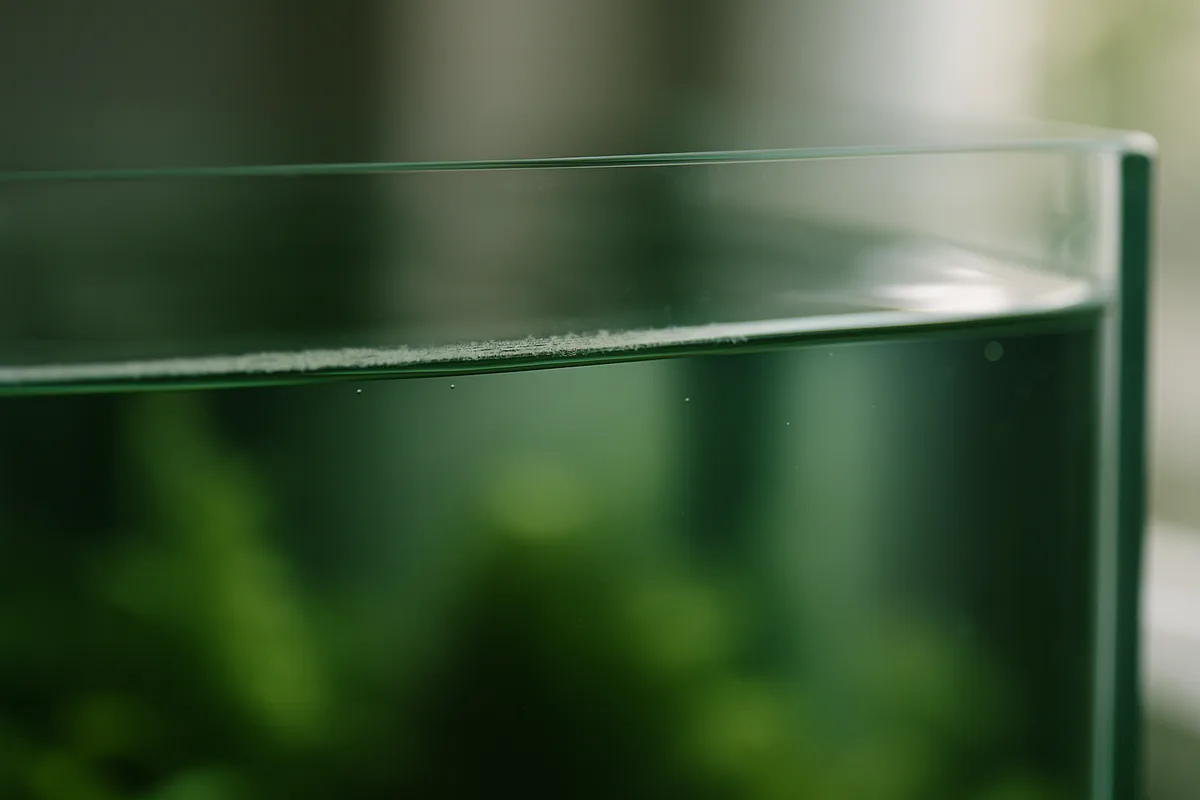
- You can't stop it completely - but you can reduce it by 70-90% with a fitted lid.
- Biggest driver: Open tops + strong surface agitation + warm, dry rooms.
- What happens if ignored: Minerals concentrate, GH/KH rise, salinity rises in marine tanks, nitrates appear worse than they are.
- Top-up rule: Replace evaporated water with plain dechlorinated tap water - not additional mineral treatments. Only pure water evaporates; the dissolved stuff stays.
- Reef tanks: ATO (auto top-off) systems are near-essential because evaporation rates are high and salinity swings are harmful to corals.
Why water evaporates from your aquarium
Evaporation is a physical process - water molecules at the surface with enough kinetic energy escape into the air as vapour. The rate at which this happens depends on several interacting factors, all of which you can influence to some degree:
Surface agitation
This is the most significant controllable factor after lid use. Agitation - from powerheads, spray bars, surface skimmers, or air stones breaking the surface - constantly disrupts the thin layer of saturated humid air that sits just above still water. That humid layer acts as a natural barrier, slowing further evaporation by reducing the vapour pressure differential between the water surface and the surrounding air. When agitation constantly breaks and mixes this layer, dry room air replaces it, and evaporation accelerates.
This creates a real tension in marine and high-tech planted tanks: both need surface agitation (reef tanks for gas exchange and oxygen, planted tanks for CO₂ exchange control), but agitation also drives the evaporation that requires constant top-off management. The trade-off is managed, not eliminated.
Temperature - water and room
Evaporation rate is strongly temperature-dependent. As a rough rule, evaporation rate roughly doubles for every 10°C rise in water or ambient temperature. A tank running at 28°C (common for discus or GBRs) evaporates meaningfully faster than one running at 22°C. A tank in a conservatory or sun-exposed room in summer loses far more water than one in a cooler interior room.
Ambient humidity
Evaporation rate is driven by the difference between the water vapour pressure at the surface and the water vapour pressure in the surrounding air. Dry air (low humidity) creates a large differential; humid air creates a smaller one. UK homes with gas central heating in winter become very dry - relative humidity of 30-40% is common. In summer, humidity is higher and evaporation rates typically decrease. This is why many fishkeepers notice noticeably faster water loss in winter despite lower room temperatures - the dryness of heated air outweighs the temperature reduction.
Surface area
A wider, shallower tank with more water surface area will lose proportionally more water than a taller, narrower tank of the same volume. A 200L standard rectangular tank and a 200L cube have the same volume but different surface areas - and therefore different evaporation rates under the same conditions.
Lighting
High-output lighting - particularly metal halide (MH) pendants used in reef tanks, and some older T5 arrays - generates significant heat at the surface of the water. MH-lit reef tanks are infamous for high evaporation rates, which is one of the reasons LED lighting has become so dominant in the reef hobby: LEDs generate far less waste heat at the water surface, reducing evaporation alongside running costs and heat management issues.
A 300L reef tank can lose 3-9L of water per day through evaporation. At 1% daily loss, that's 3L per day - over 20L per week. This is why ATO systems are standard practice in reef keeping: manual top-off at this rate is impractical and risks salinity creep between sessions.
What evaporation does to your water chemistry
This is the part most fishkeepers underestimate. Evaporation does not remove dissolved substances - only pure water molecules escape as vapour. Everything else - minerals, salts, nitrates, pH buffers, even trace elements - stays behind and becomes more concentrated as volume falls.
In freshwater tanks
- GH rises: General hardness (calcium, magnesium) concentrates as water volume falls. A tank that tested 10 dGH when full will test progressively higher as evaporation reduces volume without top-up.
- KH rises: Carbonate hardness - the buffering system that keeps pH stable - also concentrates. Paradoxically, this can seem like good news (more buffering), but the rise is artificial and can push pH in undesirable directions depending on your tank's biology.
- Nitrates appear higher: If you haven't been topping up consistently, some of your nitrate readings will reflect concentration, not actual waste load increase. This can make you think your bioload is worse than it is - or it can mask the fact that your actual nitrate production is already high.
- Conductivity rises: Total dissolved solids increase. Fish that are sensitive to water chemistry - GBRs, discus, wild-caught apistogramma - feel this as their environment becomes progressively less like what they evolved in.
In marine and reef tanks
The consequences of unmanaged evaporation are more acute in marine tanks because salinity is a precise and critical parameter for both fish and invertebrates.
Salinity creep is a serious stressor in reef tanks. As evaporation removes fresh water, the remaining water becomes more saline. A reef tank running at specific gravity 1.025 (the generally accepted range for reef tanks is 1.024-1.026) can climb to 1.028-1.030 within days if evaporation is not compensated. Corals, particularly SPS (small polyp stony corals), are extremely sensitive to salinity swings. A swing of 0.002-0.003 specific gravity can cause bleaching, polyp retraction, or in severe cases, rapid tissue necrosis. Marine fish tolerate salinity swings better than corals, but repeated swings stress immune function and make fish more susceptible to disease.
How to reduce evaporation - ranked by effectiveness
1. Use a well-fitted lid or cover glass
A tight-fitting glass or polycarbonate lid is the single most impactful intervention. A properly fitting lid can reduce evaporation by 70-90% by trapping humid air above the water surface. The humid air layer created inside the closed lid dramatically reduces the vapour pressure differential that drives evaporation. Most standard aquarium hoods do a reasonable job; custom rimless setups often use cut glass panels to cover the majority of the surface.
The trade-off: a fully sealed lid reduces gas exchange - CO₂ can build up (a concern for fish, not for heavily planted tanks where CO₂ is injected) and oxygen replenishment at the surface is reduced. Most keepers use lids with some ventilation - a gap at the back for equipment entry, or a mesh section - to balance evaporation control with gas exchange.
2. Reduce surface agitation
If your flow rate or surface agitation is higher than your fish or corals require, dialling it back reduces evaporation. This is tank-type specific: heavily planted tanks often benefit from minimal surface agitation anyway (reduces CO₂ escape); reef tanks need significant flow and cannot meaningfully reduce agitation without compromising coral health and oxygen levels.
3. Lower room temperature or use a fan wisely
A cooler room means slower evaporation from a tank that doesn't need to run hot. Conversely, some fishkeepers use clipped fans to cool their tanks in summer - fans dramatically increase evaporation as a deliberate side effect (evaporative cooling). If you're using fans to manage tank temperature in summer, expect significantly higher water loss and plan your top-off accordingly.
4. Switch to LED lighting
If you're running metal halide or high-output T5 over a marine or planted tank and finding evaporation unmanageable, modern LED alternatives produce dramatically less heat at the water surface. This is not a small difference - MH-lit tanks routinely lose 2-4x as much water through evaporation as equivalent LED-lit setups. The LED upgrade pays for itself in reduced water costs, reduced cooling costs, and reduced time spent on top-off maintenance.
5. Increase room humidity
In dry winter months, a room humidifier can measurably reduce tank evaporation rate. This is a secondary benefit of humidifiers that many fishkeepers don't consider. Running a humidifier in the tank room keeps relative humidity at 50-60%, which slows evaporation compared to a heated room at 30-35% RH. Whether this is practical depends on your setup and whether the benefits outweigh the inconvenience of running a humidifier.
6. Use floating plants
Floating plants - frogbit, Amazon frogbit, salvinia, water lettuce - cover the water surface and create a localised humid microclimate directly above the covered area. They also provide practical benefits (shade, nitrate uptake, surface cover for shy fish). For open-top tanks where a lid isn't practical or desirable aesthetically, floating plants are a useful partial mitigation.
Mark a line on your tank or sump with a waterproof marker at the 'full' water level. Check it weekly. The distance the water has dropped represents your evaporation loss that week - you can calculate the volume lost and get a sense of your tank's typical loss rate under your conditions. Once you know your baseline, you can plan top-off frequency accordingly and notice immediately if the rate changes (which can indicate a new heat source, changed equipment, or a leak).
How to top up correctly
This is where a significant number of fishkeepers make an error that compounds over time. When you top up evaporated water, you are replacing pure water - not the dissolved minerals in your tank. The rule is:
Top off with plain dechlorinated fresh water only. Not conditioned water with mineral supplements. Not buffered water. Not salt mixes. Just dechlorinated fresh water. The minerals and salts are still in your tank - concentrated, but present. Adding more of them when you top up would double-dose your tank progressively over time. The only time you add salt/minerals in top-up water is if a water test specifically shows your parameters have actually dropped - not just because the water level has.
Step-by-step top-off process
- Prepare your top-up water in a clean bucket or container - match the temperature of your tank water as closely as possible. A cold water top-up in a warm tank is a temperature shock, particularly in smaller tanks.
- Add dechlorinator/water conditioner to the top-up water in the appropriate dose for the volume you're adding - not for the full tank volume.
- Add slowly - pour gradually or siphon in over 10-15 minutes. Sudden volume additions can cause temporary parameter swings in smaller tanks.
- If you haven't topped up in a while (more than a week for a freshwater tank, more than 2-3 days for a reef), test parameters first. If GH or salinity has risen significantly, slow the top-up and add in stages over several hours to avoid osmotic shock from rapid parameter reversal.
ATO systems - are they worth it?
An Auto Top-Off (ATO) system automatically replaces evaporated water using a water level sensor, a fresh water reservoir, and a dosing pump. The sensor detects when the level drops below a set point and triggers the pump until the level is restored.
ATOs are only for reef tanks.
ATOs are essential for reef tanks, but they're also genuinely useful for any tank with high evaporation rates or for keepers who travel or work long hours. For a freshwater tank losing 5-10L per week, an ATO is a convenience. For a reef tank losing that amount per day, it's a necessity - and the stability it provides to salinity has real health benefits for coral.
ATO system cost guide
- Budget optical sensor ATOs (£30-60): Basic single-sensor units. Do the job for freshwater. Less redundancy - if the sensor fails open, the pump runs continuously and can flood the tank (a known failure mode). Always use with a failsafe timer or second sensor.
- Mid-range dual-sensor ATOs (£60-120): Two sensors - a primary and an upper safety level that cuts the pump regardless. Much safer. Worth the investment for any tank you care about.
- Premium ATO systems (£120-250): Include optical or float sensor redundancy, alarm functions, and sometimes integration with reef controllers. Standard equipment for serious reef keepers.
Related guides
Track your water level, log top-off volumes, and monitor parameter trends over time - App-aquatic keeps the full history so you can see if evaporation is affecting your chemistry.
Get the free appIs it normal for a fish tank to lose water every day?
Yes - some daily water loss through evaporation is completely normal, particularly in open-top or actively aerated tanks. A lidded freshwater tank might lose 0.1-0.3% of volume per day - barely noticeable. An open reef tank with strong flow can lose 1-3% per day. If your water level is dropping visibly faster than usual, consider whether your environment has changed (heating turned up, window opened creating airflow, new equipment generating heat) or whether there is a slow leak somewhere in the system.
Can evaporation cause algae problems?
Indirectly, yes. As evaporation concentrates minerals and nutrients in the water, there is more dissolved material available to support algae growth. The rising conductivity also changes the osmotic environment slightly. More directly, a lower water level can expose the top few centimetres of the tank to more intense light - creating a brightly lit, warm zone at the surface that green algae, particularly hair algae and green dust, exploit aggressively. Keeping the water level consistently topped up removes this advantage.
I have a sump - where should I top off, the display or the sump?
Always top off into the sump, not the display tank. The sump is specifically designed to act as the variable volume buffer - its water level rises and falls with evaporation and manual additions, while the display tank stays at a consistent level (determined by the overflow height). Adding top-off water to the display directly can cause water to back-flow into the sump or overflow. ATO sensors should be placed in the sump at the intended 'full' operating level, and the dosing line should feed into the sump.
Should I top off every day or less frequently?
For freshwater tanks - weekly top-off is fine for most setups losing 1-2% per week. For reef tanks - daily top-off is preferable to maintain salinity stability. The larger the tank, the more volume you can afford to lose before parameters shift noticeably. A 50L tank losing 2% per week has lost 1L and its parameters will shift more noticeably than a 500L system losing the same percentage. Smaller tanks benefit from more frequent top-offs; large systems can tolerate weekly management.
All guides · Rainwater in fish tanks · Water parameters · GH and KH explained · Get the app