Guide
How to set up a fish tank
Step-by-step so you don't skip the bits that keep fish alive. Plan once, set up right.
- Order matters: location → substrate → water → filter and heater → cycle → fish. Skipping steps doesn't save time, it kills fish.
- Never skip cycling: an uncycled tank has no beneficial bacteria to process ammonia. Fish die in days, sometimes hours. Fishless cycling takes 2-6 weeks and is the safest method.
- Bigger is genuinely easier: a 20-30 gallon tank is far more stable than a 5 or 10 gallon. Parameters swing harder in small volumes.
- Dechlorinate every water addition: tap water contains chlorine or chloramine, both lethal to fish and beneficial bacteria.
- Stock slowly: add a few fish, wait two weeks, test your water, then add more. Your filter needs time to catch up with each new bioload.
- Plan your stock before you buy anything: the size and chemistry needs of your fish should influence your tank choice, not the other way around.
Before you buy the tank
Most setup guides start with the tank itself. That's already too late. The decisions you make before any money changes hands determine whether this goes smoothly or expensively wrong.
First, decide what fish you actually want to keep. A planted community tank of tetras and corydoras needs completely different water chemistry to a pair of African cichlids. Your target fish should drive every other choice: tank size, substrate type, filtration capacity, temperature, and whether you need hard or soft water. Check our best fish for beginners guide if you're starting from scratch - some species are genuinely forgiving, others are not.
Second, do the weight maths before you pick a location. Water weighs 1 kg per litre (8.34 lbs per US gallon). A 100-litre (26-gallon) tank with substrate, decor, and glass runs close to 130 kg (around 290 lbs) when full. Most flat-pack furniture will not hold that safely. You need a purpose-built aquarium stand or solid hardwood furniture with the weight verified.
The "start small" advice beginners always hear is often wrong. A 10-gallon tank is cheaper upfront but harder to manage - temperature swings more, ammonia spikes faster, and your fish options are severely limited. If you can afford it, start with 20-30 gallons. The extra stability is worth every penny.
Step 1: Choosing the right location
Put the tank somewhere you'll actually enjoy it - that usually means living room height, not tucked in a corner. Beyond that, three things matter.
Avoid direct sunlight. A window behind or beside the tank will cause algae blooms you cannot control, and it creates temperature swings that stress fish. Even an hour of direct sun per day is enough to cause problems.
Avoid drafts and heat sources. Air conditioning vents, radiators, and exterior doors all push your tank temperature around. Heaters compensate for cold, but nothing compensates well for rapid oscillation. Aim for a room that holds a reasonably stable ambient temperature.
Think about water access. You will be carrying buckets for water changes weekly or fortnightly for the life of this tank. A location near a sink, or at least not down a flight of stairs, saves significant effort over time.
Also check the floor is level. A tank that isn't perfectly flat puts uneven stress on the seams and glass. Use a spirit level and shim the stand if needed.
Step 2: Substrate and hardscape
Rinse substrate thoroughly before it goes in - even "pre-washed" gravel. Fill a bucket, swirl it hard, drain, repeat until the water runs completely clear. Skipping this gives you a tank so cloudy you can't see through it for days.
How deep you go depends on what you're keeping. For most community fish with no burrowing species, 5-7 cm (2-3 inches) of gravel or coarse sand is enough. If you plan to keep corydoras, loaches, or other substrate-sifters, use fine sand - gravel damages their barbels over time.
Live plants change the equation. Stem plants and carpeting species need 7-10 cm (3-4 inches) of nutrient-rich substrate like Fluval Stratum or a capped soil mix. Standard aquarium gravel won't sustain most plants without root tabs.
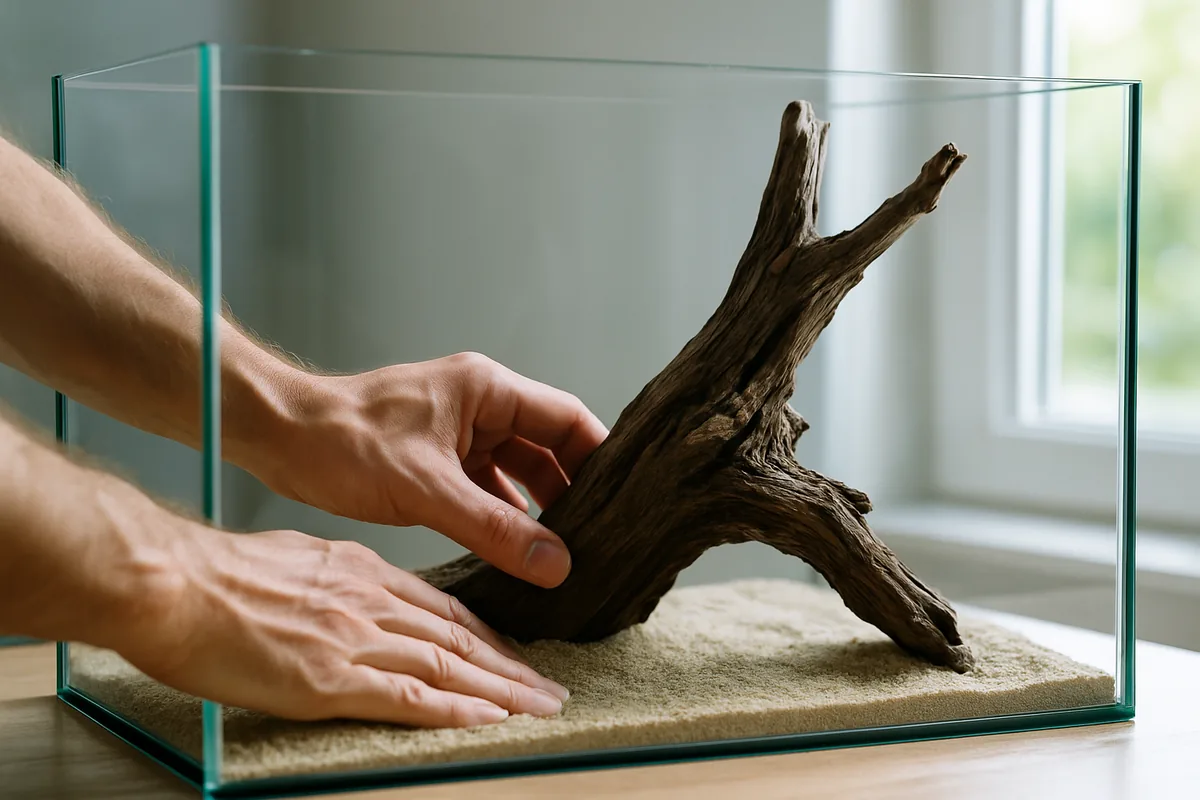
Place your hardscape - rocks, driftwood, cave structures - before adding water. Moving large rocks in a full tank risks cracking the glass. If using driftwood, expect it to leach tannins and slightly lower your pH; that's fine for most tropical fish but worth knowing.
Fill a small plastic bag with water and place it on the substrate before filling the tank. Directing the hose onto it disperses the flow and stops you blasting a crater in your substrate every time you add water.
Step 3: Water and equipment installation
Fill with cold tap water first, then add your dechlorinator - products like Seachem Prime or API Stress Coat neutralise chlorine and chloramine instantly. Always dose for the full tank volume even if you're only adding partial water; you want the dose to be in there before fish arrive.
Install your filter and heater with the tank at around two-thirds full, so you have room to work without everything overflowing. Read the specific instructions for your equipment - most hang-on-back filters need the intake positioned near the bottom of the tank, and most heaters need to be fully submerged and positioned horizontally or at an angle for even heat distribution.
Set your heater to your target temperature. For most tropical community fish - tetras, barbs, livebearers, corydoras - aim for 24-26 °C (75-79 °F). Cold water species like white cloud mountain minnows or goldfish need 15-20 °C (59-68 °F) and should not be mixed with tropicals.
Run the filter and heater for 24-48 hours before moving to the next step. Confirm the temperature is stable and where you want it. Check for leaks. If anything is dripping, fix it now.
Let the heater stabilise temperature fully before you begin the cycling process - bacteria establish faster at consistent temperatures.
Step 4: Cycling the tank - the step most people skip
This is where beginners most often go wrong. The nitrogen cycle is the biological process that makes fish tanks liveable. Beneficial bacteria colonise your filter media and convert toxic ammonia (from fish waste) first into nitrite (also toxic), then into nitrate (relatively harmless in low concentrations). Without established bacteria, ammonia spikes to lethal levels within 24-48 hours of adding fish.
For a full explanation of how this works, read our nitrogen cycle explained guide. For step-by-step instructions, see how to cycle a fish tank. The short version:
- Use fishless cycling. Add an ammonia source - pure ammonia (2-4 ppm) or a commercial product like Dr. Tim's Ammonium Chloride.
- Test every 2-3 days with a liquid test kit (not strips - strips are inaccurate enough to give you false confidence).
- The cycle is complete when you can add ammonia to 2 ppm and both ammonia and nitrite read zero within 24 hours.
- This typically takes 4-6 weeks from scratch, or as little as 1-2 weeks if you seed the filter with media from an established tank.
Using water conditioner or antibacterial products during cycling. Some dechlorinators temporarily detoxify ammonia, which interferes with the cycle. Seachem Prime at normal doses is fine. Antibacterial additives will kill the bacteria you're trying to grow. Avoid anything marketed as "making water safe instantly" - it's not a substitute for cycling.
Track your ammonia, nitrite, and nitrate readings through the cycle so you can see the curve developing - ammonia rises, then nitrite rises as the first bacteria establish, then both fall as the full cycle completes. If you want a clean log to watch the progress, App-aquatic's parameter tracking is built for exactly this kind of data.
Don't do large water changes during cycling unless ammonia or nitrite exceeds 5 ppm. Partial dilution slows the process. The bacteria need exposure to the compounds they process in order to multiply. Intervene if levels are extreme, not just high.
Step 5: Adding fish - slowly and deliberately
When your cycle test confirms both ammonia and nitrite at zero, you're ready. But "ready" doesn't mean load the tank to capacity on day one.
Add no more than 20-25% of your intended stocking in the first week. The bacterial population in your filter will have grown to handle the ammonia load you've been providing during cycling - increase that load suddenly and you'll cause a mini-cycle that stresses or kills your new fish. See our aquarium water parameters guide for what safe numbers look like.
When you introduce fish, float the sealed bag in the tank for 15 minutes to equalise temperature, then over the next 15-20 minutes, add small amounts of tank water to the bag before releasing the fish. Net the fish into the tank - don't pour the bag water in. Fish store water often contains pathogens and elevated ammonia.
Test your water every two days for the first two weeks after adding fish. Do a 25-30% water change if ammonia or nitrite registers anything above zero. For guidance on long-term water change schedules, see how often to do water changes.
Plan your community before you stock it
This is what most guides miss entirely. A tank isn't just a collection of individual fish - it's a community where size, temperament, territory, water level, and chemistry compatibility all interact. A tiger barb that fin-nips constantly makes a betta's life miserable. A pleco that grows to 45 cm (18 inches) doesn't belong in a 30-gallon tank, regardless of what the pet shop says.
Before you buy anything, use our free stocking calculator to check compatibility and bioload. The old "one inch of fish per gallon" rule is a rough guide at best and actively misleading for large or waste-heavy species.
Stock bottom, middle, and top levels of the tank deliberately. A tank where every fish competes for the same water column is more stressed and harder to manage than one where different species occupy different zones. Corydoras on the bottom, tetras in the middle, hatchetfish or danios near the surface makes for a calmer, more interesting tank.
What most setup guides miss
The filter is the most important piece of equipment you own. The tank is just a container; the filter is where the biology happens. Buy more filtration than the packaging says you need - most manufacturers rate filters optimistically. For a 100-litre (26-gallon) tank, buy a filter rated for 150-200 litres. Never clean all the filter media at once; rinse it in old tank water (not tap water) so you preserve the bacteria.
Temperature stability matters more than the exact number. Fish can adapt to a range of temperatures, but rapid swings of more than 2°C (3.6°F) in either direction cause osmotic stress and disease susceptibility. A quality heater with a thermostat - not a fixed-temperature "preset" heater - gives you control.
Lighting affects more than aesthetics. Most fish don't need intense light. Algae does. Unless you're growing plants that specifically require high light, a low-to-medium output LED on a 6-8 hour timer is enough. Long photoperiods combined with any nutrient source will give you algae problems within weeks.
Your tap water chemistry is your baseline. Know your pH, KH (carbonate hardness), and GH (general hardness) before you choose fish. It's far easier to keep fish that suit your water than to fight your tap water chemistry constantly. Most local water companies publish their analysis online, or you can test it directly.
Track your parameters and get care reminders with App-aquatic.
Get the free appHow long does it take to set up a fish tank before adding fish?
The physical setup - substrate, water, equipment - takes a few hours. The cycling process takes 4-6 weeks from scratch, or 1-2 weeks if you seed your filter with established media. There's no safe way to shortcut this timeline without risking your fish.
Can I use tap water straight from the tap?
No. Tap water contains chlorine or chloramine, both toxic to fish and to the beneficial bacteria in your filter. Always add a dechlorinator like Seachem Prime or similar before the water contacts fish or your filter. This applies to every water change, not just the initial fill.
What's the minimum tank size for a beginner?
Practically, 20 gallons (75 litres). Smaller tanks are cheaper upfront but harder to manage - parameters fluctuate more sharply, mistakes are less forgiving, and fish options are limited. If budget is genuinely the constraint, a 10-gallon can work for a single betta or a small school of nano fish, but expect to work harder to keep it stable.
Do I need a heater if I'm keeping coldwater fish like goldfish?
Not if your room temperature stays consistently between 15-20 °C (59-68 °F). But most homes, especially in summer, get warmer than goldfish prefer - above 22 °C (72 °F) oxygen levels drop and goldfish struggle. In those cases a fan or aquarium chiller matters more than a heater. What you cannot do is keep goldfish and tropical fish together; their requirements don't overlap.
My water is cloudy after setup - is that normal?
White or grey cloudiness immediately after filling is almost always fine sediment you didn't rinse out fully. It settles within 24-48 hours. Milky white cloudiness that appears a week or two into cycling is a bacterial bloom - harmless, and a sign the cycle is progressing. Green cloudiness is algae and means too much light or nutrients. Only the last one is a problem that needs action.
More guides · Cycling · First tank · App