Guide
Best plants for an axolotl tank
Five reliably cold-tolerant, axolotl-safe plants - and why how you plant them matters more than which species you choose.
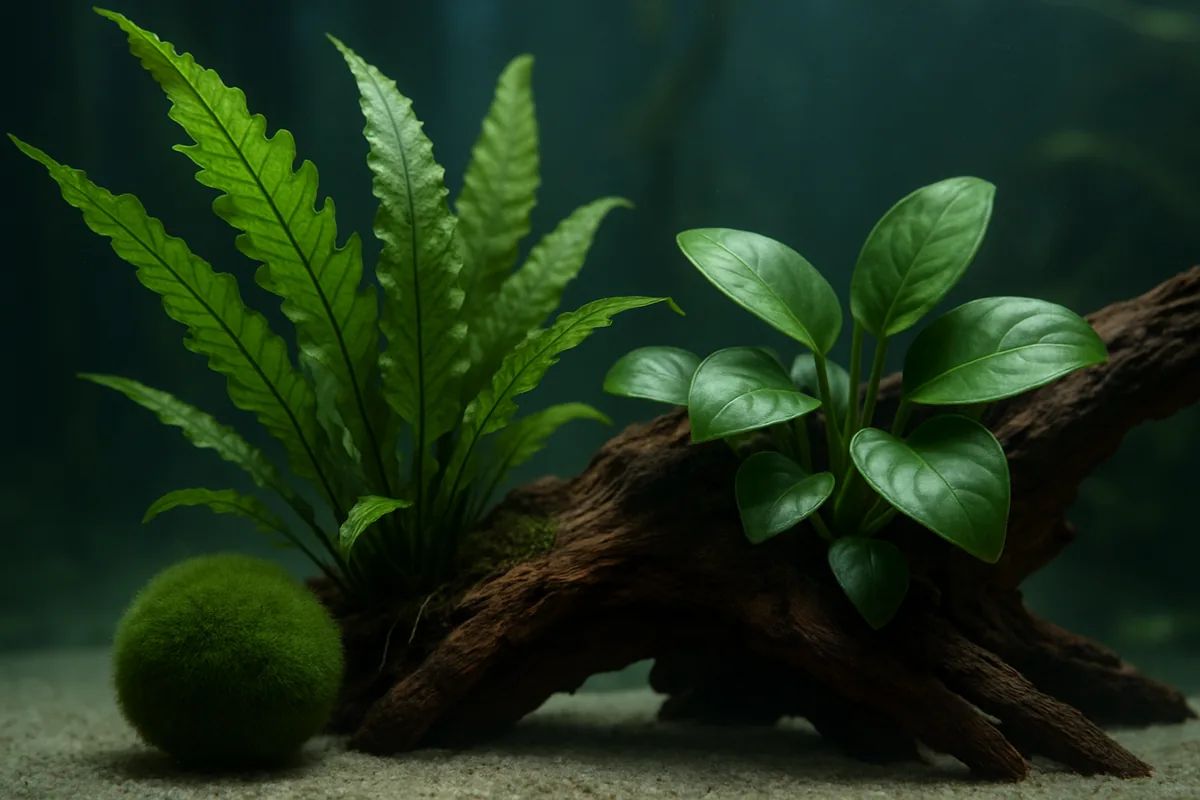
- The five reliable choices: java fern, anubias (nana or barteri), marimo moss balls, java moss, hornwort.
- The rule that matters most: attach to hardscape or float - don't rely on substrate-rooted plants.
- Why: axolotls dig and forage along the bottom, uprooting anything planted in substrate and disturbing whatever's underneath.
- Low light, no CO2 needed - convenient, since axolotls prefer dim lighting anyway.
Why plant choice is really a substrate question
Most plant guides start with light and nutrients. For an axolotl tank, the deciding factor is different: what the plant is rooted in, and whether an axolotl foraging along the bottom will pull it out. Our axolotl care guide covers the substrate rule in full - bare bottom or fine sand only, because axolotls swallow whatever's under their food and gravel causes fatal impaction. That same digging, foraging behaviour is what makes substrate-rooted plants a poor fit here, independent of the impaction risk itself. The fix for both problems is the same: keep the bottom clear, and mount plants on hardscape or let them float instead.
The five plants that actually work
Java fern (Microsorum pteropus)
The default recommendation for good reason. Java fern attaches to driftwood or rock with its rhizome rather than rooting in substrate, tolerates the cold end of the aquarium range comfortably, and copes fine with the low light most axolotl tanks run. Its broad, tough leaves also give an axolotl something soft to rest against.
Anubias (nana or barteri)
Same rhizome-on-hardscape logic as java fern, similarly unfussy about light, and similarly happy in cool water. Anubias nana's smaller leaves suit nano and standard tanks alike; barteri gets larger if you want more coverage. Tie or glue the rhizome to wood or rock - never bury it, which encourages rot regardless of species.
Marimo moss balls
Genuinely a free-floating (or gently resting) ball of algae, not rooted at all, which makes it about as axolotl-proof as a plant gets. Marimo naturally comes from cold lakes, so it's entirely at home at axolotl temperatures, and keepers regularly report their axolotls pushing the balls around like toys - enrichment as a side effect.
Java moss
Ties onto wood or rock to form a soft carpet, tolerates cold water well, and its texture is gentle on sensitive skin and gills compared to coarser plants. Good for softening hardscape edges or giving smaller tank residents somewhere to hide.
Hornwort
A fast-growing floating (or loosely anchored) stem plant that's a genuine cold-water specialist, thriving in the same range axolotls need. Because it floats, it never interacts with the substrate at all - the simplest possible way to add greenery with zero uprooting risk.
Plastic or silk plants are a completely legitimate alternative if you'd rather not manage live plant care on top of everything else axolotl-specific. They add the same cover and visual interest with zero substrate or uprooting concerns - just check edges are soft, since axolotls have delicate skin.
Plants to be cautious with
Anything that depends on being rooted in nutrient-rich substrate - carpeting foreground plants, most swords, most crypts - fights against the bare-bottom-or-sand rule and is likely to get uprooted repeatedly even if you try. It's not that these plants are toxic or dangerous; they simply don't suit how an axolotl uses the bottom of its tank. If you want a lusher look, lean on more java fern and anubias mounted at different heights on hardscape rather than reaching for rooted species.
Setting plants up to survive
- Attach, don't bury: use cotton thread, fishing line, or aquarium-safe glue to fix rhizome plants to wood or rock. They'll root into the hardscape naturally over a few weeks.
- Weight or anchor floaters loosely if you don't want them drifting into the filter intake, but avoid substrate contact entirely.
- Keep light modest. All five recommended plants are low-light species, which conveniently matches the dim lighting axolotls prefer since they have no eyelids.
- Skip CO2 injection. None of these plants need it, and it adds complexity to a tank that's already got a temperature-control job to do.
Get the rest of the setup right - temperature, substrate, and tank size - in the full care guide.
Read the axolotl care guideWhat plants are safe for an axolotl tank?
Cold-tolerant, hardscape-attached or floating plants work best: java fern, anubias (nana or barteri), marimo moss balls, java moss, and hornwort. All tolerate the 16-18C range axolotls need and don't rely on being planted in substrate, which axolotls disturb.
Can I use substrate-rooted plants with an axolotl?
It's risky. Axolotls dig and forage along the bottom and will uproot rooted plants, which can expose roots, cloud the water, and stir up whatever substrate is underneath. This is one of several reasons axolotl tanks use bare bottom or fine sand rather than gravel.
Do axolotls eat live plants?
Not typically - they're carnivores with no real interest in eating plant matter. The risk from plants is physical (uprooting, substrate disturbance) rather than the axolotl grazing on them.
Do axolotl tanks need CO2 or strong lighting for plants?
No. The plants that suit axolotl tanks (java fern, anubias, moss, hornwort) are all low-light, undemanding species that do fine without CO2 injection - which is fortunate, since axolotls prefer dim lighting anyway.
More guides · Axolotl care · Axolotl tank mates · General plant guide · App-aquatic