Fish care
Neon Tetra: Complete Care Guide
Last updated: May 2026
- School size: Keep at least 10-12 adults - fewer and they spend more time hiding than swimming.
- Water: 22-25°C (72-77°F), pH 6.0-7.0, soft to moderately hard (2-10 dGH). Stability matters more than hitting exact numbers.
- Tank size: 60 L (16 US gal) minimum, but 80-100 L gives you room for a proper school and compatible tank mates.
- Biggest health risk: Neon Tetra Disease - incurable, moves fast, and most beginners miss the early signs.
- Common mistake: Buying neons for a tank that isn't fully cycled. They're sensitive to ammonia spikes despite their "easy" label.
- Diet: Omnivore. Small flake or micro-pellet daily, supplemented with frozen daphnia or baby brine shrimp a few times a week.
What you're actually getting
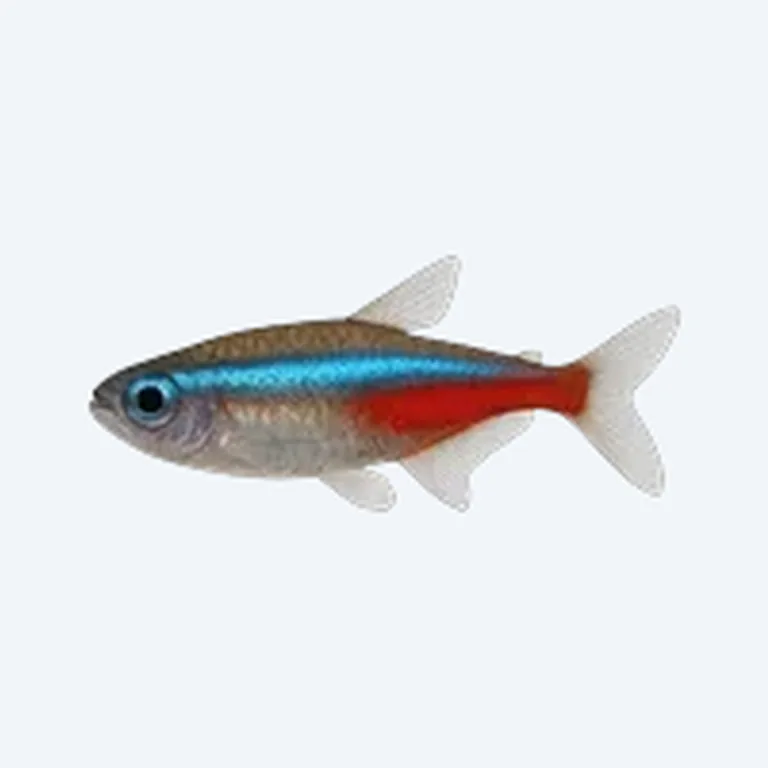
Paracheirodon innesi is one of the most-sold freshwater fish on the planet, which means the hobby has built up a lot of lazy advice around them. Yes, they're beginner-friendly. No, that doesn't mean they're indestructible. The neon tetra's "easy" rating assumes you have a fully cycled tank, a stable pH, and a school large enough that the fish actually feel secure. Skip any one of those and you'll be puzzling over why your neons are pale, hiding behind the filter, or dying off one by one two weeks after you brought them home. They're also endlessly confused with their pricier lookalike - see how neon and cardinal tetras compare.
Wild neons come from the blackwater and clearwater tributaries of the Amazon basin in Peru and Colombia - soft, acidic, heavily tannin-stained water that looks like weak tea. The fish sold in shops today are almost entirely captive-bred in Southeast Asia, so they're more adaptable than their wild cousins. But "more adaptable" doesn't mean "fine in anything." They still do best in softer, slightly acidic water, and they genuinely struggle in high-pH, hard-water setups.
Tank setup
Size and shape
The 60 L (16 US gal) minimum gets thrown around a lot, and it's workable - but only just. A school of 12 neons in a well-planted 60 L tank is fine. A school of 6 in a bare 60 L with a powerful filter blasting them around is not. If your budget allows, start with 80-100 L. You'll fit a more comfortable school, have room for a corydoras group on the bottom, and have enough water volume to buffer parameter swings.
Shape matters more than most beginners expect. Neons are horizontal swimmers. A long, shallow tank gives them far more usable space than a tall cube of the same volume. If you're choosing between a 60 L tall column and an 80 L standard rectangle, take the rectangle every time.
Flow and filtration
These are small fish from calm, tannin-rich backwaters. A turnover rate of 5-6× the tank volume per hour is plenty. Strong flow from a canister or HOB pointed directly across the tank will exhaust them. Diffuse the output with spray bars or aim it at the glass so it disperses before reaching the open water. Sponge filters work well in dedicated neon setups - they provide gentle biological filtration and the neons often pick at the surface of the sponge for microorganisms.
Plants, substrate, and light
Dark substrate and heavy planting make neons genuinely stunning. Their iridescent stripe pops against a dark background in a way it never does in a sparse, bright tank. Java fern, anubias, and hornwort are forgiving choices that don't need CO2 injection. Float some Indian almond leaves or add a piece of driftwood - both leach tannins that gently acidify water and mimic their natural habitat. Dense plant cover at the midwater level also reduces skittishness. Neons that have nowhere to retreat from perceived threats will shoal tightly in a corner and stress-fade their colour.
A few Indian almond leaves on the substrate do double duty: they leach tannins that soften and slightly acidify your water, and they provide a natural microbe layer that fry and small fish actively feed on.
Water parameters
Temperature
22-25°C (72-77°F) is the sweet spot. They'll tolerate 20°C (68°F) short-term, but chronically cool water slows their metabolism and immune response. At 27°C (81°F) and above, oxygen levels drop and pathogens become more active - not a combination you want with a susceptible species. Stable is the operative word: a 1-2°C swing from day to night is fine; a 5°C drop when you do a water change is not.
pH and hardness
Aim for pH 6.0-7.0, soft to moderately hard (2-10 dGH). Captive-bred neons tolerate neutral water well, so if your tap comes out at pH 7.2-7.4, you don't necessarily need to intervene - just don't try to push them into pH 7.8 or higher hard water. That's where you see chronic stress, poor colour, and increased disease susceptibility.
Most people get this wrong by chasing a lower pH with pH-down products (usually phosphoric acid) without understanding the relationship between pH and KH. If your carbonate hardness is high, your pH will keep bouncing back no matter how much acid you add, and the constant swings are far more damaging than a stable pH of 7.2. If you genuinely need soft, acidic water, address hardness first - RO water blended with tap, or natural tannin sources. Check the aquarium water parameters guide for a proper explanation of KH buffering before you start adjusting anything.
Never dose pH-down products without testing KH first. High carbonate hardness will just rebound your pH within hours, and repeated swings stress fish far more than stable hard water does.
Nitrogen cycle - non-negotiable
Neons are frequently sold to beginners as a "starter fish," but they're not particularly ammonia-tolerant. They die in uncycled tanks. Read the nitrogen cycle explained before you buy any fish, and use the how to cycle a fish tank guide to get your tank established first. A fishless cycle using ammonia takes 3-6 weeks but means your parameters are already stable when the fish arrive.
Rushing this is the single most common reason healthy neons die within the first month.
Feeding
Neons have small mouths and small stomachs. A good-quality small flake or micro-pellet once or twice a day covers their nutritional baseline. The thing most people skip is variety: frozen daphnia, frozen baby brine shrimp, and micro worms all get eaten greedily and keep their colour and immune system in better shape than flake alone. Feed what they'll consume in 2 minutes - neons are competitive at feeding time and will overeat if food keeps appearing.
One practical issue: if you're keeping them with larger fish, make sure the neons are actually getting food. Larger tetras and cichlids can outcompete them entirely. Target-feed with a pipette or a floating ring if needed.
Schooling behaviour and what it tells you
A school of 12 healthy neons in a well-set-up tank moves as a loose, dynamic group. They split, regroup, and explore the full tank. When you see them huddled tightly in one corner, or pressed to the substrate, or hanging at the surface, something's wrong - and it's usually one of: insufficient school size, a bullying tank mate they haven't told you about, a parameter issue, or early disease.
Colour is your other diagnostic tool. Neons are brightest mid-morning after the lights have been on 30-60 minutes. Persistently faded colour that doesn't improve with feeding or activity usually means chronic stress. Fading that starts on one fish and spreads to its body - particularly a white or grey patch appearing along the body stripe - is your early warning for Neon Tetra Disease, which gets its own section below.
Most shops sell neons in groups of 3-6 because that's what fits in a display tank. You will be told this is fine. It isn't. A school of 6 neons in a 60 L tank lives in a constant low-grade state of stress. Double the school size and watch what the fish actually do - the difference is obvious.
Neon Tetra Disease
This is the thing most neon tetra guides undersell, probably because there's no cure and it's not a pleasant subject. Neon Tetra Disease is caused by the microsporidian parasite Pleistophora hyphessobryconis. It spreads when fish eat infected material - dead tank mates, infected live food, or contaminated substrate particles.
Recognising it early
The classic presentation starts with a section of the blue-green iridescent stripe losing colour - it turns white or pale, usually mid-body. The affected fish may become lethargic, develop a slightly curved spine, or swim in an irregular pattern. As it progresses, cysts develop in the muscle tissue and the body deforms. The fish stops schooling and often sits near the bottom alone.
The reason early recognition matters: the parasite spreads via ingestion. The moment you have a confirmed or strongly suspected case, remove the fish. Other tetras and similar species - including cardinal tetras - can contract it.
What to do
There is no effective treatment. Remove the affected fish promptly, do a thorough gravel vacuum, and watch the rest of the school for two weeks. Do not buy replacement fish during this period. Maintain good water quality and reduce stressors - a stressed immune system makes remaining fish more susceptible. Prevention is everything here: quarantine new fish for 2-4 weeks before adding them to your main tank, and avoid feeding live tubifex worms, which are a known transmission vector.
Treating colour loss or lethargy in neons with broad-spectrum antibiotics or antifungals without identifying the cause. If it's Neon Tetra Disease, no medication will help and you'll stress the other fish unnecessarily. Remove, observe, and focus on preventing spread.
Tank mates
Neons are peaceful, small (4 cm / 1.6 in), and occupy the midwater column. Good companions share those traits: other small tetras like ember tetras or rummy-nose tetras, dwarf corydoras or peppered cories on the substrate, small rasboras, or a single pair of dwarf gouramis if your tank is large enough. Harlequin rasboras and neons together in a 100 L tank is a classic combination that works well.
Avoid anything that fits a neon in its mouth - that includes angelfish, which are sold as neon-compatible surprisingly often. A juvenile angel and adult neons can coexist, but once that angel reaches adult size, neons become expensive live food. Avoid fin-nippers like tiger barbs in the same space, and give any aggressive cichlid species a hard pass.
Check your proposed stocking list against the free stocking calculator before you buy - it flags temperament conflicts and bioload issues before they become your problem.
Water changes and ongoing maintenance
A 25-30% water change weekly is appropriate for a stocked neon tank. More frequent changes are needed if you're overstocked or running without live plants. The biggest mistake people make with water changes is temperature mismatch - adding water that's 5°C colder than the tank causes immediate visible stress and, over time, increases susceptibility to ich. Match temperature within 1-2°C before adding new water. See how often to do water changes for guidance on adjusting frequency based on stocking density and test results.
If you're managing multiple tanks or want to track parameter history over time, App-aquatic lets you log test results, set care reminders, and flag parameter drift before it becomes a fish problem.
Track your parameters and get care reminders with App-aquatic.
Get the free appHow many neon tetras should I keep together?
Ten to twelve as a minimum in a 60-80 L tank. Six is the number most shops suggest, but it produces a permanently stressed, tight-schooling group that shows poor colour and hides constantly. More fish, better behaviour.
Can neon tetras live with bettas?
Sometimes, but it's not a reliable combination. Some bettas ignore neons entirely; others pick them apart within hours. The iridescent stripe on a neon can trigger a betta's aggression response. If you try it, have a backup plan and watch closely for the first few days. A heavily planted tank with plenty of sightline breaks helps.
Why are my neon tetras losing colour?
The most common causes: the lights just came on and they haven't warmed up yet (normal), the school is too small and they're stressed, water parameters are off - particularly pH above 7.5 or unstable temperature - or it's the early stage of Neon Tetra Disease. Check parameters first. If one fish is fading while others look normal, isolate it and watch carefully.
What's the difference between neon tetras and cardinal tetras?
Paracheirodon axelrodi - the cardinal tetra - is slightly larger (up to 5 cm) and its red stripe runs the full length of the body, whereas the neon's red only covers the back half. Cardinals prefer softer, more acidic water and are slightly less forgiving of neutral-to-hard conditions. They're also more expensive because most are still wild-caught. Care is similar, but don't mix them in the same school - they don't naturally school together and cardinals can outcompete neons for food.
Is neon tetra disease contagious to other fish?
Yes, to other tetras and some related species. It spreads through ingestion of infected tissue - if a sick fish dies and others pick at the body, the parasite can transmit. Remove affected fish immediately, vacuum the substrate, and watch the rest of the school. Other fish families are generally not susceptible, but there's no reason to take chances. Since there's no cure, quarantining new fish for 2-4 weeks and removing sick fish quickly are the only real defences.