Guide
Neon duels: neon vs black neon and other tetra combinations
Neon tetras, black neons, cardinals, glowlights, rummynose - they look similar but behave differently. Here's how to choose and combine them.
- Black neons are hardier: Hyphessobrycon herbertaxelrodi tolerates a wider pH range (6.0-7.5) and is far less vulnerable to neon tetra disease than standard neons.
- Cardinals need soft water: Cardinal tetras look like neons but struggle in hard tap water above 10 dGH - they're best in soft, acidic setups (pH 4.5-6.5).
- Rummynose are a water quality indicator: Their red noses pale noticeably when ammonia, nitrite, or nitrate creep up. If they look faded, test your water.
- Six per species, minimum: Every tetra on this page schools - fewer than six causes stress, erratic behaviour, and washed-out colour.
- Mixing is fine in bigger tanks: 30 US gallons (114 L) and up gives you enough room to keep two or three tetra species without crowding, provided water parameters overlap.
- Neon tetra disease is real: Buy from reputable suppliers, quarantine new fish, and never add a thin, pale, or oddly-swimming neon directly to your display tank.
The neon tetra: classic for a reason, fragile by reputation
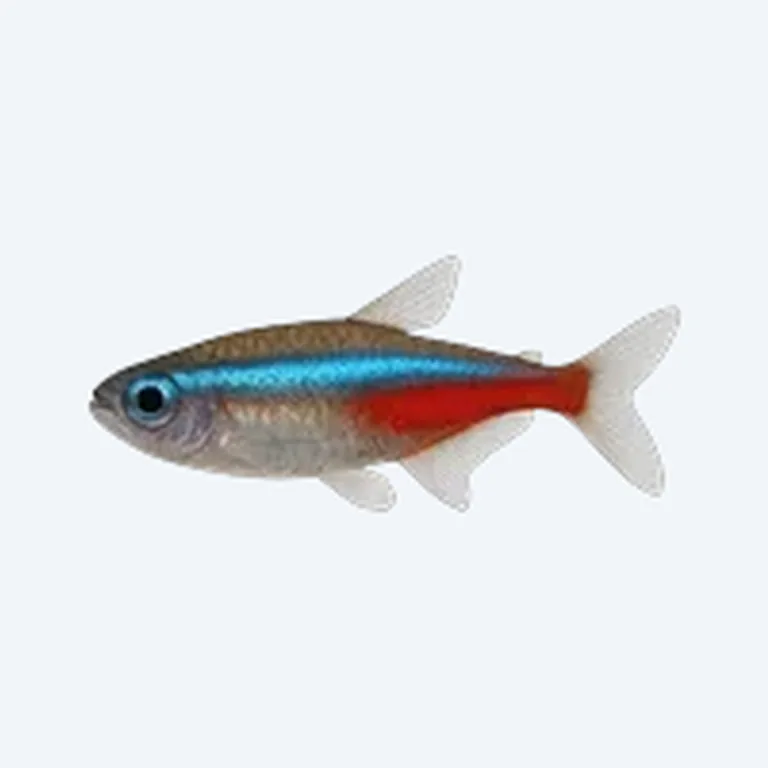
The neon tetra (Paracheirodon innesi) has been the most sold aquarium fish in the world for decades, and that popularity cuts both ways. You can find them everywhere - which means you can also find them raised in cramped wholesale conditions, weakened by stress, and carrying neon tetra disease before they ever reach your local fish store.
When you get healthy neons into a well-cycled, stable tank, they're genuinely rewarding: that iridescent blue stripe and vivid red belly look stunning in a planted aquarium, and a school of twelve moving in sync is one of the hobby's best sights. The problem is getting them to that point.
Water requirements: Neons do best at 20-26°C (68-79°F), pH 6.0-7.0, and soft to moderately hard water (2-10 dGH). They'll survive in slightly harder tap water, but their colours and breeding success suffer. They're tropical fish - don't let the temperature drop below 18°C (64°F).
Neon tetra disease (Pleistophora hyphessobryconis) is a microsporidian parasite with no cure. Affected fish develop white or grey patches that spread inward from the muscle, lose colour, swim erratically, and eventually die. The only management is immediate isolation and euthanasia of infected fish. Buy neons from tanks where every fish looks bright and active, and quarantine for at least two weeks before adding them to your display tank.
Black neon tetra: the better beginner choice
Despite the name, the black neon tetra (Hyphessobrycon herbertaxelrodi) is a completely different genus from the standard neon - it just gets lumped in because of the word "neon" on the label. Visually it's quite different: a silver-white body with a bold black stripe below a narrow iridescent green-gold stripe. Subtler than a neon, but elegant in its own way.
What makes black neons worth serious consideration is their temperament and resilience. They're not immune to disease, but they don't carry the same vulnerability to neon tetra disease, and they handle a wider range of water conditions - pH 6.0-7.5, temperature 22-28°C (72-82°F), up to 15 dGH. That means they're workable in typical unmodified tap water across most of the UK, Europe, and North America without heroic water chemistry adjustment.
They grow to about 3.5-4 cm (1.4-1.6 in), slightly larger than neons, which also makes them a bit more visible in a planted tank with dense foliage. They're peaceful, school tightly, and mix without issue with most community fish.
If you're setting up your first tank and want a tetra, black neons are a more sensible starting point than standard neons. They're less likely to die in your first three months, they tolerate the inevitable early parameter wobbles better, and you won't spend as much time wondering whether that pale patch is disease or just stress. Neons are beautiful - but earn them by getting your tank stable first.
Cardinal tetra: the upgrade for experienced soft-water setups
At first glance, the cardinal tetra (Paracheirodon axelrodi) looks like a neon with better genetics. The blue stripe is the same, but the red extends the full length of the body from gill to tail, rather than just the rear half. They're larger too, reaching 5 cm (2 in), and in numbers they create one of the most visually striking displays in the freshwater hobby.
The catch is water chemistry. Cardinals come from the Rio Negro and its blackwater tributaries in the Amazon basin - water that's soft, warm, and acidic in a way that British or American tap water rarely is naturally. Their optimal range is pH 4.5-6.5, temperature 24-29°C (75-84°F), and very soft water under 6 dGH. You can keep them in slightly harder water (up to 8-9 dGH at a stretch), but they won't colour up fully, their lifespan shortens, and breeding is essentially off the table.
If your tap water is hard - common in southern England, the American Midwest, or anywhere limestone-heavy - you'll need to cut it with RO water or use a dedicated soft-water source before cardinals make sense. That's an ongoing commitment, not a one-time fix.
Cardinals and neons can coexist peacefully in the same tank as long as water parameters fall in the overlap zone - roughly pH 6.0-6.8, 24-26°C (75-79°F), soft to slightly hard. If your tank water sits above pH 7.0 or above 10 dGH, keep neons and skip the cardinals until your setup is dialled in.
Glowlight tetra: the underrated alternative
The glowlight tetra (Hemigrammus erythrozonus) doesn't get the attention it deserves, partly because it's quieter-looking than a neon on a brightly lit shop shelf. In a well-planted tank with slightly subdued lighting, that orange-gold stripe running along the body with a red-tipped nose becomes genuinely striking - especially against green plants.
They're small - around 3-4 cm (1.2-1.6 in) - peaceful, and undemanding. Water requirements: pH 5.8-7.5, temperature 22-28°C (72-82°F), soft to moderately hard. They're more adaptable than cardinals and roughly comparable to neons in terms of robustness. Like all small tetras, they're shy in bare tanks or under harsh lighting - give them some plant cover and they'll reward you by coming out and schooling properly.
One genuine weakness: glowlights can be fin-nipped by more boisterous tankmates, and they're small enough that any fish over 8 cm (3 in) that's even mildly nippy (tiger barbs, serpae tetras) will cause them stress. Stick to genuinely peaceful community fish.
Rummynose tetra: the water quality gauge
The rummynose tetra (Hemigrammus rhodostomus, though you'll also encounter Petitella georgiae sold under the same name) is the most visually distinctive of this group: silver body, vivid red head, and a black-and-white striped tail. They're also the tightest schoolers - in a healthy, stable environment, a group of rummynose moves as a single unit in a way other tetras simply don't match.
That tight schooling behaviour is directly tied to their sensitivity. Rummynose are more demanding than neons or black neons - they need stable, clean water (pH 6.0-7.0, 24-28°C / 75-82°F, low nitrates under 20 ppm) and they react visibly when things go wrong. The red on the nose fades to pale pink or white when ammonia or nitrate spike, when the tank is newly cycled, or when the fish are stressed. It recovers when conditions improve.
This makes them an excellent choice for experienced keepers who want a living parameter check - but a poor choice for anyone still struggling with cycling or water changes. Get your tank stable first. Use App-aquatic to log your test results over a few weeks and confirm you're holding steady before adding rummynose.
Above this level, nose colour noticeably fades. Many community tanks run at 40-80 ppm without regular water changes - rummynose will look washed out and stressed in those conditions.
Mixing tetra species: what actually works
You can keep multiple tetra species in the same tank - the hobby does it all the time, and it works well. There are a few practical rules that separate the setups that thrive from the ones that don't.
Tank size and group size
The most common mistake is keeping too few of each species in too small a tank. Tetras shoal for security - below six, they're chronically stressed, hide more, and often lose colour. In a 30-gallon (114 L) tank you can comfortably keep two species at eight to ten fish each. In a 55-gallon (208 L) and up, three or four species becomes practical. Use the free stocking calculator to check bioload before committing.
Water parameter overlap
Every species in a mixed tank lives in the same water, so their requirements need to overlap. Neons, black neons, and glowlights all work together across a wide range. Adding cardinals means your whole tank needs to run at pH 6.0-6.5 and soft water - if you can't maintain that, don't add cardinals just because they look good with neons. Rummynose can share water with any of the above as long as nitrates stay controlled.
Size and temperament matching
All five species covered here are peaceful, but size disparity matters when choosing other tankmates. Neons and glowlights are small enough (under 4 cm) to be harassed or eaten by any fish over 8-10 cm that has a wide mouth or nippy temperament. Angels (Pterophyllum scalare) are a classic pairing with larger tetras - but adult angels will eat neons. Rummynose and cardinals at 4-5 cm fare better with angels than neons do.
Buying three neons, three black neons, and three glowlights to "have variety" in a small tank. You end up with nine stressed, underperforming fish instead of three confident, properly schooling groups. Pick two species and buy six or more of each - the visual impact is dramatically better, and the fish are healthier for it.
What most guides miss
Nearly every tetra guide focuses on water parameters and stops there. A few things that actually make a difference in practice:
Lighting matters more than most people admit. All five of these species come from shaded forest streams. Bright, direct light without plant cover makes them nervous and washes out their colour. A well-planted tank or one with floating plants to diffuse surface light produces noticeably better colour and more confident behaviour.
Current and oxygenation. These are active, riverine fish. A gentle flow - not a hurricane, but not a stagnant pond either - keeps them comfortable. Avoid deadspots in larger tanks where waste accumulates.
Quarantine is non-negotiable. The risk of introducing neon tetra disease, ich, or columnaris from an unchecked batch of fish is real. Two weeks in a separate tank costs very little and has saved countless display tanks. See our guide on how to cycle a fish tank if you're setting up a quarantine tank for the first time.
Feed variety. Dry flake is fine as a base, but small tetras genuinely thrive with regular small frozen or live foods - daphnia, micro worms, baby brine shrimp. Colour, breeding condition, and immune function all improve. A few feedings a week of live or frozen food makes a real difference over months.
For a full breakdown of what parameters to target and how to interpret your test results, see our aquarium water parameters guide and the companion piece on how often to do water changes.
Track your parameters and get care reminders with App-aquatic.
Get the free appCan neon tetras and black neon tetras school together?
They'll often loosely associate, especially in smaller tanks, but they're different species and don't form a true unified school. You'll usually see each group gravitating toward its own cluster. That's fine - it's not stress, just species preference. Keep at least six of each for the best results.
Why are my rummynose tetras losing their red colour?
Almost always water quality. Test for ammonia, nitrite, and nitrate - elevated nitrate (above 20 ppm) is the most common culprit in established tanks. Stress from new tankmates, transport, or a recent parameter shift will also cause temporary fading. If water tests clean and the fish are eating normally, colour usually recovers within a week or two.
Are cardinal tetras really that much harder than neons?
In soft, acidic water - no, they're comparable. The difficulty is entirely about water chemistry. If your tap water is hard (above 10 dGH) and you're not willing to use RO water to soften it, cardinals are genuinely harder to keep long-term. In a properly set-up soft-water tank, they're straightforward.
What fish can I keep with small tetras like neons and glowlights?
Corydoras catfish, dwarf cichlids like Apistogramma species (with care), small rasboras, peaceful loaches like kuhlis, and otocinclus all work well. Avoid tiger barbs, serpae tetras, and any cichlid large enough to view a 3 cm fish as a snack. If you're planning a community, run your stock list through the stocking calculator first.
More guides · Neon vs cardinal · Neons with betta · Combining fish · App features