
Guide
Siamese algae eaters, black beard algae, and what they do to other algae
The true Siamese algae eater is a hardworking grazer - and one of the few fish with a real appetite for some black beard algae. It is still not a substitute for fixing light, CO2, and nutrients, and it is easy to buy the wrong species by mistake.
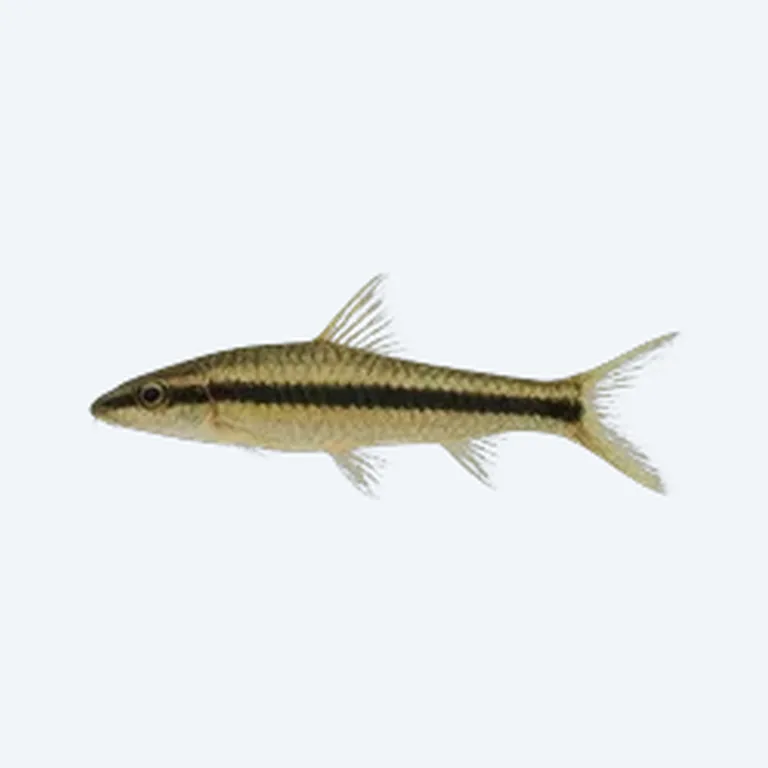
- BBA and young growth: True Siamese algae eaters (Crossocheilus spp.) will graze soft, new black beard algae and help prevent it returning - but they cannot clear an established mat on their own. Fix the root cause first.
- ID is everything: Most fish sold as "Siamese algae eater" are not. Chinese algae eaters (Gyrinocheilus aymonieri) and flying fox types are commonly mislabelled and behave very differently as adults.
- They are not a cleanup crew: True SAEs browse biofilm, soft algae, and some thread algae opportunistically - they will ignore plenty of species entirely.
- Plan for 15 cm (6 in) adults: These are active, fast-growing fish that need space, strong flow, and company. A single SAE in a 40-litre nano is a bad idea.
- Black beard algae needs more than fish: Inconsistent CO₂, low flow, and unbalanced nutrients cause BBA. SAEs support recovery - they do not replace parameter work.
- Adults become less interested in algae: As SAEs mature past 8-10 cm, they shift toward a more omnivorous diet. Juvenile enthusiasm for algae does not last forever.
Which fish is the actual Siamese algae eater?
This is where most fishkeepers go wrong before they even get home from the shop. The name "Siamese algae eater" gets applied to several completely different fish, and the one you actually want - a true Crossocheilus - is often not the one in the tank.
The fish most reliably identified as true Siamese algae eaters belong to the genus Crossocheilus, most commonly Crossocheilus oblongus and closely related species. Look for:
- A continuous dark lateral stripe running from the tip of the snout to the base of the tail - and crucially, it extends onto the tail fin lobes, which most lookalikes do not have.
- A slightly ragged or irregular upper edge to the stripe, not a clean geometric line.
- A streamlined, torpedo-shaped body with a small, fleshy barbel at the corner of the mouth.
- A semi-transparent lower lobe to the tail and generally muted, non-iridescent colouration.
Juveniles show bolder contrast - nearly black-and-white - that softens into the adult pattern around 5-7 cm.
The Chinese algae eater (Gyrinocheilus aymonieri) is sold alongside true SAEs in most shops. Young specimens do eat algae, but adults - which reach 25-28 cm - switch to a largely omnivorous diet, become territorial, and are known to rasp the slime coats off flat-bodied fish like discus, angelfish, and large cichlids. They are not an equivalent substitute.
The flying fox (Epalzeorhynchus kalopterus) is another common mix-up. It has a cleaner, more defined black stripe and a vivid gold stripe above it. Adults become territorial and eat far less algae than a true SAE. The Siamese flying fox (Crossocheilus siamensis) is closer to the real thing and sometimes what you actually get - it does eat BBA - but even here, species sold under that name are inconsistently identified in the trade.
When buying, bring a reference photo from a reputable source and compare the tail stripe specifically. If the stripe stops at the body and does not bleed into the caudal fin, walk away.
Black beard algae: what SAEs actually do
Black beard algae - BBA, Audouinella sp., sometimes called brush algae - is a red algae despite its near-black colour. It anchors to wood, slow-flow corners, plant leaves, and filter intake edges, and it is notoriously resistant because it grows where conditions are already suboptimal. Once it matures into dense, wiry tufts, it is tough.
True SAEs are genuinely useful against BBA, but with a specific and limited brief:
- Young, soft growth: SAEs actively graze the early, fuzzy stage of BBA before it hardens. This can meaningfully slow an outbreak if you catch it early.
- Post-treatment maintenance: After you have manually removed mature BBA and corrected your CO₂, flow, and nutrients, SAEs help prevent re-establishment by picking off new growth before it gets a foothold.
- Established mats: They will nibble around the edges but will not strip a thick BBA carpet. Do not expect them to fix an existing problem.
The BBA reputation of Siamese algae eaters is partly real and partly overstated by the trade because they are a fish people want to buy. They work best as part of a solution - not as the solution. If your CO₂ is inconsistent, your flow has dead spots, or your photoperiod is too long, SAEs will slow the problem marginally at best. Fix the tank first; then the fish help.
For a full breakdown of what actually drives BBA and how to clear it, see our aquarium water parameters guide - specifically the sections on CO₂, phosphate, and circulation balance.
What else do they eat?
True SAEs are opportunistic grazers, not specialists. Their diet in a tank includes:
- Biofilm and microalgae coating glass, rocks, and wood - they are consistently good at this.
- Soft filamentous algae - green thread algae, hair algae in early stages, and similar fine-textured growth.
- BBA - as described above, with caveats.
- Prepared food - they will eat sinking wafers, algae tabs, and most foods that reach the bottom. They compete actively at feeding time.
They do not reliably eat staghorn algae, green spot algae on glass, or cyanobacteria (which is not a true algae anyway). They also ignore green water. If your tank has a specific algae problem, check which species you are dealing with before buying fish on the assumption they will fix it.
Buying SAEs specifically to control green spot algae on glass. They are not the right tool for that - nerite snails (Neritina spp.) are far more effective on hard, smooth surfaces. Most people who buy SAEs for green spot algae end up disappointed and have a large, food-competing fish they did not plan for.
Tank requirements
Size and flow
SAEs are native to fast-moving Southeast Asian rivers - Thailand, the Malay Peninsula - and they need good water movement. A sluggish, heavily planted tank with a gentle internal filter is not a great match. They do best with:
- Tank size: 120 litres (30 US gallons) absolute minimum for a small group of adults. Bigger is better - these fish cover ground quickly.
- Flow: Moderate to strong. A turnover of 8-10× the tank volume per hour suits them. They will actively swim against a current.
- Length over height: A long, shallow tank serves them better than a tall display tank. They are horizontal swimmers.
True SAEs reach around 14-16 cm (5.5-6.3 in). Most are sold at 3-5 cm - the difference matters for long-term planning.
Water parameters
SAEs are reasonably adaptable, but they come from soft, slightly acidic water in the wild. Target:
- Temperature: 24-26 °C (75-79 °F). They tolerate 22-28 °C but are less active at the extremes.
- pH: 6.5-7.5. They handle a slightly wider range but do not push it.
- Hardness: Soft to moderately hard - 2-15 dGH. Avoid very hard, alkaline setups if you can.
- Ammonia/nitrite: Zero, as with any fish. Check your nitrogen cycle is complete before adding them.
Social behaviour and stocking
SAEs are shoaling fish and do better in groups of four or more. Kept alone or in pairs, they can become skittish or mildly aggressive toward similarly shaped tank mates. In a group, they are active, peaceful mid-to-bottom dwellers that work well in most community setups.
They do not play well long-term with very slow, flat-bodied fish if kept hungry - like the Chinese algae eater, a poorly-fed SAE may investigate the slime coat of a discus or a large fancy goldfish. Keep them well fed and this is rarely an issue.
If you are stocking a new tank and want to include SAEs, run your stocking calculator before you buy. A group of five adult SAEs carries a significant bioload - especially if you are also keeping larger fish. Their juvenile size is deceptive.
Feeding
SAEs will eat algae willingly when young, but they also need regular feeding with sinking foods - algae wafers, blanched vegetables, and quality sinking pellets. An underfed SAE becomes a problem fish: more aggressive, more likely to harass tank mates, and - ironically - more destructive toward plants as it starts sampling leaves. Feed once daily minimum, and do not rely on tank algae as their primary food source.
Age and the algae-eating drop-off
This is what most guides skip. SAEs are enthusiastic algae grazers at 3-8 cm. As they approach adulthood - around 10-12 cm - their interest in algae decreases noticeably. Adult SAEs spend more time competing for prepared food and less time methodically grazing surfaces.
This does not make them useless - they still browse and they still help with BBA maintenance - but if you are buying adult-sized fish expecting the same grazing output as juveniles, you will be disappointed. The sweet spot for algae control is the 4-9 cm range. Plan your tank accordingly and do not expect the same fish to do the same job at five years old that it did at one.
Practical BBA management: the honest sequence
If you have a BBA problem and are considering SAEs, here is the actual order of operations:
- Diagnose the cause. BBA almost always comes down to CO₂ fluctuation, low or inconsistent CO₂ in planted tanks, slow flow creating dead spots, or nutrients (usually phosphate) running high. Test your water. See aquarium water parameters for what to check.
- Correct the underlying issue. Stable CO₂ injection, improved circulation, and adjusted nutrient dosing. Without this, nothing else holds.
- Manually remove mature growth. Use a toothbrush, scissors, or spot-treat dense mats with diluted hydrogen peroxide (3% solution, applied directly with a syringe with flow off for 5 minutes, then water change). Remove what you can physically.
- Add SAEs. Now that conditions are improving and mature BBA is reduced, a group of young SAEs will graze regrowth and help hold the line.
- Maintain parameters consistently. Use a tool like App-aquatic to log your CO₂, nitrate, and phosphate readings over time - pattern recognition matters more than any single test result.
Skipping straight to step four without doing the others is why so many people report that "SAEs did nothing for my BBA."
There is genuine debate in the hobby about whether Crossocheilus oblongus versus Crossocheilus siamensis is more effective against BBA - partly because consistent species identification at point of sale is unreliable enough that most keeper accounts are based on fish of uncertain ID. What the evidence does support is that true Crossocheilus fish eat BBA; exactly which species and to what degree varies. Buy from a shop that can show you the fish next to a reference photo, and you are in better shape than most.
Track your parameters and get care reminders with App-aquatic.
Get the free appWill Siamese algae eaters completely eliminate black beard algae?
No. They graze young, soft BBA and slow regrowth after you have fixed the underlying cause - but they will not clear an established mat, and they will not prevent BBA returning if your CO₂ or flow is still the problem. Think of them as maintenance support, not a cure.
How do I tell a true SAE from a Chinese algae eater or flying fox?
The most reliable marker on a true Crossocheilus SAE is the dark lateral stripe extending into the tail fin lobes - most lookalikes stop the stripe at the body. Chinese algae eaters (Gyrinocheilus aymonieri) have a round, sucking mouth and no visible stripe. Flying foxes (Epalzeorhynchus kalopterus) have a clean, sharply defined stripe with a gold band above it. Compare to a species-specific photo before buying.
How many Siamese algae eaters should I keep?
A minimum of four, in a tank of at least 120 litres (30 US gallons). They are shoaling fish and behave better in groups - lone SAEs can be skittish or mildly aggressive. Remember they reach 15 cm as adults, so use a stocking calculator to plan the full bioload before buying.
My SAEs were eating algae when young but seem to have stopped. Is this normal?
Yes - it is one of the most common disappointments with this species. Algae interest drops noticeably as SAEs approach adulthood at around 10-12 cm, and adults spend more time competing for prepared food than grazing surfaces. They still browse and still help with BBA maintenance, just less enthusiastically. Keep feeding them properly - an underfed SAE becomes more aggressive rather than a better algae eater.
All guides · Black beard algae · Algae 101 · Water parameters · Get the app