
Fish care
Tiger Barb: Complete Care Guide
Last updated: May 2026
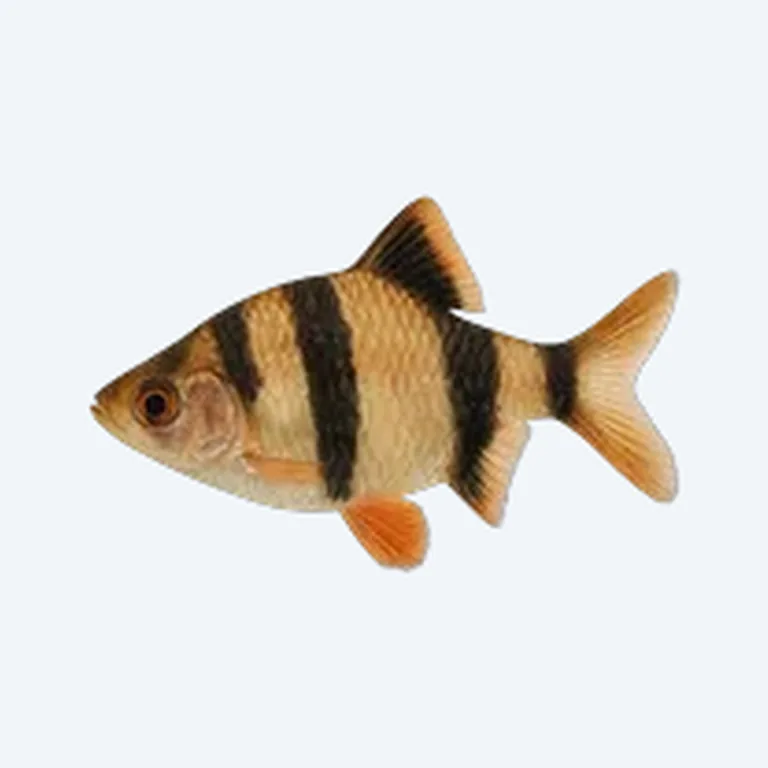
- School size matters more than anything: Keep a minimum of 6, ideally 8-10. Below that, tiger barbs redirect aggression outward and shred your other fish.
- Tank size: 80 L (21 US gal) is the floor for a small group; 120-150 L (32-40 US gal) gives a proper school room to establish hierarchy without constant stress.
- Water: 22-26°C (72-79°F), pH 6.0-7.0, soft to moderately hard. They tolerate a range but do best toward the warmer, slightly acidic end.
- Fin nipping is real but manageable: It's an intraspecies dominance behaviour. A large school in the right tank largely contains it. Put them with long-finned or slow tankmates and you will lose fins.
- Diet: Omnivores that accept almost anything - quality flake, micro pellets, frozen or live daphnia and bloodworm. Variety keeps condition and colour sharp.
- Care level: Intermediate. Not a beginner fish - not because they're fragile, but because their social needs are easy to mismanage.
What tiger barbs actually are
Puntigrus tetrazona originates from the Malay Peninsula, Sumatra, and Borneo - blackwater tributaries and peat swamp streams with soft, acidic, heavily vegetated water. In the wild they school in the hundreds. That context explains almost every mistake people make keeping them: a group of three in a bare 60 L tank is about as far from their natural situation as you can get.
Adults reach around 7-8 cm (2.75-3.1 in). They're stocky, fast, and bold - the four vertical black bars on a gold-orange body are unmistakable. You'll also find colour morphs in shops: the green (moss) barb, the albino, and the platinum. All are the same species and behave identically.
Lifespan in a well-kept tank is 5-7 years. Most people see 3-4 because the fish gets blamed for aggression problems caused by poor stocking, not because the fish is inherently short-lived.
Tank setup
Size and dimensions
The 80 L (21 US gal) minimum is tight - workable for 6 fish, but you'll want to push toward 120 L (32 US gal) if you plan a group of 8-10 or want any meaningful community. Footprint matters more than height: tiger barbs are mid-water swimmers that cover horizontal distance, so a tank 90 cm (36 in) or longer is more useful than a tall 80 L cube.
Filtration and flow
These fish come from flowing water, so they appreciate moderate current. A hang-on-back or canister rated at 5-8× tank volume per hour works well. Make sure the tank is fully cycled before adding any fish - if you're not sure what that means, read the guide on how to cycle a fish tank before you spend money on livestock.
Substrate and planting
Tiger barbs aren't fussy about substrate. Sand or fine gravel both work. Dense planting - java fern, vallisneria, cryptocoryne - serves two functions: it breaks sightlines so dominant fish can't endlessly chase subordinates, and it replicates the structure they'd navigate in the wild. A densely planted tank with open swimming space in the centre is the ideal layout. Floating plants to diffuse light are a bonus.
Water parameters
Target 24-26°C (75-79°F) for best colour and activity. They'll survive cooler - down to 22°C (72°F) - but growth slows and immunity dips. pH of 6.5-7.0 is the practical sweet spot for most tap water setups; they can handle up to 7.5 but there's no benefit in pushing alkalinity. General hardness of 5-15 dGH covers most scenarios.
Regular water testing and consistent water changes matter far more than hitting perfect numbers on day one. See the aquarium water parameters guide for a full breakdown of what you're measuring and why.
Add a handful of dried Indian almond leaves or a small bag of peat to your filter if your tap water runs hard and alkaline. It softens water gently, lowers pH slightly, and releases tannins that bring out the orange in tiger barb colouration.
The schooling and aggression question
This is where tiger barbs get a bad reputation they only partially deserve. Here's what's actually happening: tiger barbs establish a pecking order within the group through chasing, nipping, and posturing. In a school of 6 or more, that energy is mostly absorbed internally - fish establish rank, things settle, and the group functions. Drop below 6 fish and that social structure breaks down. The dominant fish has nowhere productive to direct its energy and starts targeting your angelfish, your guppy, your betta.
Below six, intraspecies hierarchy collapses and fin-nipping redirects to tankmates. Eight to ten is a more comfortable number.
Most people get this wrong by buying three or four tiger barbs because the tank "isn't big enough for more." That logic is backwards. A small group in a small tank is the worst combination. If your tank genuinely can't support 6, it can't support tiger barbs - choose a different species.
Fin nipping isn't random. Tiger barbs specifically target flowing, slow-moving fins. Angelfish, male bettas, veil-tail guppies, fancy goldfish, threadfin rainbows - any fish with long finnage or a slow, drifting swimming style is a target. This isn't a compatibility you can manage your way around with enough plants. Don't mix these species.
Compatible tankmates
Tiger barbs do well with fish that are similarly active, similarly sized, and don't have the triggering finnage. Good choices include:
- Other barbs - cherry barbs, rosy barbs, tinfoil barbs (in larger tanks). They speak the same social language.
- Danios - zebra and giant danios are fast enough to avoid harassment and active enough to hold their own.
- Rainbowfish - Melanotaenia species (not threadfins) work well at similar temperatures.
- Larger tetras - black skirt tetras, Colombian tetras, Buenos Aires tetras. Avoid small or long-finned tetras like neons in a tank with large, boisterous barb groups.
- Bottom dwellers - cory catfish, bristlenose plecos, and khuli loaches occupy a different swim zone and rarely come into conflict.
The principle is simple: fast, robust, short-finned fish with a similar energy level. Check any proposed combination against your full stocking list using the free stocking calculator before buying.
You'll find forum threads claiming someone successfully keeps tiger barbs with a betta or angelfish long-term. It happens occasionally - a mellow individual, a very large tank, a heavily planted setup. But it's the exception, not something to plan around. If you're asking "can I try it?", the honest answer is: you might get lucky, but you're gambling with your other fish's fins and stress levels. Design for the likely outcome, not the best-case one.
Feeding
Tiger barbs are enthusiastic, unfussy eaters. A quality omnivore flake or micro pellet covers the daily baseline. Where most people underdeliver is variety - these fish genuinely benefit from regular protein sources. Frozen bloodworm, daphnia, and brine shrimp two or three times a week improve condition, intensify colour, and seem to reduce intragroup aggression (a well-fed fish is less edgy than a hungry one).
Feed small amounts twice daily rather than one large feeding. They're fast and competitive at the surface - watch that all fish are getting food, not just the dominant individuals. Sinking pellets or bottom-targeted feeding helps ensure corys and loaches in the same tank aren't going hungry.
Overfeeding is the fastest route to poor water quality with tiger barbs, because they eat aggressively and it's easy to keep adding food. Anything uneaten after two minutes is too much. Excess food breaks down into ammonia and drives the exact water quality problems that suppress immune function and shorten lifespan. Stay on top of water changes - weekly 25-30% is a reasonable baseline for a stocked community tank.
Health and disease
Tiger barbs are hardy once established in a cycled, stable tank. The problems you'll encounter are almost always linked to water quality or stress from poor social dynamics - not to the species being inherently delicate.
What to watch for
Ich (Ichthyophthirius multifiliis) - white salt-grain spots across the body and fins. Triggered by temperature stress or introduction of infected fish. Raise temperature to 28°C (82°F) gradually and treat with a standard ich medication. Quarantine new fish for 2-4 weeks before introducing them to your display tank.
Fin rot - ragged, receding fin edges, often with a whitish border. Usually bacterial, usually triggered by poor water quality or the stress of being housed in too small a group with constant harassment. Fix water conditions first, then treat if it doesn't resolve.
Velvet (Oodinium) - gold or rust-coloured dusty coating, sometimes only visible under a torch. More insidious than ich. Treat promptly with a copper-based medication, keep the tank dark during treatment.
Understanding what's happening in your tank's biological cycle - particularly ammonia and nitrite spikes - is the foundation of disease prevention. Read the nitrogen cycle explained if you're still fuzzy on why new tanks go through a crash period.
Breeding
Tiger barbs breed readily in captivity once you have a conditioned male-female pair. Males are slimmer with more intensely red noses and fins; females are rounder when carrying eggs. They're egg scatterers with no parental care - in fact, they'll eat their own eggs immediately if given the chance.
To breed deliberately: set up a separate 40-60 L (10-15 US gal) tank with a mesh or pebble bottom layer (so eggs fall out of reach), raise temperature to 26-27°C (79-81°F), and condition the pair on live or frozen food for a week. Introduce them to the breeding tank in the evening. Spawning usually happens in the morning. Remove the adults immediately after spawning is complete. Eggs hatch in 24-36 hours; fry are free-swimming within a few days and will take microworms or newly hatched brine shrimp.
Is this the right fish for you?
Tiger barbs are genuinely rewarding - a large school in a well-planned tank is one of the most dynamic displays in freshwater fishkeeping. The activity level, the sparring, the colour, the personality - it's compelling. But they require you to plan the tank around them, not slot them into an existing community and hope for the best.
If you're new to the hobby and looking for an easier starting point, check the best fish for beginners - there are species that forgive more mistakes while you build experience. If you're ready for tiger barbs, go in with a school of 8, a tank of at least 100 L (26 US gal), and tankmates you've actually researched rather than assumed will be fine.
Track your parameters and get care reminders with App-aquatic.
Get the free appHow many tiger barbs should I keep together?
A minimum of 6, with 8-10 being significantly better. The school size directly controls whether aggression stays internal (fish sorting out their own hierarchy) or gets redirected at other species. Three or four tiger barbs is the worst configuration you can choose.
Can tiger barbs live with bettas?
It's not recommended. Bettas have long, flowing fins that trigger fin-nipping, and bettas are slow swimmers that can't evade a fast-moving barb group. Some people report it working short-term in large, heavily planted tanks, but the risk to the betta's fins and stress levels is real. There are better tankmate options for both species.
Why are my tiger barbs chasing and nipping each other?
This is normal dominance behaviour within the group, not a problem that needs fixing. Tiger barbs establish a pecking order through chasing and occasional nipping. As long as no single fish is being cornered continuously or losing significant fin tissue, this is just how tiger barbs communicate. If one fish is being relentlessly targeted, check group size - you probably need more fish to distribute the social pressure.
What's the difference between tiger barbs and green tiger barbs?
Green (moss) barbs are a colour morph of the same species, Puntigrus tetrazona. They have a dark iridescent green overlay instead of the classic orange-gold body. Behaviour, care requirements, temperament, and size are identical. You can mix morphs in the same group - they school together without issue.
My tiger barbs keep dying - what am I doing wrong?
The most common causes are an uncycled tank (ammonia and nitrite poisoning), water temperature swings, or stress from being kept in too small a group. Check your ammonia, nitrite, and nitrate levels first - if ammonia or nitrite reads anything above zero in an established tank, that's your answer. If water quality is fine, look at group dynamics and stocking density. Tiger barbs that are constantly stressed by social pressure or incompatible tankmates have suppressed immune systems and become disease-prone.