Guide
Good setups for a 50 litre tank
50 litres is about 13 US gallons - a compact footprint that suits nano schooling fish, a single centrepiece, or a small community. Use our stocking calculator to test combinations.
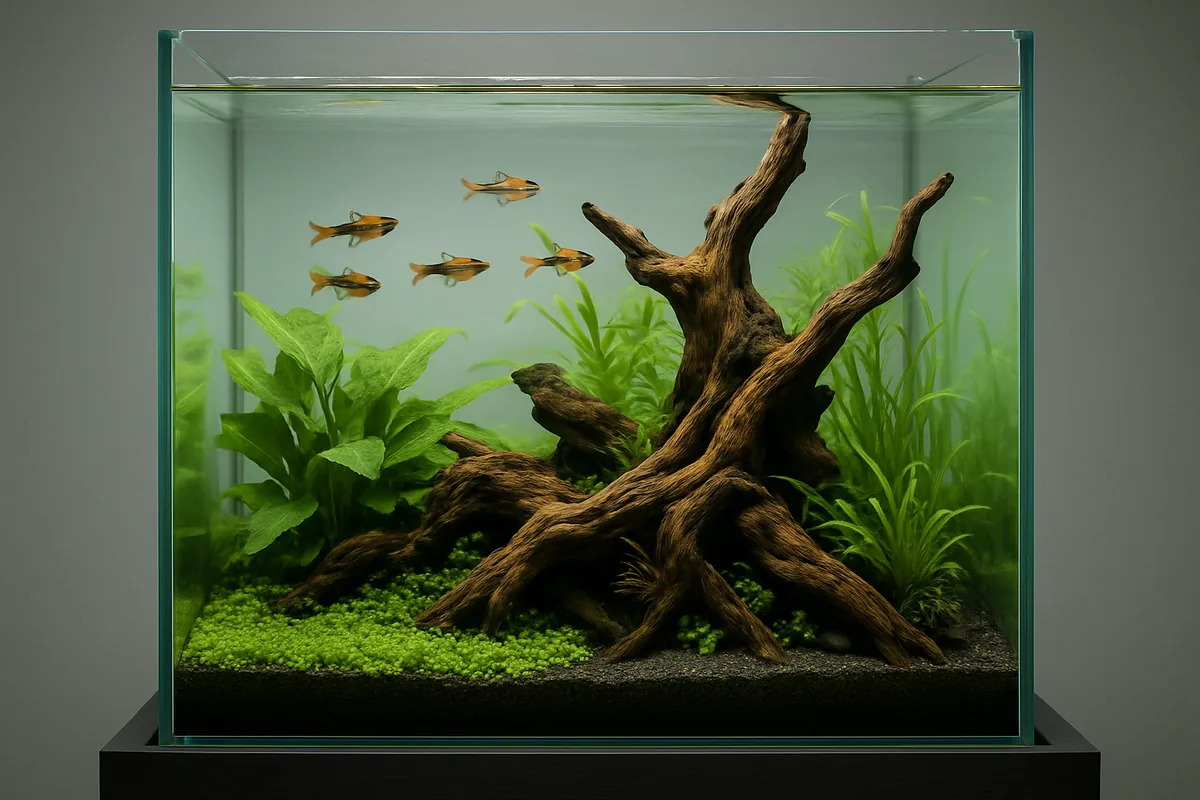
- Three setups work well: a light community (small school + bottom dwellers), a centrepiece fish with supporting cast, or a nano-only shrimp/micro-fish tank.
- Stick to small species: nothing that grows beyond 4-5 cm (1.5-2 in) as an adult, or you'll be fighting bioload and territory problems constantly.
- Cycle before you stock: 50 litres has very little buffer - ammonia spikes fast and kills fish faster. Cycling properly isn't optional.
- Water changes matter more here: small volumes dilute waste less efficiently than larger tanks. Weekly 20-30% changes are the baseline.
- Hard no's: cichlids, goldfish, large livebearers (mollies, swordtails), and anything labelled "grows to 15 cm" at the fish store.
- Roughly 13 US gallons: enough for a genuinely attractive, low-stress setup - just not a community of ten different species.
What a 50 litre tank actually gives you
Fifty litres sounds generous until you subtract the substrate, hardscape, and equipment. Your actual water volume is probably closer to 40-44 litres. That's not a criticism of the size - it's a useful tank - but it shapes every stocking decision you make.
The footprint on a typical 50 litre tank runs around 60 × 30 cm (24 × 12 in), occasionally wider. That horizontal space matters more than the volume number for fish that swim mid-water or along the bottom. A longer, shallower 50 litre beats a tall, narrow one almost every time for livestock welfare.
Temperature stability is your other constraint. Smaller volumes swing faster when a heater sticks, a window lets in cold air, or summer heat pushes your room temperature up. A reliable 50-100W adjustable heater (not a preset "tropical" stick) and a thermometer you actually check weekly are non-negotiable.
Most nano fish guides dramatically underestimate how quickly a 50 litre tank goes wrong. One missed water change, a slight overfeeding habit, or a single fish death you don't notice for two days can crash your parameters before you've had time to react. This isn't a low-effort tank - it rewards attentive keepers who test regularly.
Setup 1: the light community
This is the most popular approach, and when done with restraint it works beautifully. The idea is a small school of mid-water fish, a bottom-dwelling cleanup crew, and nothing else pushing the bioload.
A proven combination
Six Hyphessobrycon amandae (ember tetras) or six Boraras brigittae (chili rasboras) as your main school. Both stay under 2 cm, are genuinely peaceful, and look spectacular in planted tanks. Add four to six Corydoras pygmaeus or Corydoras habrosus (pygmy or salt-and-pepper corydoras) for the bottom - these are true schooling corys that swim actively rather than just sitting on the substrate. Optionally, one Trichogaster chuna (honey gourami) as a centrepiece. That's your tank. Done.
Six ember tetras or chili rasboras, six pygmy corydoras, one honey gourami - this is close to the ceiling for a well-maintained 50 litre.
Water parameters for this community
Ember tetras, chili rasboras, and honey gouramis all originate from soft, slightly acidic water. Aim for pH 6.5-7.2, hardness 2-10 dGH, and temperature 24-28°C (75-82°F). Pygmy corys share similar preferences. This is an unusually compatible group - no one is compromising to fit the others.
Mixing fish with significantly different water requirements in a 50 litre tank. You can't run pH 6.5 for South American tetras and pH 7.5+ for livebearers in the same small volume - one group will always be stressed. Pick a region and stick to it.
What most guides miss about corydoras in small tanks
Pygmy corys are not the same as standard Corydoras aeneus or Corydoras paleatus. Full-size corys reach 5-7 cm and produce significantly more waste. In 50 litres, two or three standard corys eat into your bioload budget fast. Pygmy species top out at 2.5-3 cm and stay active in the water column, not just the substrate - they're a genuinely different fish in terms of behaviour and tank impact.
Setup 2: centrepiece fish with supporting cast
If you want one fish to be the clear focal point, build the tank around it. The centrepiece gets the space and personality; the school adds movement and fills the tank visually without competing for dominance.
Betta with small rasboras
A single male Betta splendens with six Boraras brigittae (chili rasboras) or six Trigonostigma espei (lambchop rasboras) works well in a planted 50 litre. The rasboras are small enough not to trigger fin-nipping behaviour and fast enough to avoid the betta entirely if he does posture. Add four pygmy corys and you have a complete, visually striking tank.
The key variable is the individual betta's temperament. Some males ignore tank mates completely; others are relentlessly aggressive. If you're buying a betta specifically for a community setup, look for fish that aren't already flaring constantly at their own reflection in the store cup.
Add the betta last. Let the rasboras and corydoras establish themselves for two to three weeks first. A betta introduced to an already-active tank is less likely to behave territorially than one that's been the sole resident for months.
Dwarf gourami alternative
A single male Trichogaster lalius (dwarf gourami) with six Paracheirodon innesi (neon tetras) and four pygmy corydoras is a reliable, colourful combination - but the temperature window is narrower than it looks. The gourami wants 24-28°C (75-82°F) and neon tetras are a 20-26°C (68-79°F) fish, so run the tank at 24-26°C (75-79°F) and no warmer; pygmy corys are comfortable there too. If you want the tank at the top of the gourami's range, swap the neons for cardinal tetras (Paracheirodon axelrodi), which thrive at 26-30°C (79-86°F). pH 6.5-7.5 suits all of them. The honest caveat on dwarf gouramis: the hobby has a known problem with Dwarf Gourami Iridovirus (DGIV), a fatal disease with no treatment. Wild-caught fish have lower incidence rates than farmed stock. Buy from reputable suppliers, quarantine new fish for three to four weeks, and don't buy a fish that looks lethargic or discoloured in the store.
Two male bettas or two male dwarf gouramis in the same 50 litre will fight. There isn't enough territory to separate them at this volume. One male per tank, no exceptions.
Setup 3: nano-only
This is the underrated option. A shrimp-and-snail tank, or a single species micro-fish setup, often looks more deliberate and polished than a mixed community - and it's far easier to maintain.
Neocaridina shrimp colony
Neocaridina davidi - cherry shrimp, blue velvet, yellow neocaridina, etc. - thrive in 50 litres. Start with 10-15 shrimp and they'll breed to a self-regulating colony over a few months. They tolerate a wider pH range (6.8-7.8) than many fish and do well in moderately hard water, which makes them adaptable to most UK and US tap water. Add a nerite snail or two for algae control. That's a complete, interesting tank with almost no bioload.
Neocaridina shrimp should not be kept with most fish - even "shrimp-safe" species will eat juveniles. If you want shrimp in a community, the only genuinely safe option is the chili rasbora, which is too small to take adult shrimp but will eat newly hatched shrimplets anyway. A species-only shrimp tank is cleaner and more successful.
Single-species micro-fish
A school of 12-15 Danio margaritatus (celestial pearl danios) in a well-planted 50 litre is one of the most visually impressive nano setups available. These fish reach only 2.5 cm, have extraordinary colouration, and show interesting spawning behaviour. They prefer slightly cooler water than most tropicals - 22-26°C (72-79°F) - which means you can often run them without a heater in a room-temperature home during summer, or with a low-wattage heater in winter.
Alternatively, a school of 12-15 ember tetras with heavy planting and no other species is remarkably striking. The fish display more natural behaviour - including actual shoaling movement - when they're not competing for space with other species.
Cooler than most tropicals - don't keep them at the 28°C you'd run for bettas or discus.
What to avoid in a 50 litre
Some of these are obvious; a few aren't.
Cichlids: even so-called "dwarf" cichlids like Apistogramma species can work in 50 litres, but only as a single pair with no other bottom dwellers and expert-level water management. German blue rams (Mikrogeophagus ramirezi) need very warm, very soft water (27-30°C, pH 5.5-6.5) and are sensitive to any parameter fluctuation - exactly the conditions a small tank struggles to maintain. These are not beginner fish in any tank size.
Goldfish: a single fancy goldfish needs a minimum of 100-150 litres with strong filtration. They produce enormous amounts of ammonia relative to their size. In 50 litres, a goldfish will stunt, develop health problems, and die early. This is one of the most common and damaging beginner mistakes in the hobby.
Large livebearers: mollies reach 8-10 cm and are heavy waste producers. Swordtails similarly. Platies are borderline acceptable in a 50 litre but they breed prolifically and the fry quickly overcrowd a small tank. If you want livebearers, endlers (Poecilia wingei) are genuinely nano-appropriate at 2-3 cm for males.
Any fish labelled "grows to X" at the store where X is over 5 cm: fish grow to their adult size regardless of tank volume. Stunting is stress and organ compression, not a management strategy.
The stocking calculator is a useful sanity check, but no calculator replaces understanding your specific fish's waste output, territory needs, and behaviour. Numbers help; they don't decide for you.
Filtration, cycling, and maintenance
A sponge filter or hang-on-back rated for slightly above your tank volume (look for 50-80 litre ratings) works well. Avoid powerful canister filters in a 50 litre - they generate too much flow for small fish and shrimp. If you use a hang-on-back, cover the intake with a fine sponge pre-filter to protect shrimp and fry.
Cycling is not optional. A new tank has no beneficial bacteria to process ammonia from fish waste. Running fish in an uncycled tank exposes them to toxic ammonia and nitrite. A fish-in cycle is possible but stressful on livestock; a fishless cycle with pure ammonia takes three to six weeks and is cleaner. Full details in our guide on the nitrogen cycle and how to cycle your tank.
For water changes, 20-30% weekly is the minimum for a stocked 50 litre. If you're running a heavier bioload or feeding heavily, twice weekly smaller changes are better than one large one. The goal is keeping nitrates below 20-25 ppm between changes - test to verify, don't assume. More detail on frequency in our water change guide.
Track your test results somewhere. A log you don't keep is a log that can't warn you when nitrates creep up over three months. App-aquatic lets you log water tests, set change reminders, and track parameters over time - useful for spotting slow trends that individual readings miss.
Do your water change and your water test at the same time each week - but test before the change, not after. Pre-change readings show you the actual peak levels your fish are living in, which is the number that matters.
Track your parameters and get care reminders with App-aquatic.
Get the free appHow many fish can I keep in a 50 litre tank?
There's no clean formula, but a practical ceiling for nano fish (under 3 cm adult size) in a well-maintained 50 litre is roughly 15-20 small fish, or fewer if you include a centrepiece species. The old "1 cm per litre" rule is meaningless - it treats a 10 cm goldfish the same as ten 1 cm rasboras, which is absurd. Use a stocking calculator and factor in adult size, waste output, and territory needs.
Can I keep a betta in a 50 litre tank?
Yes - a 50 litre is actually a comfortable size for a single betta, better than the cramped 20-litre "betta tanks" often sold at pet stores. A heavily planted 50 litre with a gentle filter and temperature held at 26-28°C (79-82°F) suits a betta well. You can add small, fast-moving companions like chili rasboras or pygmy corydoras, but avoid nippy or long-finned species and keep only one male betta. Add the betta last, and be ready to separate him if he turns out to be one of the aggressive individuals.
Stocking calculator · 30 litre setups · 60 litre setups · 100 litre setups · More guides · Get the app