Guide
Good setups for a 60 litre tank
60 litres (~16 US gallons) is a common starter size. Enough room for a proper school and a centrepiece, but still tight - plan carefully with a stocking calculator.
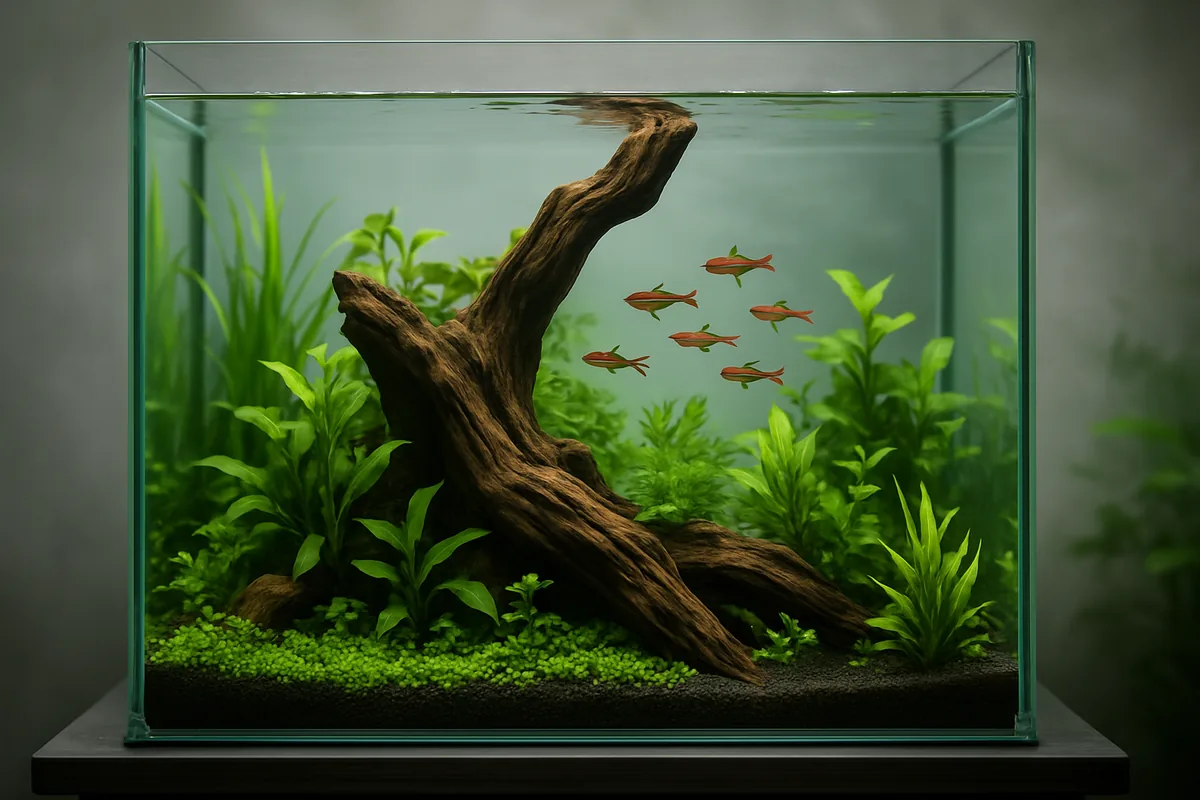
- Footprint matters more than volume: most 60-litre tanks measure roughly 60 × 30 cm, which limits swimming lanes - choose fish accordingly, not just by litre count.
- Two schools plus bottom crew is the reliable formula: six nano or small tetras, six rasboras or danios, six pygmy corydoras. That's a full, balanced tank.
- Centrepiece route: one betta or pair of dwarf gouramis, eight small schooling fish, six corys - works well if you plan compatibility first.
- Schools below six are a welfare issue: shoaling fish kept in groups of three or four are chronically stressed, show faded colour, and often hide constantly.
- Cycle the tank before any fish go in - a 60-litre can spike to toxic ammonia levels within 24 hours of adding fish to an uncycled tank.
- Livebearers breed fast: six guppies become thirty in two months. Have a plan before you stock them.
What a 60-litre tank actually gives you
Sixty litres is roughly 16 US gallons. It's one of the most popular tank sizes sold in Europe - often sold as a starter kit - and it genuinely is a capable little aquarium, but only if you stock it with fish that suit the dimensions rather than just the volume.
Most 60-litre tanks ship in a 60 × 30 × 35 cm footprint. That 60 cm length is your main constraint. A fish that needs open swimming space - anything above 5-6 cm as an adult - will feel cramped. What the tank does well is depth for plants and height for midwater schooling fish. Lean into that.
The other thing to understand is how little buffer a small tank has. A 300-litre tank dilutes a missed water change or a small overfeeding event. A 60-litre doesn't. Ammonia and nitrates climb fast, temperature swings faster, and one overstocked month can set a cycle back significantly. That's not a reason to avoid the size - it's a reason to take the maintenance seriously.
Pet shops will sometimes suggest fish that are technically "small" but are still wrong for a 60-litre - tiger barbs, serpae tetras, or any single species that needs a large group to control aggression. The inch-per-litre rule is also useless: a 6 cm adult rainbow fish creates far more bioload and needs far more swimming space than six 2 cm neon tetras. Stock by species requirements, not arithmetic.
The community setup: two schools and a bottom crew
This is the most reliable approach for a 60-litre and the one most experienced fishkeepers would recommend to someone starting out. It layers the tank vertically - activity in the midwater column, movement along the substrate - and gives you enough visual interest without pushing the bioload.
A proven stocking list
Six Paracheirodon innesi (neon tetras) or P. axelrodi (cardinal tetras) as your primary school. Six Trigonostigma heteromorpha (harlequin rasboras) or six ember tetras (Hyphessobrycon amandae) as your second school. Six Corydoras habrosus or C. pygmaeus (pygmy corys) on the bottom. That's your tank - 18 fish, all under 4 cm, all occupying different zones, all suited to similar soft, slightly acidic water.
If you want a focal point without changing the water requirements, add a single honey gourami (Trichogaster chuna) or a pair. They're peaceful, stay under 6 cm, and tolerate the same water conditions as tetras and corys. Avoid the common dwarf gourami (Trichogaster lalius) from most shops - the commercial strain is plagued with Iridovirus and many specimens are already sick when sold.
Shoaling species like tetras and rasboras show natural behaviour, better colour, and lower stress only when kept in groups of six or more - three or four is not a compromise, it's a welfare problem.
Water parameters for this community
Target pH 6.5-7.2, temperature 24-26 °C (75-79 °F), GH 4-10 dGH. Neons and cardinals both prefer the softer end of that range; cardinals specifically want pH closer to 6.0-6.8 and dislike hard water. Corydoras habrosus share similar soft-water preferences. If your tap water runs hard (above 15 dGH) and alkaline, the community tetra setup is harder to maintain - consider a livebearer setup instead, which actually prefers harder water.
Run a sponge filter or a hang-on-back rated for 80-100 litres in a 60-litre tank. Corydoras are sensitive to low oxygen and poor flow, and undersized filtration is one of the most common reasons they decline slowly over months. Over-filtering a small tank costs you nothing; under-filtering costs you fish.
The centrepiece setup
If you want one fish to be the obvious star of the tank, structure the stocking around it rather than crowding the tank with equal-sized groups.
Betta as centrepiece
A single male betta (Betta splendens) with eight ember tetras or eight cardinal tetras and six pygmy corys works consistently well. The betta occupies the upper zone and provides the colour; the tetras fill the midwater; the corys handle the bottom. Keep the tank well-planted - floating plants like frogbit or Amazon frogbit slow the betta down and give the tetras some surface cover when he's in a mood.
The compatibility debate around bettas and tetras is real. Most bettas ignore small, fast, non-nippy tetras. The risk is with fin-nipping species - avoid serpae tetras, tiger barbs, or any tetra with a history of nipping. Ember tetras and cardinals are low-risk. Watch for the first two weeks and be ready to separate if needed.
Temperature for this combination: 25-27 °C (77-81 °F). Bettas prefer warmer water than neons, which is one reason cardinal tetras are a better pairing - they tolerate 26-28 °C more comfortably than neons do.
Dwarf cichlids as centrepiece
A pair of Apistogramma cacatuoides or Mikrogeophagus ramirezi (German blue ram) can work in a 60-litre, but this is an intermediate setup, not a beginner one. Rams want temperatures of 27-30 °C (81-86 °F) and pH 5.5-7.0. They're sensitive to water quality and will show signs of stress - hiding, faded colour, fin clamping - within days of a parameter shift. If you go this route, keep the 60-litre species-only or add only very small, peaceful dithers like eight ember tetras. Skip the corys at those temperatures - most corydoras prefer cooler water below 26 °C.
German blue rams sold in most shops have been commercially bred at high temperatures with hormone treatments to accelerate colour. Many are weakened before you buy them. Source from a reputable breeder if you can, and quarantine for at least three weeks before adding them to an established tank.
The livebearer setup
If your tap water is hard and alkaline - pH 7.4-8.2, GH above 15 dGH - stop fighting it with softened water for tetras and use fish that love those conditions instead. Livebearers are built for it.
Six guppies (Poecilia reticulata), six platies (Xiphophorus maculatus), and six Corydoras aeneus or C. sterbai work well together and suit the harder water range. Add a few nerite snails to clean algae without adding bioload. Keep the ratio of males to females at 1:2 minimum for guppies and platies - males will harass females to death if they outnumber them.
People buy two male and two female guppies thinking it's a manageable number. Within six weeks they have thirty fish. Livebearers breed in the tank whether you plan for it or not - females can store sperm from a single mating for months. Either keep males only, or have a clear plan for what happens to the fry. A 60-litre cannot absorb population growth for long.
What won't work in 60 litres
Some fish get suggested for 60-litre tanks online and they simply shouldn't be there. Angelfish - wrong on every dimension, they need height and grow to 15 cm. Goldfish - bioload is enormous for the volume and they need much larger tanks. Any cichlid above dwarf species - including convicts, firemouths, and most Africans. Bristlenose plecos are sometimes listed as 60-litre fish; a fully grown specimen at 12-15 cm produces significant waste and competes for the bottom territory your corys need.
Aggressive fin-nippers in a tank this size also cause disproportionate problems - there isn't enough space for target fish to escape. Tiger barbs in a 60-litre with any long-finned fish is a reliable recipe for shredded fins.
Setting the tank up correctly
Before any fish: cycle the tank. This is not optional or something you can rush with chemicals. The nitrogen cycle establishes the bacterial colonies that convert toxic ammonia into nitrite and then into comparatively harmless nitrate. In a 60-litre, skipping this step means fish die - often within a week, and sometimes more slowly in ways that look like disease but are actually chronic ammonia poisoning. The full process takes 4-6 weeks with a fishless cycle. Read the full guide on how to cycle a fish tank before you buy anything.
Once cycled, stock in stages. Add one group, wait two to three weeks, test your parameters, then add the next group. A cycled tank still has limits to how fast its bacterial population can scale up to new bioload. Dropping 18 fish in at once risks a mini-cycle spike. Use App-aquatic to log your ammonia, nitrite, and nitrate readings across the stocking process - seeing the numbers over time tells you far more than a single test on one afternoon.
For substrate, fine sand works best for corydoras - they sift through it naturally and can damage their barbels on coarse gravel over time. Any inert aquarium sand at 3-5 cm depth is fine. Plants aren't mandatory but they help: live plants absorb nitrates, provide cover that reduces stress, and make the tank look far better. Anubias, Java fern, and Cryptocoryne species all thrive in low-to-medium light with no CO2 injection.
Do a 25-30% water change every week in a 60-litre community tank. Not every two weeks, not "when it looks murky." Weekly. In a small volume, nitrates rise fast, and the difference between 20 ppm and 60 ppm nitrate can happen in ten days with a full stocking. Check how often to do water changes if you want to understand why the schedule matters.
Checking your stocking before you buy
Before committing to any combination, run it through the free stocking calculator to cross-check bioload against your filter capacity and tank volume. It won't replace reading about individual species - compatibility is about behaviour as much as numbers - but it catches obvious overstocking problems before money changes hands.
If you're still deciding on fish species, the guide to the best fish for beginners has honest assessments of which commonly sold fish are genuinely easy and which are falsely labelled beginner fish in shops.
Stocking plans checked by our calculator
Each plan below is built from our species data and passes every check in the stocking calculator: no clashing pairs, a shared temperature and pH range, healthy group sizes, and bioload under 85% of capacity. They assume a moderately planted 60-litre tank with a standard filter. Open one to change the fish, the planting or your filter.
Community · easy care
Sparkling Gourami with Neon Tetra
- Bioload
- 83%
- Pairings
- 1 thing to watch
- Temperature
- 24-26°C
- pH
- 7.0-7.5
- Water changes
- Weekly
- Fish
- 16 in 4 species
Watch: Sparkling Gourami can be territorial - give it space and broken sight-lines.
Open this plan in the calculatorNano · easy care
Ember Tetra
- Bioload
- 62%
- Pairings
- All compatible
- Temperature
- 22-27°C
- pH
- 6.5-7.0
- Water changes
- Weekly
- Fish
- 20 in 3 species
Livebearers · easy care
Southern Platy
- Bioload
- 72%
- Pairings
- All compatible
- Temperature
- 21-26°C
- pH
- 7.0-8.2
- Water changes
- Weekly
- Fish
- 9 in 2 species
Track your parameters and get care reminders with App-aquatic.
Get the free appHow many fish can I keep in a 60-litre tank?
There's no single number because it depends entirely on species size, bioload, and behaviour. A workable stocking for a community setup is 18-20 small fish (under 4 cm) across three species groups. A betta centrepiece setup might be 1 betta plus 14 small schooling fish. The inch-per-litre rule is outdated - use species research and a stocking calculator instead.
Can I keep a betta in a 60-litre tank with other fish?
Yes, a 60-litre is actually a better betta tank than the small solo bowls often marketed for them. Pair a single male with small, fast, non-nippy species like ember tetras or cardinal tetras plus pygmy corys. Avoid fin-nippers, avoid other gouramis, and avoid anything that looks like another betta. The extra space reduces territorial aggression compared to a smaller tank.
Do I need live plants in a 60-litre?
No, but they make your job easier. Live plants absorb ammonia and nitrates directly, provide natural cover that reduces fish stress, and outcompete algae for nutrients. In a 60-litre where parameters shift quickly, any natural buffering helps. Hardy low-light species like Anubias and Java fern need no CO2, no special substrate, and minimal light - they're genuinely low effort.
Can I put cichlids in a 60-litre tank?
Only dwarf species, and only if you're experienced enough to maintain tight water quality. A pair of Apistogramma or German blue rams can work in a species-only 60-litre, but they're sensitive fish with specific temperature and pH demands. Most cichlid species - anything from African Rift Lake cichlids to severums or firemouths - need significantly larger tanks. For a first cichlid experience, 100 litres is a more forgiving starting point.
How long does it take to cycle a 60-litre tank?
Usually four to six weeks for a fishless cycle using a pure ammonia source. Seeding the filter with a mature sponge or media from an established tank can cut that to a week or two. The tank is cycled when it takes a dose of ammonia down to zero ammonia and zero nitrite within 24 hours, several days in a row. Bottled bacteria products vary a lot in quality, so go by your test results, not the date on the calendar or the promise on the bottle.
Stocking calculator · 80 litre setups · 50 litre setups · 100 litre setups · More guides · Get the app