Guide
Peaceful community tank fish
Species that get along: tetras, rasboras, livebearers, corydoras.
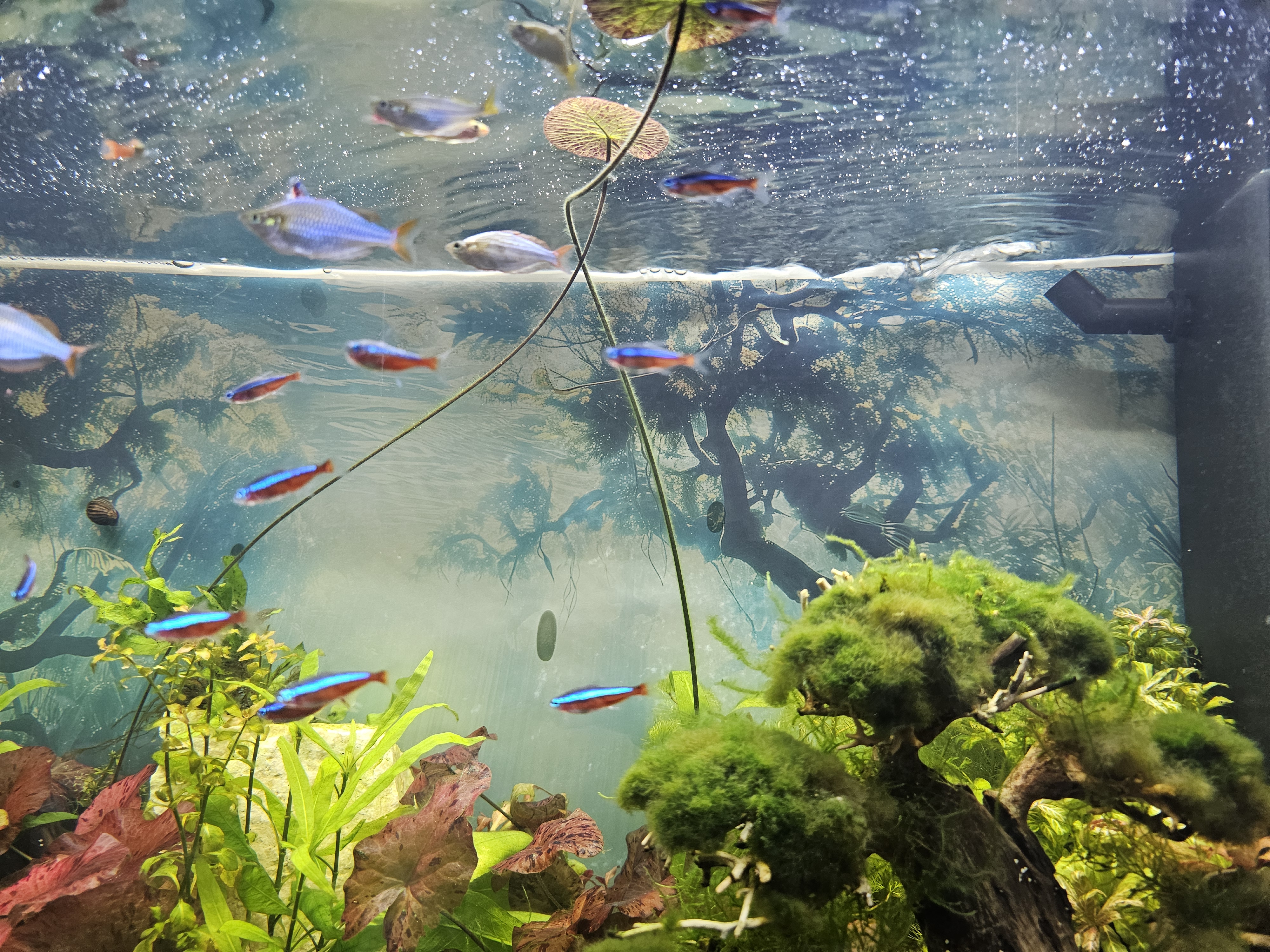
- Best schooling fish: neon tetras, cardinal tetras, harlequin rasboras, and zebra danios - keep any of them in groups of 6 or more or they'll be stressed and dull.
- Best livebearers: guppies, platies, and mollies are forgiving, colourful, and get along with nearly everything - but they breed fast, so plan for that.
- Bottom layer: corydoras catfish and otocinclus are peaceful, sociable, and need groups of 4-6 minimum - don't keep either species solo.
- Minimum tank size: 20 gallons (75 litres) for a mixed community; smaller tanks make stable parameters harder to maintain and conflict more likely.
- What to avoid: tiger barbs, serpae tetras, and most cichlids in a general community - fin-nipping and aggression will stress or kill quieter fish.
- Water first: establish the nitrogen cycle before adding any fish. An uncycled tank kills community fish quickly regardless of species choice.
What actually makes a fish "community safe"
The phrase "community fish" gets thrown around loosely in the hobby. It broadly means fish that won't bully, bite, or eat their tankmates - but that's only part of the picture. A genuinely compatible community also means fish that share similar water requirements, occupy different tank levels so they're not competing for the same space, and have similar activity levels. A skittish species like a Corydoras sterbai can be technically peaceful but still suffer if you pair it with fast, boisterous fish that outcompete it for food.
The honest framework is this: match water chemistry first, then temperament, then size, then activity level. Get those four things right and most mixes work. Skip any one of them and you'll have problems no amount of tank decoration will fix.
Schooling fish: the backbone of most community tanks
Schooling fish make up the mid-water layer of most community setups, and for good reason - they're active, visible, and most species are genuinely non-aggressive. The species you'll encounter most often are worth knowing individually rather than treating as interchangeable.
Neon and cardinal tetras
Paracheirodon innesi (neon tetra) and Paracheirodon axelrodi (cardinal tetra) are the two most commonly confused species in the hobby. Cardinals are larger (up to 5 cm / 2 inches), their red stripe runs the full length of the body rather than the lower half, and they prefer softer, slightly acidic water: pH 5.5-7.0, 24-28°C (75-82°F). Neons are slightly more tolerant of harder water up to about pH 7.5, which makes them the easier choice if your tap water is on the harder side.
Keep either species in groups of at least 8 - the commonly cited "6 minimum" produces noticeably more nervous fish than a group of 10 or 12. In a well-planted 60-litre (15-gallon) tank you can comfortably keep 12 neons alongside a pair of corydoras and a small cleanup crew.
Buying 6 neon tetras and adding them to a newly set up tank. Neons are particularly sensitive to ammonia spikes. They should go into a fully cycled tank - ideally one that's been running for at least 4-6 weeks. Most losses branded as "neon tetra disease" are actually ammonia poisoning from an uncycled or recovering tank.
Harlequin rasboras
Trigonostigma heteromorpha is one of the most reliable community fish you can buy. They're hardy, peaceful, stay around 4.5 cm (1.75 inches), and do well in groups of 6-10. They prefer soft to moderately hard water, pH 6.0-7.5, temperature 22-27°C (72-81°F). Unlike tetras, they tend to stay in the upper-middle column of the tank and are active without being frantic, which makes them easy neighbours for slower species.
Zebra danios
Danio rerio are bulletproof - they tolerate a wide temperature range (18-26°C / 64-79°F), pH 6.5-7.5, and a range of water hardness. That resilience makes them a popular first fish and a common recommendation for beginners. The downside is that they're fast, active, and will nip fins if the tank is too small or understocked. Keep at least 6 together and give them room to move - a 60 cm (24-inch) tank minimum. Don't put them with slow, long-finned fish like bettas or fancy guppies.
Below this number, most schooling species show stress behaviours: hiding, pale colouration, and erratic swimming.
Livebearers: easy, colourful, and surprisingly varied
Guppies, platies, and mollies are livebearers - they give birth to free-swimming young rather than laying eggs - and they're among the most beginner-friendly fish available. All three are peaceful, eat most prepared foods readily, and coexist easily with tetras, rasboras, and corydoras.
Guppies
Poecilia reticulata males are the colourful ones; females are larger but plainer. Males reach about 3.5 cm (1.4 inches), females up to 6 cm (2.4 inches). They prefer slightly hard, alkaline water: pH 7.0-7.5, 22-28°C (72-82°F). That preference means they're not ideal tankmates for cardinal tetras or other soft-water species - the overlap is workable but not ideal long-term.
The breeding issue is real. A single female can produce 20-40 fry every 4-6 weeks. If you don't want to manage a population explosion, keep males only. A male-only group of 5-6 is peaceful and looks great.
Platies
Xiphophorus maculatus are arguably the most versatile livebearer for a mixed community. They're hardier than guppies, accept a wider pH range (7.0-8.2), and come in enough colour variants to satisfy most hobbyists without requiring specialist care. They breed readily too, but less prolifically than guppies. Good tankmates for corydoras, tetras, and rasboras across a standard community setup.
Mollies
Poecilia sphenops and related species need special mention because they're often sold as standard community fish but have specific needs most tank guides skip. Mollies do best in hard, alkaline water (pH 7.5-8.5) and genuinely benefit from a small amount of aquarium salt - something that will stress or harm tetras, corydoras, and most other community species. A pure molly tank or a livebearer-only setup suits them better than a mixed community.
Mollies are sold as universal community fish in almost every fish shop. They're not. Their preference for hard, brackish-leaning water puts them at odds with most soft-water tetras and corydoras. They survive in a general community but they don't thrive. If you want livebearers in a mixed community, platies and male-only guppies are a better fit.
Bottom dwellers: corydoras and otocinclus
A community tank without bottom dwellers often looks incomplete - there's a whole layer of the tank that's empty. More practically, corydoras and otos are peaceful, add activity to an area other fish ignore, and corydoras in particular will clean up leftover food before it decomposes.
Corydoras catfish
There are over 160 described Corydoras species, but for a standard community tank the most commonly available and easiest to keep are Corydoras paleatus (peppered cory), C. sterbai, and C. aeneus (bronze cory). All three prefer soft to moderately hard water, pH 6.0-7.5, and temperature 22-26°C (72-79°F). They're bottom-feeders that graze across the substrate - they need smooth sand or fine rounded gravel, not sharp substrate that damages their barbels.
Keep a minimum of 4-6 individuals, and ideally keep a single species rather than mixing. Corydoras do school with their own kind; mixing species results in looser groups that are less settled. They're not aggressive toward any tankmate but will compete with other bottom-dwellers for food, so make sure sinking pellets or wafers reach them before surface-feeding fish intercept everything.
Feed corydoras after lights-out if surface feeders are grabbing all the food before it sinks. Drop sinking wafers or a few pieces of blanched courgette near the glass where you can watch them eat. It takes one week of this habit to know whether your corydoras are getting enough food.
Otocinclus catfish
Otocinclus vittatus and related species are small (4-5 cm / 1.5-2 inches), peaceful algae eaters that work well in a planted community. They rasp soft green algae off plant leaves and glass without damaging the plants - unlike larger plecos, which can shred foliage. Keep them in groups of 4-6 minimum; single otos in a tank become lethargic and often don't eat well.
One thing most guides miss: otos are almost always wild-caught. They're delicate on arrival and often arrive thin and stressed. Quarantine new otos for 2-3 weeks, feed them blanched courgette or spirulina wafers from day one, and don't add them to a brand-new tank. They need a tank with established algae growth to bridge the gap until they accept prepared foods reliably.
Planning a community: what a balanced stocking list looks like
A functional community tank generally has fish spread across three levels: a top-to-middle schooling species, a mid-water species or livebearer, and a bottom-dwelling group. For a 75-litre (20-gallon) tank, a practical example:
- 10 harlequin rasboras (mid-water school)
- 6 male guppies (upper layer, colour contrast)
- 6 peppered corydoras (bottom)
That's a workable, stable community that shares similar water requirements (pH 6.8-7.2, 24°C / 75°F) and doesn't overcrowd any layer. Before committing to a stocking list, run it through the free stocking calculator to check bioload and compatibility - it's faster than cross-referencing half a dozen care sheets.
The tank also needs to be fully cycled before any fish go in. If you're not sure what that means, start with how to cycle a fish tank - skipping this step is the single most common reason new community tanks fail within the first month.
Overstocking is the most common cause of water quality problems in community tanks. The "1 inch of fish per gallon" rule is outdated and misleading - a single 6-inch fish produces far more waste than six 1-inch fish. Base your stocking on bioload and filtration capacity, not a simple size formula.
Water parameters and why they determine compatibility
Most peaceful community fish are adaptable, but "adaptable" has limits. Consistently pushing fish outside their preferred range suppresses immune function, reduces breeding success, and shortens lifespan - sometimes without obvious symptoms until a fish dies from a secondary infection that a healthy specimen would have fought off.
For a broad community that includes tetras, rasboras, corydoras, and guppies, aim for: pH 6.8-7.2, hardness 4-12 dGH, temperature 23-26°C (73-79°F). That range suits all of them without perfectly optimising for any single species, which is the practical reality of a mixed tank.
Test your water regularly - at minimum weekly for the first two months, then every two weeks once the tank is established. Log your results so you can spot gradual drift before it becomes a problem. App-aquatic's parameter tracking lets you log tests and set alerts when readings go outside your chosen range, which is genuinely useful when you're managing several parameters at once.
For a full breakdown of what each parameter means and what affects it, see the guide to aquarium water parameters.
What to avoid in a peaceful community
The species that cause the most trouble in community tanks are ones sold as "semi-aggressive" or with fine print like "may nip fins." Take that seriously.
Tiger barbs (Puntigrus tetrazona) are the most commonly cited offenders. They're fin-nippers by nature and will harass guppies, slow-moving tetras, and anything with flowing fins. They can work in a species-only tank with a large group (10+) where their aggression redirects inward, but not in a general community.
Serpae tetras (Hyphessobrycon eques) have a similar reputation and are often sold unlabelled alongside peaceful tetras. Check before you buy.
Most cichlids are not community fish. The exceptions - German blue rams, apistogrammas, some dwarf cichlids - can work in a well-planned setup, but they're not beginner-friendly and need specific conditions. Leave them out until you have experience with the species.
Common plecos (Hypostomus plecostomus) are sold as algae eaters and cleanup crew for community tanks constantly. They reach 30-45 cm (12-18 inches), produce enormous waste, and will damage plants. An otocinclus group does the same job in a fraction of the space.
Quarantine: the step most people skip
Every new fish you add to an established community should spend 2-4 weeks in a separate quarantine tank first. This isn't excessive caution - it's how you prevent wiping out a tank you've spent months building. Ich, velvet, and internal parasites can all arrive on fish that look healthy in the shop. A bare 40-litre (10-gallon) tank with a cycled sponge filter is enough. Treat any visible symptoms before introducing new fish to the main tank, and even symptom-free fish should complete the full quarantine period.
On the subject of new additions: acclimate fish to your tank's temperature and pH slowly. Float the bag for 15 minutes, then add small amounts of your tank water to the bag over another 15 minutes before releasing. Sudden parameter changes cause osmotic shock even if the destination tank is otherwise ideal.
Track your parameters
More guides · 20 gallon stocking · Betta tank mates · Combining fish · App-aquatic