Guide
Does fish food expire? What actually happens after the best-before date
Yes, it really does - and it's not just a legal formality. Fish food degrades in specific, measurable ways after opening. Vitamins break down, oils go rancid, moisture invites mould. Understanding what actually happens is the difference between feeding your fish and silently making them sick.
- Yes, fish food expires. It's not just a legal formality - nutritional content genuinely degrades.
- Opened flake food: best within 1-3 months. Pellets: 3-6 months. Freeze-dried: 6-12 months.
- Signs it's gone bad: rancid or sharp smell, visible mould, clumping, significant colour fade.
- Worst storage mistake: keeping food on top of or beside the tank - warmth and humidity accelerate degradation dramatically.
- Buy smaller tubs more often. One large tub lasting 12 months is nutritionally worse than four small tubs used fresh.
What actually degrades in fish food over time?
Fish food is not shelf-stable indefinitely. It contains a combination of proteins, fats, vitamins, and minerals - and each of these degrades at different rates. Understanding which ones matter helps you understand why the expiry date is not arbitrary.
Vitamins - particularly C and E
Vitamin C (ascorbic acid) is essential for immune function, wound healing, and collagen synthesis in fish. It is also notoriously unstable - it oxidises and degrades on contact with air and light. How fast it degrades depends heavily on the form used and on storage: feeds built on stabilised ascorbyl polyphosphate retain vitamin C far better than those using plain ascorbic acid, which oxidises quickly once the container is opened. Vitamin E - a fat-soluble antioxidant - degrades at similar rates, particularly once the container is opened and oxygen exposure begins.
This matters because fish that are chronically low in vitamin C show reduced disease resistance, poor wound healing, and in severe cases, spinal deformities (lordosis and scoliosis, particularly visible in fry). You won't see this overnight. Over months, the effects accumulate silently.
Fats and oils - oxidation and rancidity
High-protein fish foods - particularly marine-based flake, pellets containing krill or fishmeal, and freeze-dried foods - contain significant unsaturated fatty acids, including omega-3s (DHA and EPA), which are nutritionally valuable for fish. These fats oxidise over time in a process called lipid peroxidation. Rancid fats have a characteristic sharp, acrid smell distinctly different from fresh food. But rancidity at a lower level happens before the smell becomes obvious - by the time food smells noticeably wrong, the fats have been degrading for some time.
Rancid fats in fish food cause liver damage when fed chronically. In long-term studies, fish fed oxidised lipid diets show fatty liver disease, reduced growth rates, and increased mortality. This is a real risk when using old food - not theoretical.
Moisture and mould
Dry fish food is manufactured to a low moisture content to prevent microbial growth during storage. Once opened, every time you open the container you introduce humid air - and humidity allows mould and bacteria to establish in the food. Mould produces mycotoxins (fungal toxins) that are harmful to fish even at low concentrations. Visible mould - white, green, or black fuzzy patches - is the obvious sign, but mycotoxin contamination begins before visible mould appears.
Do not tap wet fingers into the food tub, lick your fingers before handling food, or allow any moisture into the container. A single episode of introducing moisture into a dry food tub can initiate mould growth within days, especially in warm environments. Use a dry spoon or the supplied measuring spoon. If you see any clumping in what should be dry food, moisture has entered and the food is suspect.
Shelf life by food type
Flake food
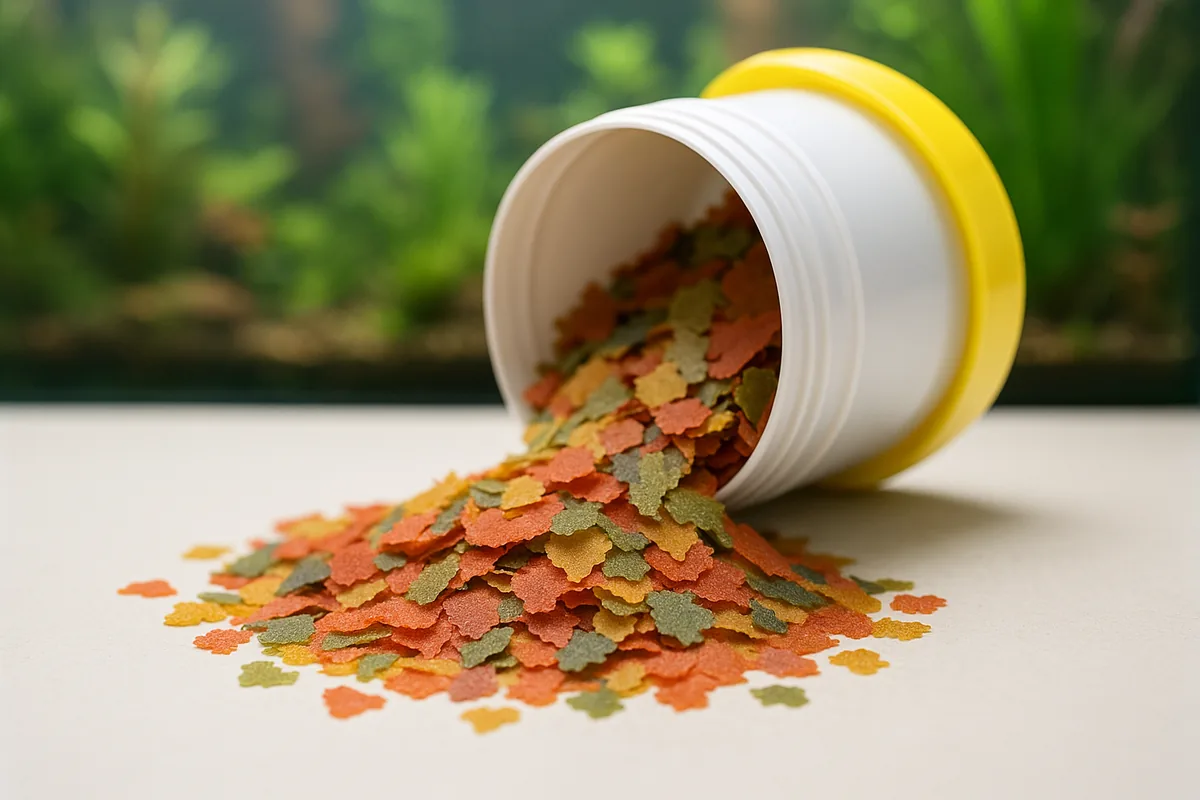
The most common fish food and the one that degrades fastest once opened. Flakes have a high surface-area-to-volume ratio - every flake is exposed to oxygen. Vitamins begin degrading immediately on opening. Optimum use: within 1-3 months of opening. Most manufacturers print a best-before date 18-36 months from manufacture - but this assumes sealed storage. Once opened, that date is irrelevant. Best practice: buy smaller tubs that you'll use within 2 months, not large economy tubs that sit open for a year.
Sinking and floating pellets
Better than flakes for longevity because the dense, compressed structure limits oxygen contact. A sealed tub of quality pellets keeps well to its printed date. Once opened: 3-6 months if stored correctly. Soft-moist pellets (the kind that feel slightly pliable rather than bone-dry) are more moisture-sensitive and should be used within 1-2 months of opening.
Freeze-dried foods (bloodworm, tubifex, brine shrimp)
Freeze-drying removes moisture, which extends shelf life significantly compared to flake. Sealed: 2-3 years from manufacture. Opened: 6-12 months if kept dry and cool. The main risk is moisture ingress - once rehydrated during feeding, any remaining food in the tub that was exposed to tank water or humid air will degrade rapidly. Always reseal tightly immediately after use.
Frozen foods (bloodworm, daphnia, brine shrimp, etc.)
Frozen foods are the most nutritionally stable - freezing largely halts chemical degradation. Best use within 6 months of purchase. Freezer burn (ice crystals visible on the food, desiccated appearance) indicates quality loss. Never refreeze thawed food - once thawed, use immediately or discard. The habit of thawing a whole blister pack and refreezing it is a significant food safety issue that many fishkeepers don't consider.
Live foods
These have no meaningful shelf life as a stored product - they're alive and must be kept alive. Daphnia, brine shrimp nauplii, and microworms need appropriate culture conditions. Dead live food in a container is the fastest-degrading food type of all and should be discarded immediately.
Vitamin C degrades on contact with air and light, and flake has the worst surface-area-to-volume ratio of any dry food. How fast it goes depends on the form used: feeds built on stabilised ascorbyl polyphosphate hold their vitamin C far better in storage than those using plain ascorbic acid, which degrades quickly once opened. Check the ingredients panel - and buy tubs small enough to finish, because the printed date assumes a sealed container.
How to tell if fish food has gone bad
You don't need lab equipment. Use your senses:
- Smell: Fresh fish food smells mildly fishy or savoury. Bad food smells sharp, acrid, or rancid - noticeably different. This is oxidised fat. Trust your nose: if it smells wrong, it is wrong.
- Appearance: Visible mould (any fuzzy growth of any colour), significant clumping in dry food, or a dramatic change in colour (fading or darkening) are all red flags.
- Texture: Dry food that has become soft or sticky has absorbed moisture. This is a mould risk regardless of whether mould is visible yet.
- Fish reaction: Healthy fish that suddenly show less interest in food they previously ate readily may be detecting something you can't smell yet. Fish detect dissolved compounds at concentrations far below anything we could smell.
Correct storage - the single biggest variable
The difference between food that lasts 2 months and food that lasts 4 months is almost entirely storage. The same product stored correctly vs incorrectly will have dramatically different nutritional profiles at the same age.
Keeping fish food on top of or next to the tank. This feels convenient - which is exactly why most people do it. But the space above and around a running aquarium is one of the worst possible storage environments: warm, humid, and often lit. Heat accelerates vitamin degradation and fat oxidation. Humidity invites moisture into even well-sealed containers. Direct light degrades light-sensitive vitamins. Store food in a cool, dry cupboard away from the tank.
Correct storage conditions for dry fish food:
- Airtight container. If the original packaging doesn't seal reliably, decant into a proper airtight container (glass or BPA-free plastic with a good seal).
- Cool and dark. A kitchen cupboard away from the oven is ideal. Avoid direct sunlight.
- Dry hands only. Never introduce moisture into a food container.
- Don't refrigerate dry food. Condensation when removing from cold to warm environments introduces moisture. The fridge is appropriate for liquid foods or supplements; dry flake and pellet food does not benefit from refrigeration.
- Desiccant sachets: Some food tubs include silica gel sachets. Keep them in the tub - they absorb ambient moisture and genuinely extend quality.
The honest case for buying small
The aquarium food market sells large "economy" tubs at better value per gram. For most individual fishkeepers, this is a false economy. Unless you have multiple large tanks and genuinely use large quantities within 2-3 months, a 500g tub of flake food will be nutritionally depleted long before it's empty.
The better approach: buy the smallest tub size that you'll finish within 2 months for flake, 3-4 months for pellets. The cost difference per gram is far less significant than the difference in nutritional quality your fish actually receive.
The large economy tub is better margin than the small tub and better for the retailer's stock rotation. There's no incentive at the point of sale to explain that the value calculation only works if you use the food fast enough. Many fishkeepers have a tub of flake that's been open for 9 months. At that point the vitamin C is substantially degraded and the fats are beginning to oxidise - but the fish are eating and appear fine, so nothing changes. The damage is cumulative and slow.
Related guides
Set feeding reminders and track your food stock rotation in App-aquatic - never forget when you opened a new tub.
Get the free appIs it OK to use fish food after the expiry date?
If unopened and stored correctly - marginally, for a short period. The best-before date on sealed food is a reasonable guide to nutritional quality under ideal conditions. For opened food, the opening date is what matters - the printed date is largely irrelevant once the seal is broken. Using food 1-2 months past opening is a bigger nutritional risk than using food 3 months past the printed best-before on an unopened tub.
Can expired fish food kill fish?
Rarely, acutely. The risk is chronic: months of vitamin-depleted, potentially rancid food causes gradual immune compromise, liver stress, and increased disease susceptibility. Fish fed old food don't die suddenly from the food - they become progressively less robust and die more readily from infections or stressors that a well-nourished fish would survive. It's a slow harm, not an acute poison.
How long does an unopened tub of fish flakes last?
To the printed best-before date if kept sealed, cool, and dark. Most quality flake foods have a shelf life of 18-36 months from manufacture. Check the date on the bottom or back of the tub before buying - retailers occasionally have slow-moving stock that is already a year old when it reaches you.
Should I refrigerate fish food to make it last longer?
Not dry food (flake, pellets, freeze-dried). Refrigeration creates a condensation cycle each time you take it in and out - which introduces moisture. Dry food stays best in a cool, dry cupboard. The exception is liquid supplements, vitamin drops, or open pots of soft-moist food, which can benefit from refrigeration once opened.
What is the best fish food for long shelf life?
Freeze-dried foods have the longest usable shelf life once opened - 6-12 months stored correctly. Dense, hard pellets keep better than flake. Any food with added vitamin C stabilised as ascorbyl polyphosphate (check ingredients) retains vitamin C better than ascorbic acid, which degrades more rapidly. But shelf life is always secondary to freshness - buy fresh food in appropriate quantities rather than optimising for the longest-lasting format.
All guides · Overfeeding guide · Frozen food: defrost or not? · Safe fish treats · Peas for fish · Get the app