Guide
Neon tetra guide: 10 things every fishkeeper needs to know
They are the most recognised freshwater fish in the world. They are sold in the tens of millions every year. And they are, frankly, kept badly far too often. Here is everything you need to know to keep neon tetras not just alive, but genuinely thriving.
- Not beginner fish. They need a fully cycled, stable tank - ammonia or nitrite will kill them fast.
- Keep at least 8-10 together. Fewer than 6 causes chronic stress and pale colour.
- Water: 20-26°C, pH 6.0-7.5. Hard, alkaline tap water is a slow killer.
- Neon tetra disease is incurable - quarantine all new fish for 2 weeks before adding.
- Properly cared for, they live 5-10 years. Most die in year one because of avoidable mistakes.
1. They are not beginner fish - despite what you've been told
The aquarium trade has categorised neon tetras as “beginner fish” for decades, and millions of them have died because of it. They are routinely sold to first-time fishkeepers, added to uncycled tanks, and placed in water conditions completely unsuitable for them. They die. The keeper assumes they did something obviously wrong, buys more neons, and the cycle repeats.
The truth: neon tetras are not particularly hardy. They are not forgiving of ammonia spikes, chlorine, temperature fluctuations, or hard water. They originated from the soft, warm, pristine blackwater streams of the Amazon basin - conditions that many community tanks don't come close to replicating. Zebra danios are beginner fish. Cherry barbs are beginner fish. Neon tetras are community fish that require a well-established, properly cycled tank with appropriate water chemistry. Know the difference before you buy.
Neons are categorised as "easy beginner fish" because they sell well, not because they're appropriate for beginners. They have been the hobby's best-selling fish for decades - which means the trade has every financial incentive to keep calling them easy. They are not. They are sensitive, parameter-dependent, and intolerant of the conditions that characterise most new tanks. Every experienced fishkeeper knows this. Most beginners find out the hard way.
2. The tank must be fully cycled before neons go in
This is non-negotiable and yet constantly ignored. An uncycled tank has no established colony of nitrifying bacteria to process ammonia from fish waste. Neon tetras are particularly sensitive to ammonia and nitrite. Even brief exposure to ammonia above 0.25 ppm can cause gill damage that leads to respiratory problems and secondary infection. Putting neons into a new, uncycled tank is a reliable way to lose them within 1-4 weeks.
Cycle your tank first - fully. That means zero ammonia, zero nitrite, and a measurable nitrate reading before any fish go in. If you're not sure what cycling involves, read our complete tank cycling guide. It takes 4-8 weeks typically, but skipping it costs fish lives. Every time.
Adding neon tetras to a brand-new tank. The fish shop sells them. The tank looks ready. The water is clear. So in they go - and within 2-3 weeks, they start dying one by one. The culprit is almost always ammonia or nitrite from a tank that hasn't completed its nitrogen cycle. Clear water is not clean water. Test before you add fish. Always.
3. Water parameters are more important than most fishkeepers realise
Paracheirodon innesi is named after a naturalist and comes from genuinely extreme softwater environments. Wild neons live in water so soft and acidic it makes most UK tap water look like brine. In practice, tank-bred neons - which account for virtually all neon tetras sold in shops - are more adaptable than their wild counterparts. But they still have requirements that need to be met:
- Temperature: 20-26°C. Optimal is 22-24°C. They can tolerate the warmer end, but above 26°C for extended periods stresses them and shortens lifespan. Many fishkeepers run tropicals at 26-28°C - the top of that range is not ideal for neons long-term.
- pH: 6.0-7.5 for tank-bred fish, ideally 6.5-7.0. They struggle in alkaline water above pH 7.5. Hard, alkaline tap water (common in much of England) should be treated or blended with RO water if keeping neons seriously.
- Hardness: GH 5-12 dGH. Soft to moderately hard water. Very hard water (15+ dGH) causes chronic stress over months and is associated with poor colour, reduced activity, and susceptibility to disease.
- Nitrate: Below 20 ppm. Regular water changes are essential. See our water change frequency guide.
4. They are schooling fish and require a group - the minimum is 6, more is better
Neon tetras are obligate schoolers. In the wild, they exist in massive shoals - the synchronised, iridescent movement of thousands of fish through dark river water is one of the most extraordinary sights in nature. In a tank, they need a group to feel secure. A school of fewer than 6 will be visibly stressed - erratic, hiding, pale in colour. A school of 10-12 will school properly. A school of 20+ in a planted tank is genuinely spectacular.
Buying 3 or 4 neons “to start with” and planning to add more later is counterproductive. Add your minimum group from the beginning. The tank bioload of 10-15 neon tetras is modest - they are small fish with low waste output - and the visual difference between a school of 5 and a school of 15 is dramatic. Use our stocking calculator to check bioload for your tank size.
5. The iridescent stripe turns off in the dark - and this is normal
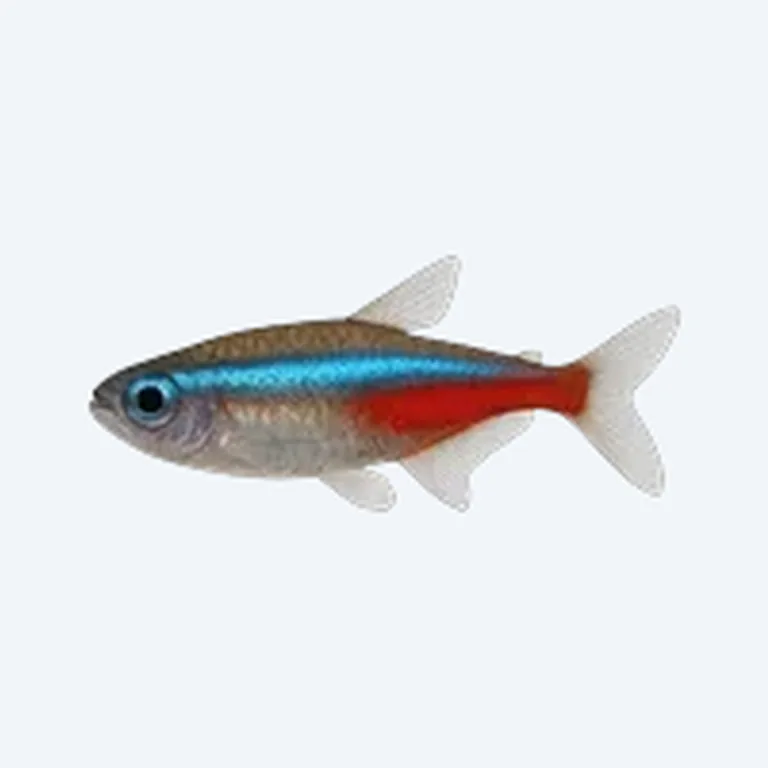
The blue-green iridescent stripe that runs horizontally along the body of the neon tetra is not a pigment. It is produced by iridophores - specialised cells containing crystalline structures that reflect light at specific wavelengths. This is structural colouration, the same physical phenomenon responsible for the blue of morpho butterfly wings.
At night, or under stress, neon tetras can partially or fully suppress this iridescence - the stripe appears faded or disappears almost entirely. This is completely normal physiology. If your neons look pale at night or when the lights first come on in the morning, this is expected. If they are pale during the day consistently, that is a health or stress indicator. Consistently pale fish in daylight indicates stress - wrong water, inadequate schooling, illness, or bullying from tank mates.
Most neons in home aquariums live 2-4 years. The gap between potential and actual lifespan is almost entirely down to water quality, group size, and correct parameters. A 7-year-old neon in a well-maintained tank is genuinely achievable.
6. Neon tetra disease is real, incurable, and highly contagious
Neon Tetra Disease (NTD) - caused by the microsporidian parasite Pleistophora hyphessobryconis - is one of the most devastating diseases in the hobby precisely because it is incurable and spreads readily. Symptoms progress over weeks:
- Fading or loss of the blue iridescent stripe, often patchy
- White or grey patches in the muscle tissue (cysts under the skin)
- Curved or distorted spine (late stage)
- Difficulty swimming, loss of schooling behaviour
- Bloating or fin deterioration
There is no cure. Affected fish should be removed and humanely euthanised promptly - every day they remain in the tank is another day of disease spread to tank mates. The parasite spreads through consumption of infected tissue (fish eating dead or dying fish) and potentially through the water. Treat the tank with aquarium salt as a supportive measure and monitor all remaining fish closely. See our neon tetra disease guide for full detail on diagnosis and management.
False NTD - symptoms that look like NTD but are caused by bacterial infection or columnaris - can sometimes be treated with appropriate antibiotics if caught early. Distinguishing between true NTD and bacterial infection requires close observation of the progression and pattern of symptoms.
7. They live longer than you think - but rarely reach full lifespan in captivity
In ideal conditions, neon tetras live 5-10 years. Most in home aquariums live 3-5 years. The gap between potential and actual lifespan is a direct reflection of the conditions they're kept in. Fish chronically stressed by wrong water chemistry, inadequate schooling, overcrowding, or poor nutrition will live shorter lives with more health problems. Fish kept in well-cycled, appropriate water, in a large school, with a clean, varied diet, will regularly live to 5+ years. A 7-year-old neon tetra is not unusual in a well-maintained tank.
8. Feeding is simple but matters more than people think
Neon tetras are micro-predators in the wild - they eat tiny invertebrates, zooplankton, and small insects, not plant material. Their small mouths require appropriately sized food: micro pellets, crushed flake, frozen baby brine shrimp, frozen daphnia, and micro worms. Standard-sized flake needs crushing to a fine powder for neons. Large pellets are ignored or inhaled and regurgitated.
Feed twice daily, small amounts - what they consume in 2 minutes. Overfeeding neons (or anything else) is the most common water quality problem in the hobby. See our guide on overfeeding fish. Variety in diet produces better colour and supports immune function. Don't just feed flake forever.
9. Compatible tank mates - and who to avoid
Neon tetras are peaceful, mid-water swimmers. They are compatible with a wide range of community fish - but not all of them. Key compatibility factors:
Good tank mates:
- Other peaceful, similarly-sized tetras (harlequin rasboras, ember tetras, rummynose tetras)
- Corydoras catfish - same water parameters, bottom-dwelling so no competition
- Otocinclus catfish - peaceful algae eaters
- Dwarf gouramis - peaceful centrepiece option
- German Blue Rams, Bolivian Rams - share water parameters, won't eat neons
- Cherry shrimp - peaceful, same parameter requirements
- Small loaches (kuhli loach) - bottom dwellers, compatible
Avoid with neons:
- Large cichlids - most will eat or stress neons
- Angelfish (adults) - significant predation risk. See our full guide on angelfish and neon tetras
- Bettas - variable. Many bettas fin-nip or harass neon tetras. Individual fish differ.
- Tiger barbs - notorious fin nippers; will shred neon fins
- Large loaches (clown loach) - may bother or eat neons in cramped conditions
- Pufferfish - neons are food to puffers
Check all compatibility combinations with our stocking calculator before buying.
10. Why your neons keep dying - the most common causes
If you're losing neon tetras, the cause is almost always one of these:
- Uncycled or poorly cycled tank. Ammonia or nitrite is present. Test immediately.
- Wrong temperature. Too warm (above 26°C for extended periods) or too cold. Check your thermometer reading, not your heater setting - heater thermostat dials can be inaccurate.
- Hard, alkaline tap water. Neons in very hard water suffer chronically. pH above 7.8 or GH above 15 dGH is a problem. Test your tap water and understand your parameters.
- Group too small. Chronic stress from isolation or an undersized school. Minimum 8-10.
- Neon tetra disease. Check for the fading stripe pattern described above.
- Copper in medications or tap water. Kills invertebrates and stresses delicate fish. Check all medication labels.
- Overfeeding and poor water quality. Accumulated nitrate above 30-40 ppm is a slow killer.
Log your water parameter readings in App-aquatic to spot trends - a creeping nitrate level or slowly drifting pH often precedes health problems by weeks. Catching it before fish die is always better than diagnosing it after.
Never add neon tetras straight from the shop bag to your tank. Quarantine all new fish for 2 weeks in a separate tank before introducing them to your main display. Neon tetra disease enters tanks on apparently healthy fish that are already infected but not yet symptomatic. One infected fish in a school of 15 can take the whole group over weeks.
Quick reference: neon tetra care card
- Scientific name: Paracheirodon innesi
- Adult size: 3-4 cm
- Temperature: 20-26°C (optimal 22-24°C)
- pH: 6.0-7.5 (optimal 6.5-7.0)
- GH: 5-12 dGH
- Minimum group size: 8 (10-15+ recommended)
- Minimum tank size: 60 litres for a group of 10
- Swim zone: Mid-water
- Diet: Micro omnivore - micro pellet, crushed flake, frozen daphnia, baby brine shrimp
- Lifespan: 5-10 years (3-5 typical in captivity)
- Experience level: Intermediate - requires cycled, stable tank
Related guides
Track neon tetra water parameters, set feeding reminders, and log tank health over time in App-aquatic. Catch problems before they become fish deaths.
Get the free appWhy are my neon tetras dying?
Test your water first. The most common causes are ammonia or nitrite from an uncycled or disturbed tank, temperature above 26°C, pH above 7.8, group stress from too few fish, or neon tetra disease. See our guide on sequential fish deaths for a full diagnostic framework.
How many neon tetras should I keep together?
Minimum 8 - but 10-15 is where they actually thrive and school properly. The difference between 6 neons and 14 neons is dramatic, both visually and in fish welfare. Their bioload is modest; adding more fish costs nothing in water quality terms.
Can neon tetras live with bettas?
It depends on the individual betta. Some ignore neons entirely; others fin-nip or harass them constantly. There's no reliable way to predict behaviour before trying - which means you need a backup plan if it doesn't work out. A community tank of 60+ litres gives neons enough space to escape aggression if it occurs.
What is neon tetra disease and can it be cured?
Neon Tetra Disease (NTD) is caused by a microsporidian parasite - Pleistophora hyphessobryconis. Symptoms: fading iridescent stripe, white cysts visible in the muscle tissue, curved spine, loss of schooling. It cannot be cured. Remove infected fish immediately and humanely euthanise - every day they remain spreads the disease further. Read the full neon tetra disease guide.
Do neon tetras need a heater?
Yes. Neon tetras are tropical fish that need 20-26°C. In most UK and Northern European homes, tap water runs 10-18°C - far too cold without a heater. A reliable aquarium heater and a separate thermometer (don't trust the heater dial alone) are both essential.
All guides · Neon vs cardinal tetra · Neon tetra disease · Angelfish with neons · Cycling guide · Stocking calculator