Guide
Centrepiece fish: how to choose the perfect showpiece for your tank
A centrepiece fish is the one everyone looks at first. It sets the tone, anchors the tank, and demands your full attention when it moves. Picking the right one - for your tank size, your community, and your experience level - is the difference between a tank that works and one that doesn't.
- Best for small tanks (40-60L): Betta, German Blue Ram pair, pea puffer group
- Best for medium tanks (100-150L): Angelfish, Bolivian Ram, Pearl Gourami
- Best unusual choice: Pea puffer (personality unlike anything else), Leopard Bush Fish (conversation piece)
- Most underrated: Pearl Gourami - peaceful, beautiful, compatible with almost everything
- Best for wow factor on a budget: German Blue Ram - extraordinary colour, relatively affordable
What actually makes a centrepiece fish?
The term “centrepiece fish” isn't a scientific classification - it's a hobby term for a single fish (or mated pair) that acts as the visual anchor of a tank. Typically: larger than the rest of the tank's inhabitants, visually distinctive, and interesting to watch. The best centrepiece fish have personality - they interact with their environment, respond to the glass, and do something. A fish that hides all day is a poor centrepiece.
Before you fall in love with a species online, answer four questions:
- How big does it actually get? Many stunning fish are bought small and grow large. Adult size - not juvenile size - determines minimum tank requirements.
- What does it eat? What does it eat that's in your tank? Angelfish eat small fish. Oscars eat anything. Pufferfish eat snails and crustaceans. Know what you have.
- What is the temperament? Some centrepiece fish are placid with anything. Others are territorial during spawning, or simply aggressive by nature. Check whether it will tolerate or terrorise your existing community.
- What are the water parameters? Discus need 28-30°C and very soft water. Many African cichlids want hard, alkaline conditions. Get this right first - your centrepiece fish can't thrive in the wrong water regardless of how good everything else looks. Use our water parameters guide and stocking calculator to check compatibility before you buy.
The popular centrepiece fish
These are the species that have earned their reputation. Reliably available, reliably stunning, and with enough information available that keeping them well is achievable with research.
Angelfish (Pterophyllum scalare)
The quintessential centrepiece for the community tank. Triangular, tall-bodied, and slow-moving - they move through a planted tank like no other fish. Adults reach 15 cm tall and nearly as wide. They come in dozens of colour forms: wild-type silver and black striping, gold, marble, koi, albino, and long-finned varieties. Minimum tank size: 75 litres for a single fish, 150 litres+ for a pair or group. Angelfish care requires soft, slightly acidic water (pH 6.5-7.2, 24-28°C). They will eat small fish - neon tetras are at risk. They pair bond strongly and will defend territories during breeding. For a 150-200 litre planted community tank, a pair of angelfish remains one of the most compelling choices in freshwater fishkeeping.
Discus (Symphysodon spp.)
The “king of freshwater fish” - round-bodied, spectacularly coloured, and genuinely challenging to keep well. Discus are demanding: they need 28-30°C (warmer than most tropical fish), very soft and acidic water (pH 6.0-7.0, hardness below 10 dGH), pristine water quality with low nitrates, and a high-protein diet. They are schooling fish and do best in groups of 5-6 minimum, requiring tanks of 300 litres or more. Adult discus reach 15-20 cm. The reward for getting it right is extraordinary - a group of quality discus in a planted tank is one of the most visually striking sights in the hobby. Not recommended for beginners.
Ram cichlids - German Blue Ram (Mikrogeophagus ramirezi)
For smaller tanks, the German Blue Ram is the definitive small centrepiece fish. At 5-7 cm, they are compact enough for a 60-litre tank (a pair needs minimum 80 litres). The colour is extraordinary - iridescent blue spots across a yellow-gold body, red eye, black markings. They form pair bonds, display interesting courtship and spawning behaviour, and are generally peaceful toward fish too large to fit in their mouths. They need warm water (26-30°C), soft and slightly acidic conditions (pH 6.0-7.2). They are sensitive to water quality - the pristine side of tropical parameters is where they thrive. A pair of German Blue Rams in a heavily planted 100-litre tank is a genuinely spectacular setup.
Bolivian Ram (Mikrogeophagus altispinosus)
The tougher, slightly less flashy cousin of the German Blue Ram. Still beautiful - red-edged fins, spangled scales, distinctive black spot - but more forgiving of water conditions. Tolerates pH up to 7.5 and temperatures as low as 22°C, making them compatible with a wider range of community fish. Grows slightly larger (8-10 cm). An excellent choice if you want the ram centrepiece experience without the strict softwater requirement.
Betta (Betta splendens)
The betta is the most accessible centrepiece fish in the hobby and consistently underrated. Long-finned males are spectacular - flowing fins in every imaginable colour combination - and each fish has a genuinely individual personality. They are solitary fish (males cannot be kept together) and are best kept as the sole centrepiece in a community of peaceful, non-fin-nipping species. Minimum tank size: 40 litres (many sources say less - ignore them). See our full betta care guide and tank mates guide for compatible community options. Their accessibility, low cost relative to discus and rare cichlids, and personality make bettas the best starting point for beginners wanting a centrepiece.
Pearl Gourami (Trichopodus leerii)
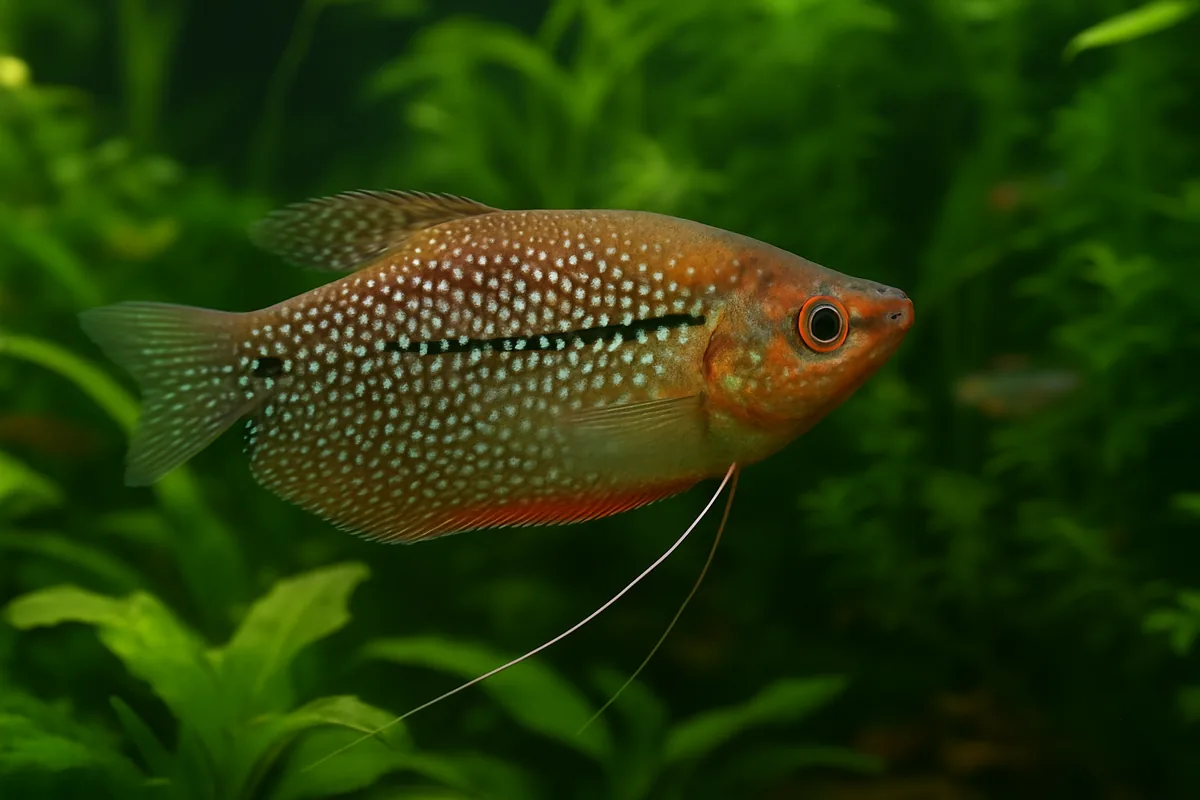
An underappreciated gem. The pearl gourami reaches 12 cm and is covered in a white pearl-dot pattern on a warm tan body with a distinctive orange-red stripe running from eye to tail. Peaceful, elegant, slow-moving, and hardy. Tolerates a wide range of water conditions (pH 6.0-8.0, 24-28°C). Does not bother small fish. Pairs beautifully with schooling tetras, corydoras, and planted tank setups. One of the most community-friendly centrepiece options available.
Unusual and underrated centrepiece fish
Keyhole cichlid (Cleithracara maronii)
One of the gentlest cichlids in existence - genuinely. Keyhole cichlids are shy, peaceful, and fascinatingly personalised: each fish develops a slightly different pattern around its distinctive keyhole-shaped marking. They reach 10-12 cm and are suitable for tanks from 150 litres. They will pair bond and exhibit fascinating parental behaviour without becoming aggressive. Often overlooked because they're beige-toned compared to flashier species - but watch one for five minutes and you'll understand the appeal.
Festivum cichlid (Mesonauta festivus)
Tall-bodied like an angelfish, with a bold diagonal stripe from the mouth to the dorsal fin. Peaceful for a cichlid, compatible with a community if tank mates aren't small enough to eat. Grows to 15-20 cm. Rare enough that most aquarists haven't heard of it, visually striking enough to be a genuine conversation piece.
Leopard bush fish / ctenopoma (Ctenopoma acutirostre)
One of the most interesting ambush predators available in the hobby. Covered in a brown-and-cream spotted camouflage pattern, the leopard ctenopoma is a member of the labyrinth fish family (related to bettas and gouramis) that grows to 15 cm. It moves through the tank slowly, often hanging motionless at odd angles among plants, and is a sight to behold in a large, heavily planted setup. It will eat anything that fits in its mouth, so community options are limited to larger fish. But in a species-appropriate setup, it's extraordinary.
Rope fish / reedfish (Erpetoichthys calabaricus)
Technically a primitive fish related to bichirs. Rope fish look exactly like a brown-green snake - elongated, sinuous, ancient-looking. They reach 30-37 cm, are nocturnal, mostly bottom-dwelling, and are skilled escape artists (tanks need tight-fitting lids). Not aggressive toward fish too large to swallow. Utterly bizarre, completely captivating, and unlike anything else in a freshwater community setup. Keep with larger peaceful fish and ensure no gaps in the lid.
Pea puffer (Carinotetraodon travancoricus)
The world's smallest pufferfish at just 2.5 cm. What they lack in size they more than compensate in personality. Pea puffers watch you. They swim in an unusual, hovering manner - rotating independently with pectoral fins while a dorsal fin rows. They express curiosity, investigate objects, and will chase their reflection. They are aggressive and cannot be reliably kept with most community fish - particularly slow-moving or long-finned species - but in a species tank or carefully curated setup, a group of 3-5 pea puffers in a 60-litre planted tank is one of the most engaging aquariums you can build.
Rare and showpiece centrepiece fish
Altum angelfish (Pterophyllum altum)
The wild-type altum angelfish - taller and more dramatically marked than the common P. scalare - is genuinely rare in the hobby. They require very specific soft, warm, acidic conditions, large tanks (the fish reach 35-40 cm tall), and are difficult to source. When kept in a biotope-style Orinoco setup, they are breathtaking.
Flowerhorn cichlid
A hybrid cichlid - not found in nature - with an extraordinary genetic-derived head growth (the nuchal hump) that has made them enormously popular in parts of Asia. They come in vivid reds, pinks, and blues. They are large (30-40 cm), aggressive, and must be kept alone or with only the most robust tank mates. Not community fish. But as a single-specimen display fish in a 300-litre tank, they are undeniably impressive - and they recognise their owner, following movement at the glass and begging for food. They live 10-12 years.
Peacock bass (Cichla spp.)
Large, predatory cichlids from South America - not for community tanks in any sense of the word, but kept by advanced hobbyists as the ultimate predator display fish. They grow to 60-70 cm, require enormous tanks (1000+ litres for adults), and eat live or meaty foods exclusively. They are spectacularly marked and among the most powerful freshwater fish available in the hobby. Not for most people. But worth knowing exist.
Centrepiece fish by tank size
- 40-60 litres: Betta splendens, pea puffer group, German Blue Ram pair (at the larger end)
- 60-100 litres: German Blue Ram pair, Bolivian Ram pair, pearl gourami
- 100-150 litres: Angelfish (single), pearl gourami pair, keyhole cichlid pair
- 150-300 litres: Angelfish pair or group, festivum cichlid, leopard ctenopoma, German Blue Ram group
- 300 litres+: Discus group, altum angelfish, large cichlid species, rope fish
Check compatibility before you buy
Whatever centrepiece you choose, run it through a stocking compatibility check with your existing fish before purchasing. It's much easier to discover a compatibility problem before the fish is in the tank. Check water parameter overlaps, temperament, and size. In App-aquatic, you can add a species to your tank and instantly see compatibility flags before committing. It's exactly the kind of research that prevents expensive mistakes.
Related guides
Preview any centrepiece fish's compatibility with your existing stocking before you buy - free, no sign-up required.
Try the stocking calculatorWhat is the best centrepiece fish for a 60-litre tank?
A betta, a German Blue Ram pair, or a small group of pea puffers (species tank only - pea puffers don't play well with others). All three are visually striking, have strong personalities, and work in tanks from 60 litres. The betta is the most accessible and beginner-friendly; the German Blue Ram is the most impressive colour-wise; the pea puffer is the most entertaining.
Can I have two centrepiece fish in the same tank?
Sometimes. Two pearl gouramis (male + female) work beautifully together. Two German Blue Rams as a mated pair are stunning. Two angelfish is standard. Two bettas or two territorial cichlids is usually a disaster. The species and sex combination matters enormously - research the specific pairing before attempting it.
What centrepiece fish can live with neon tetras?
German Blue Ram, Bolivian Ram, pearl gourami, keyhole cichlid, and betta (with careful monitoring) all work with neon tetras. Angelfish should be treated as a calculated risk. Discus can work in the right setup with large neon schools. Predatory species like ctenopoma, rope fish, or pufferfish are incompatible - they will eat the tetras.
What is the most unusual centrepiece fish?
For freshwater: the leopard bush fish (ctenopoma) - spotted, ambush predator, moves like nothing else. Rope fish - literally looks like a snake. Pea puffer for personality. For the more advanced: altum angelfish, flowerhorn cichlid, or peacock bass for a specimen tank. Each is genuinely conversation-stopping.
All guides · Combining fish · Angelfish care · Betta care · Stocking calculator · Get the app