Guide
Types of cichlids
Not all cichlids are hyper-aggressive - but many need careful planning.
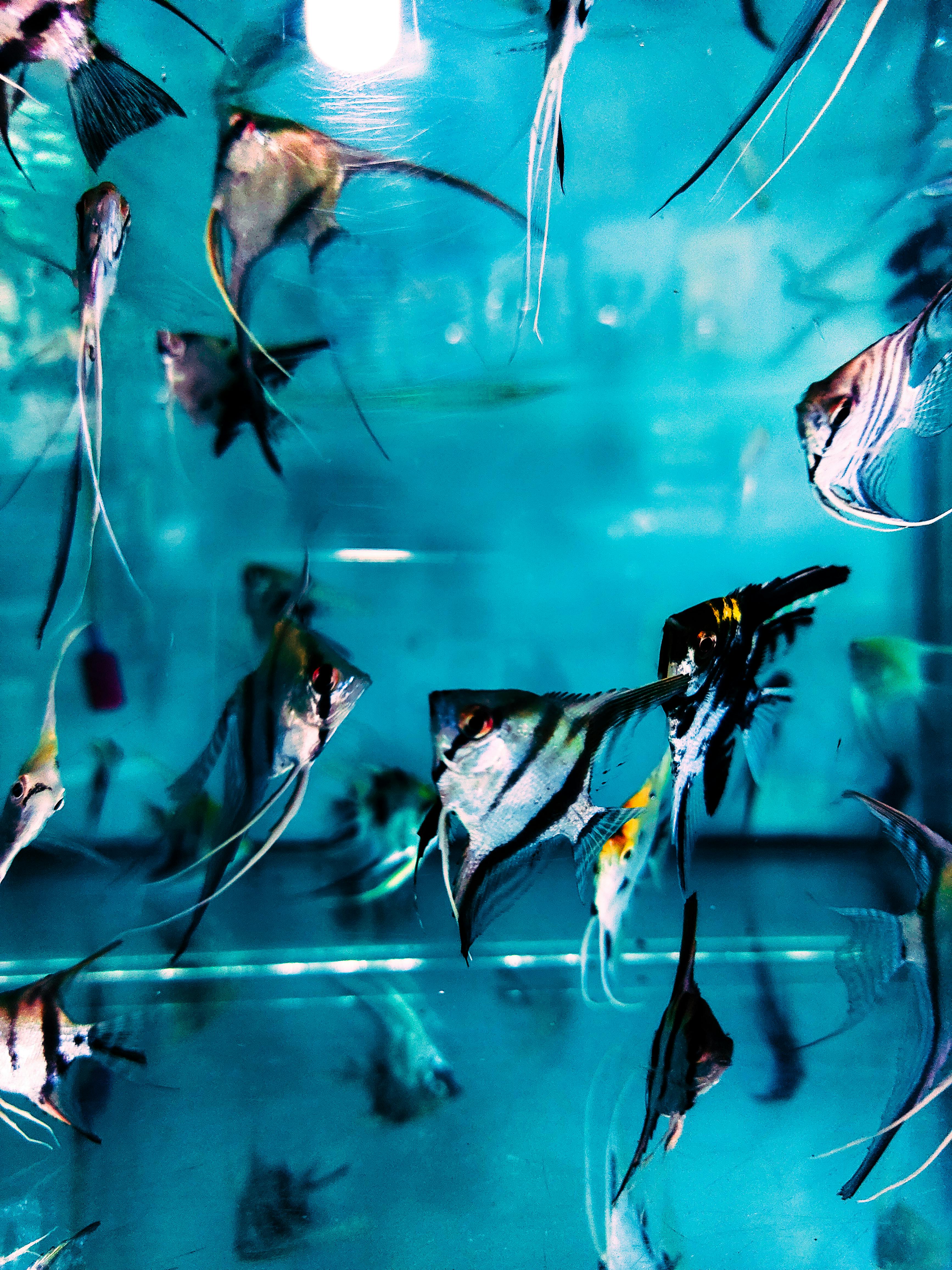
- Two main groups: South American cichlids (angelfish, rams, oscars, discus) and African Rift Lake cichlids (Malawi, Tanganyika, Victoria). They have different water chemistry needs and should not be mixed.
- Dwarf cichlids - Apistogramma species, German blue rams, bolivian rams - are the most community-friendly and suit tanks from 60 litres (15 gal) upward.
- African Rift Lake cichlids need hard, alkaline water: pH 7.8-8.5, hardness 10-20 dGH. Most South Americans prefer softer, slightly acidic water: pH 6.0-7.2.
- Aggression is species-specific, not family-wide. An angelfish and an oscar are both cichlids. One can live in a community; the other will eat it.
- Territory and space matter more than tank volume alone. Stocking cichlids without managing sight lines and hiding spots causes constant fighting regardless of tank size.
- Pick a direction before you buy anything. A dedicated dwarf cichlid community and a Malawi mbuna setup are both great. A random mix of both is usually neither.
What makes cichlids different from other freshwater fish
Cichlids (Cichlidae) are a family of around 1,700 described species - more than almost any other vertebrate family - spread across Central and South America, Africa, and parts of South Asia. What unites them isn't looks or size. It's behaviour. Cichlids are intelligent, curious, and territorial in ways that most other aquarium fish simply aren't. They recognise their owners, rearrange their tanks, and will defend a patch of gravel with the same conviction whether they're 4 cm or 40 cm long.
That behaviour is why people love them. It's also why keeping cichlids badly goes wrong faster than with most other fish. This guide breaks down the main groups, what each actually needs, and where beginners most often trip up.
South American cichlids
South America contains cichlid species across an enormous range of sizes, temperaments, and water chemistry preferences. Grouping them all as "South American cichlids" is useful shorthand, but don't let it fool you into thinking they're interchangeable.
Dwarf South American cichlids
This is where most hobbyists should start. Apistogramma species - A. cacatuoides, A. agassizii, A. borellii and many others - stay under 8 cm (3 in) and can be kept in tanks from about 80 litres (20 gal) for a pair. German blue rams (Mikrogeophagus ramirezi) and bolivian rams (M. altispinosus) fall into the same category.
These fish want warm, soft, slightly acidic water. German blue rams specifically are fussier than most beginners expect: they do best at 27-30°C (80-86°F), pH 5.5-7.0, and very low nitrates - ideally under 10 ppm. Bolivian rams are more forgiving (24-28°C / 75-82°F, pH 6.5-7.5) and a genuinely good first cichlid if you want something with personality in a community setup.
German blue rams sold in fish shops have often been commercially bred at warmer temperatures and can be sensitive to newly cycled tanks. Don't add them until your tank has been running stably for at least 6-8 weeks and nitrates are consistently low. They're not the ideal first fish despite being labelled "community safe".
Apistogramma males are territorial with each other but usually tolerable with other species. A classic setup is one male Apistogramma with two or three females in a densely planted 100-litre (26-gal) tank, with tetras or rasboras in the mid and upper water column. The Apistogramma holds the bottom; the other fish stay out of his way.
Mid-sized South American cichlids
Severums (Heros efasciatus) reach around 20-25 cm (8-10 in) and are among the more peaceful large cichlids, often kept in community tanks with similarly sized fish. They need at least 200 litres (55 gal) as adults and prefer pH 6.0-7.0 at 24-28°C (75-82°F).
Keyhole cichlids (Cleithracara maronii) are genuinely peaceful - one of the few larger cichlids that works reliably in a community - but they're shy and need heavy planting and plenty of cover to feel secure.
Geophagus species (eartheaters) are fascinating and underrated. They sift substrate constantly, which means you need fine sand rather than gravel, and they're sensitive to nitrates. But they're not particularly aggressive and can coexist with other calm, similarly-sized fish.
Large and aggressive South American cichlids
Oscars (Astronotus ocellatus), red devils (Amphilophus labiatus), and flowerhorn hybrids are in a different category entirely. These are dedicated species setups, not community fish. An oscar needs a minimum of 300 litres (75 gal) as a single adult, produces enormous waste, and will eat anything that fits in its mouth. They're wonderful fish with real personalities - but they require commitment to a single-species or species-matched tank and serious filtration.
The hobby romanticises oscars as "beginner-friendly because they're hardy." They are hardy. But they're also 30+ cm fish that outgrow most tanks people actually buy, need weekly large water changes, and will destroy plants and décor. Go in with open eyes.
African Rift Lake cichlids
Lake Malawi, Lake Tanganyika, and Lake Victoria each contain hundreds of cichlid species that evolved in isolation - and each lake has its own chemistry, its own fish community structure, and its own rules for captive keeping.
Lake Malawi cichlids
Malawi cichlids are what most people picture when they think "African cichlid": bright colours, active behaviour, and a tank that looks like a reef. The two broad groups are mbuna (rock-dwelling herbivores) and peacocks/haps (open-water, often predatory species).
Mbuna - Pseudotropheus, Melanochromis, Labidochromis, and others - are aggressive, fast, and territorial. The standard advice for managing aggression is to overstock slightly and break up sight lines with dense rockwork. That sounds counterintuitive, but it works: aggression spreads across more fish rather than fixating on one individual. A 300-litre (75-gal) tank with 20+ mbuna, heavily stacked rocks, and strong filtration is more stable than the same tank with 8 fish and open space.
Water chemistry is non-negotiable: pH 7.8-8.5, hardness 10-20 dGH, temperature 24-28°C (75-82°F). Most tap water in limestone areas is close enough; if yours isn't, you'll need to buffer it. Don't try to keep mbuna in soft, acidic water - they'll be stressed, dull-coloured, and disease-prone.
Mixing mbuna with peacocks or haps in the same tank often ends badly - mbuna harass the calmer haps relentlessly. Pick one group and stick to it, or get a significantly larger tank where territories don't constantly overlap.
Lake Tanganyika cichlids
Tanganyika offers some of the most interesting cichlids in the hobby and some of the most beginner-accessible. Shell-dwellers - Neolamprologus multifasciatus, N. ocellatus - are tiny (4-5 cm), can be kept in tanks from 60 litres (15 gal), and build fascinating colonies around empty snail shells. They're not for community tanks, but as a species-only setup they're manageable and endlessly entertaining.
Julidochromis species are hardy, relatively peaceful with each other, and do well in pairs or trios. Cyprichromis are open-water schooling cichlids - yes, schooling - that work as a calm upper layer above more territorial bottom-dwellers. Tanganyika is genuinely worth exploring beyond the obvious options.
Lake Victoria cichlids
Victorian cichlids are less common in the hobby, which is a shame - many are brilliantly coloured and not as aggressive as mbuna. They share similar water parameter requirements to Malawi fish (pH 7.5-8.2) and are worth researching if you want something less mainstream. The main practical issue is finding them: availability depends heavily on your location and local fish store stock.
Mixing cichlids from different African lakes because they're all "African cichlids." Tanganyika shell-dwellers and Malawi mbuna have different social structures, aggression levels, and sometimes subtly different water requirements. They don't naturally coexist and combining them usually disadvantages the calmer species.
What most guides miss: territory structure is everything
Most cichlid advice focuses on water parameters and stocking numbers. Both matter. But the single most overlooked factor is how the tank is laid out.
Cichlids are territorial in three dimensions. A male Apistogramma will defend a patch of substrate. A mbuna will defend a specific rock face. An oscar will consider the entire tank his. Without physical barriers - rocks, wood, plants, dense décor - dominant fish can see and chase subordinates across the whole tank constantly. That's not just stressful; it's lethal for the weaker fish.
The practical fix is to create visual breaks so fish can't see from one end of the tank to the other at substrate level. Stack rocks into caves and overhangs. Use tall plants or driftwood as dividers. For mbuna specifically, build a rockscape that reaches near the waterline with multiple separate cave systems - each one becomes its own territory, and aggression becomes manageable.
Making Cichlidae one of the largest vertebrate families - and one reason "cichlid" covers fish as different as a 4 cm shell-dweller and a 45 cm oscar.
Water parameters by cichlid type
Getting the chemistry wrong is the most common reason cichlid tanks fail slowly. Fish don't die immediately from wrong pH, but they stay stressed, their immune systems underperform, and diseases take hold faster.
South American dwarfs (Apistogramma, rams): pH 6.0-7.2, temperature 25-30°C (77-86°F), soft to moderately hard water (2-10 dGH). Nitrates below 20 ppm; below 10 ppm for rams.
Malawi cichlids: pH 7.8-8.5, temperature 24-28°C (75-82°F), hard water 10-20 dGH. Nitrates tolerated better than by dwarfs, but regular water changes still required.
Tanganyika cichlids: pH 7.8-9.0 (Tanganyika is the most alkaline of the Rift Lakes), temperature 24-27°C (75-80°F), moderately hard to hard water.
Check your tap water chemistry before deciding which group to keep. Trying to maintain Malawi parameters from naturally very soft tap water is a continuous battle. Working with what comes out of your tap is always easier. Use App-aquatic to log your test results over time - it's much easier to spot parameter drift when you have a running record rather than trying to remember what your pH was three weeks ago.
For more detail on what these numbers mean and how to adjust them, see the guide to aquarium water parameters.
Cycling before you add any cichlid
Cichlids are sensitive to ammonia and nitrite spikes in ways that a zebra danio or platy might survive. Do not add cichlids - especially dwarf South Americans - to an uncycled tank. The nitrogen cycle needs to complete first, which typically takes 4-8 weeks.
If you're new to this process, read the guide to cycling a fish tank before you buy anything. It's the step that makes the difference between a tank that works and one that keeps killing fish for reasons that aren't obvious.
Choosing your first cichlid setup
The honest framework is simple: pick one direction and commit to it properly rather than trying to have everything.
If you want a community tank with other fish: bolivian rams or a single Apistogramma species with small tetras or rasboras. Tank from 80-120 litres (20-30 gal), planted, soft-to-neutral water. This is the most forgiving cichlid setup.
If you want colour and activity without a planted tank: Malawi peacocks or a single-species mbuna group in 250+ litres (65+ gal) with heavy rockwork. Harder water, robust filtration, no live plants (mbuna eat them).
If you want something unusual and manageable: Tanganyika shell-dwellers in a 60-80 litre (15-20 gal) species tank. Minimal equipment, fascinating behaviour, easy to maintain once established.
If you want a big personality fish: A single oscar or a bonded oscar pair in 300+ litres (75+ gal) with heavy filtration and commitment to frequent water changes.
Use the free stocking calculator to check whether your planned combination makes sense before you buy.
Track your parameters and get care reminders with App-aquatic.
Get the free appCan I keep African and South American cichlids together?
Not practically. African Rift Lake cichlids need hard, alkaline water (pH 7.8-8.5) while most South American cichlids prefer soft, slightly acidic conditions (pH 6.0-7.2). You can't maintain both in the same tank without compromising both groups. Aggression compatibility is also unpredictable. Keep